
 Français
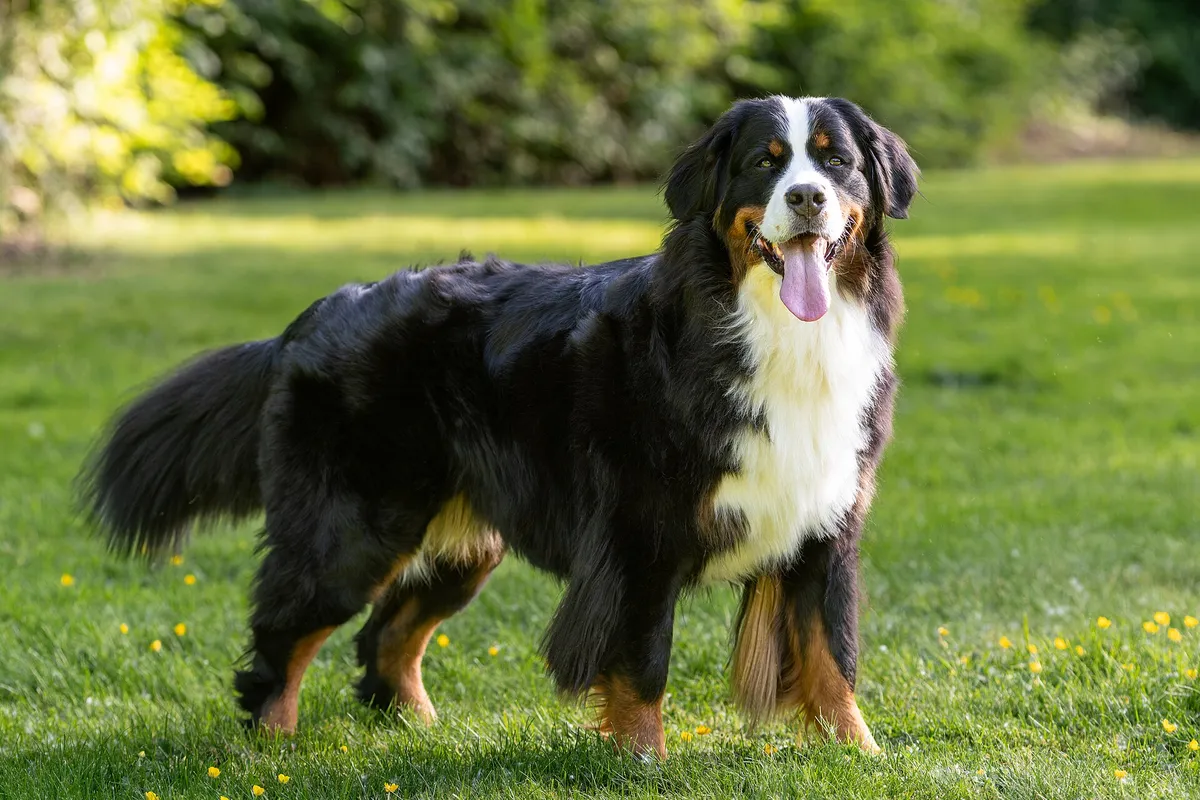
Bernese Mountain Dog at a glance
| Trait | Detail |
|---|---|
| Origin | Switzerland [1] |
| Breed group | FCI Group 2 (Pinscher and Schnauzer type, Molossoid breeds, Swiss Mountain and Cattle Dogs); AKC Working Group [1, 2] |
| Weight | 36–52 kg (80–115 lb) for males, 32–43 kg (70–95 lb) for females [2] |
| Height | 64–70 cm (25–27.5 in) for males, 58–66 cm (23–26 in) for females [1] |
| Life expectancy | Median 8.4 years in a Swiss study [3]; 10.1 years in a 2024 UK study of over 580,000 dogs [4] |
| Coat | Long, shining, straight or slightly wavy; jet black with rich tan and white markings [1] |
Origin
The Bernese is an old farm dog used as a guard, a draught dog and a cattle dog in the prealpine regions and midlands around Bern. It was first called “Dürrbächler”, after a hamlet and inn near Riggisberg where these long-haired tricolored dogs were especially common [1].
In 1907, breeders from the Burgdorf area founded a breed club to promote pure breeding, and 107 dogs were shown at Burgdorf in 1910. Renamed Bernese Mountain Dog, it is now known worldwide as a family dog [1].
Common health problems
- Cancer: in a Swiss study of 381 Bernese that had died, cancer caused 58.3% of deaths (the cause was unknown in 23.4%). Females lived longer than males (median 8.8 vs 7.7 years) [3]. In the Netherlands, at least 55.1% of deaths were linked to malignant tumors [5].
- Histiocytic sarcoma: a malignant tumor that is especially common in the breed. More than 1 Bernese in 7 died of it in a Dutch study [5], and it is estimated to occur in 15–25% of the breed [6].
- Kidney disease: a familial glomerulonephritis (membranoproliferative) was described in Bernese aged 2 to 5 years [7]. In a German study, 17.8% of healthy-looking Bernese had lab signs of kidney disease, against 1.8% of control dogs [8]. See kidney disease in dogs.
- Elbow and hip dysplasia: at screening in Sweden, 17.0% of young Bernese had elbow dysplasia and 19.9% had hip dysplasia (grades C–E) [9]. Degenerative joint disease caused 4.2% of deaths in the Swiss study [3].
- Other causes of death: spinal disorders (3.4%), kidney injury (3.1%) and gastric or mesenteric volvulus (1.8%) [3].
- Degenerative myelopathy: a second SOD1 gene variant (SOD1:c.52T) has been found only in Bernese Mountain Dogs [10].
Tests and screening in Bernese
- Urine protein and kidney values: in the German study, kidney disease was defined as a urine protein-to-creatinine ratio above 0.5 with an inactive sediment and/or a raised kidney value [8]. See protein in urine and creatinine in dogs.
- Lyme disease antibodies: 58% of healthy Bernese had antibodies to Borrelia burgdorferi, against 15% of control dogs [11]. Bernese also had more antibodies to Anaplasma, but no link was found between these antibodies and kidney disease [8]. See tick-borne diseases in dogs.
- Histiocytic sarcoma: there is no screening blood test. A gene region (MTAP–CDKN2A) carries a haplotype found in 96% of affected Bernese, but it is a research finding about susceptibility [6].
- DNA test for degenerative myelopathy (SOD1): genotyping looks for the SOD1 variants linked to the disease, including SOD1:c.52T, which has been found only in Bernese [10].
- Elbow and hip scoring: X-rays graded on the International Elbow Working Group elbow scale and the FCI hip scale [9].
Related articles
En français : Bouvier bernois.
Questions to ask your veterinarian
- Should my Bernese have a urine protein-to-creatinine ratio checked regularly?
- Are my dog’s kidney values and urine normal for its age?
- Should my dog’s elbows and hips be X-rayed or scored?
- Which signs could point to histiocytic sarcoma or another cancer?
- Is my dog protected against ticks, and should we test for tick-borne infections?
Get your Bernese’s blood and urine tests explained.
AI DiagAnimals reads the kidney values, the urine protein-to-creatinine ratio, the blood count and the rest of the chemistry with your laboratory’s intervals, and prepares the questions for your vet. The service opens soon: leave your email to be told first.
Frequently asked questions
How long do Bernese Mountain Dogs live?
The median was 8.4 years in a Swiss study, with females living longer than males [3]. A 2024 UK study found a median of 10.1 years [4].
Why do Bernese Mountain Dogs die young?
Mostly because of cancer: it caused 58.3% of deaths in the Swiss study [3], and histiocytic sarcoma alone killed more than 1 Bernese in 7 in the Netherlands [5].
What is histiocytic sarcoma?
A malignant tumor estimated to occur in 15–25% of Bernese Mountain Dogs [6]; more than 1 Bernese in 7 died of it in a Dutch study [5].
Sources
- Fédération Cynologique Internationale. FCI Standard No. 45: Bernese Mountain Dog. fci.be/Nomenclature/Standards/045g02-en.pdf
- American Kennel Club. Bernese Mountain Dog: dog breed information. akc.org/dog-breeds/bernese-mountain-dog
- Klopfenstein M et al. Life expectancy and causes of death in Bernese mountain dogs in Switzerland. BMC Vet Res. 2016;12(1):153. doi.org/10.1186/s12917-016-0782-9
- McMillan KM et al. Longevity of companion dog breeds: those at risk from early death. Sci Rep. 2024;14:531. doi.org/10.1038/s41598-023-50458-w
- Erich SA et al. Causes of death and the impact of histiocytic sarcoma on the life expectancy of the Dutch population of Bernese mountain dogs and Flat-coated retrievers. Vet J. 2013;198(3):678-683. doi.org/10.1016/j.tvjl.2013.09.062
- Shearin AL et al. The MTAP-CDKN2A locus confers susceptibility to a naturally occurring canine cancer. Cancer Epidemiol Biomarkers Prev. 2012;21(7):1019-1027. doi.org/10.1158/1055-9965.EPI-12-0190-T
- Minkus G et al. Familial nephropathy in Bernese mountain dogs. Vet Pathol. 1994;31(4):421-428. doi.org/10.1177/030098589403100403
- Preyß-Jägeler C et al. Changes in renal parameters and their association with subclinical vector-borne infections in Bernese Mountain dogs. BMC Vet Res. 2020;16(1):285. doi.org/10.1186/s12917-020-02506-0
- Engdahl K et al. Prevalence of hip and elbow dysplasia in young adult dogs in Sweden. Vet Rec. 2026;198(12):e560-e573. doi.org/10.1002/vetr.70224
- Zeng R et al. Breed distribution of SOD1 alleles previously associated with canine degenerative myelopathy. J Vet Intern Med. 2014;28(2):515-521. doi.org/10.1111/jvim.12317
- Gerber B et al. Increased prevalence of Borrelia burgdorferi infections in Bernese Mountain Dogs: a possible breed predisposition. BMC Vet Res. 2007;3:15. doi.org/10.1186/1746-6148-3-15
Laboratory methods and reference intervals vary. This article explains; it does not diagnose. For a decision about your pet, use the original report and talk to your veterinarian. Our editorial policy.