
 Français
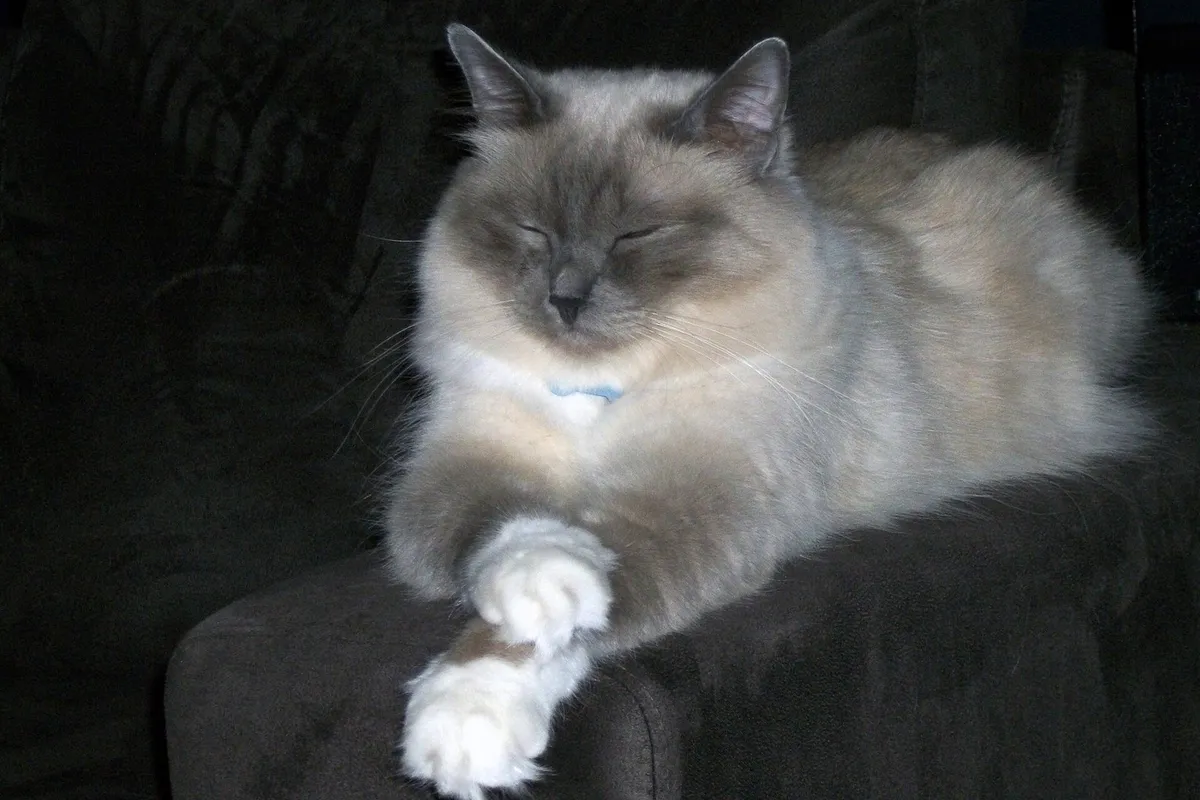
Birman cat at a glance
| Trait | Detail |
|---|---|
| Origin | France, from a pair of cats shipped from Burma around 1919; the name comes from “Birmanie”, French for Burma [1] |
| Breed group | FIFe Category 1 [2, 3] |
| Build | Medium size, slightly long body and short, strong legs, males more massive than females [3]; about three years to mature [1] |
| Life expectancy | 14.39 years at birth in a 2019 UK study of 7,936 cat deaths, among the longest of the breeds analysed [4] |
| Coat | Long to semi-long and silky with little undercoat; colour-pointed, with white “gloves” on all four feet [3] |
Origin
Many legends surround the Birman, but its documented history starts with a breeding pair shipped from Burma to France around 1919; the pregnant female founded the breed in France [1]. During the Second World War the breed nearly died out, with a single breeding pair left in Europe. French breeders rebuilt it with Persian and Siamese outcrosses, and pure Birman litters were again produced by the early 1950s [1].
The Sacred Birman is one of the breeds recognized by FIFe since its foundation year, 1949 [2]. It reached the United States in 1959 and was accepted for Cat Fanciers’ Association registration in 1967 [1].
Common health problems
- A creatinine that looks like kidney disease: healthy Birmans have a higher serum creatinine than other cats [5, 6]. A 2002 report already described an unexpectedly high prevalence of azotaemia (high kidney values) in Birman cats [7]. This makes kidney disease harder to diagnose and stage in the breed [5]. See kidney disease in cats.
- FIP: at a US veterinary teaching hospital, Birmans were among the breeds with a significantly higher risk of feline infectious peritonitis [11]. See FIP in cats.
- Blood type B and neonatal isoerythrolysis: blood type B was found in 18% of 216 US Birmans and in 30% of 24 UK Birmans [8]. Type B cats have strong natural antibodies against type A, so type A kittens born to a type B queen mated with a type A male can die of neonatal isoerythrolysis [9].
- Neutrophil granulation anomaly: an inherited, recessive trait in which neutrophils carry fine pinkish (eosinophilic) granules. The cells work normally: their ability to kill bacteria and engulf particles was unchanged [10].
- Long life: Birmans and Burmese had the longest life expectancy of the 12 groups analysed in the UK life tables [4].
Kidney values and other lab quirks in Birmans
- Creatinine: in 50 healthy Birmans, creatinine averaged 1.58 ± 0.36 mg/dL (about 140 µmol/L), against 1.19 ± 0.17 mg/dL (about 105 µmol/L) in other breeds. In 20 of the 50 Birmans (40%), creatinine was above the laboratory interval and above 1.6 mg/dL, the threshold for IRIS stage 2 [5]. See creatinine and BUN in cats.
- SDMA: SDMA was also slightly higher in Birmans (12.2 vs 10.3 µg/dL), but fewer Birmans exceeded 14 µg/dL (10 of 50), often by less than the test’s own variability. A Birman-specific SDMA interval was 3.5–18.7 µg/dL. The authors suggest that SDMA may be a better kidney marker than creatinine in Birmans, and that reading both together helps avoid errors in diagnosing and staging kidney disease [5]. See SDMA in dogs and cats.
- Glucose and globulins: healthy Birmans also had higher glucose and α2-globulin concentrations than published intervals, and breed-specific intervals are recommended [6].
- Cardiac troponin I: healthy Birmans had higher cardiac troponin I than healthy Norwegian Forest Cats, so breed may affect this heart marker [12].
- Blood typing: type B is common in the breed [8], and type B cats carry strong natural antibodies against type A blood, which is why knowing the blood type matters before a mating [9]. See anemia in cats.
- Blood smear: the inherited neutrophil granules of the breed are a harmless finding on the smear [10].
Related articles
En français : Sacré de Birmanie.
Questions to ask your veterinarian
- Is my Birman’s creatinine high for a cat, or within what is expected for the breed?
- Should SDMA and a urine test be added to judge my cat’s kidneys?
- How has my cat’s creatinine changed compared with earlier results?
- Do you know my cat’s blood type?
- Which signs of FIP should make me call you?
Get your Birman’s kidney values explained.
AI DiagAnimals reads the creatinine, SDMA, urea, urine specific gravity and the rest of the report with your laboratory’s cat intervals, compares them with previous results and prepares the questions for your vet. The service opens soon: leave your email to be told first.
Frequently asked questions
How long do Birman cats live?
In a UK study of cats that died in 2019, Birmans had a life expectancy at birth of 14.39 years, among the longest of all breeds [4].
Why is my Birman’s creatinine high?
Healthy Birmans have higher creatinine than other cats: 40% of healthy Birmans in one study were above 1.6 mg/dL. A high value alone does not prove kidney disease in this breed; reading SDMA together with creatinine helps your vet decide [5].
What health problems do Birman cats have?
Documented issues include a higher risk of FIP [11], frequent blood type B with a risk of neonatal isoerythrolysis [8, 9], and a harmless inherited neutrophil anomaly [10]. Their high creatinine is mostly a lab quirk to know about [5].
What blood type are Birman cats?
Most are type A, but type B is common: 18% of 216 US Birmans and 30% of 24 UK Birmans [8].
Sources
- The Cat Fanciers’ Association. Birman: breed profile. cfa.org/breed/birman
- Fédération Internationale Féline. Breeds and standards. fifeweb.org/cats/breeds
- Fédération Internationale Féline. Breed standard: Sacred Birman (SBI). fifeweb.org/wp-content/uploads/2023/10/SBI.pdf
- Teng KT et al. Life tables of annual life expectancy and risk factors for mortality in cats in the UK. J Feline Med Surg. 2024;26(5):1098612X241234556. doi.org/10.1177/1098612X241234556
- Paltrinieri S et al. Serum symmetric dimethylarginine and creatinine in Birman cats compared with cats of other breeds. J Feline Med Surg. 2018;20(10):905-912. doi.org/10.1177/1098612X17734066
- Paltrinieri S et al. Haematological and biochemical reference intervals of four feline breeds. J Feline Med Surg. 2014;16(2):125-136. doi.org/10.1177/1098612X13499337
- Gunn-Moore DA et al. An unexpectedly high prevalence of azotaemia in Birman cats. J Feline Med Surg. 2002;4(3):165-166. doi.org/10.1053/jfms.2002.0175
- Gavazza A et al. Feline blood groups: a systematic review of phylogenetic and geographical origin. Animals (Basel). 2021;11(12):3339. doi.org/10.3390/ani11123339
- Giger U et al. Frequency and inheritance of A and B blood types in feline breeds of the United States. J Hered. 1991;82(1):15-20. doi.org/10.1093/jhered/82.1.15
- Hirsch VM, Cunningham TA. Hereditary anomaly of neutrophil granulation in Birman cats. Am J Vet Res. 1984;45(10):2170-2174. pubmed.ncbi.nlm.nih.gov/6497118
- Pesteanu-Somogyi LD et al. Prevalence of feline infectious peritonitis in specific cat breeds. J Feline Med Surg. 2006;8(1):1-5. doi.org/10.1016/j.jfms.2005.04.003
- Hanås S et al. Cardiac troponin I in healthy Norwegian Forest Cat, Birman and domestic shorthair cats, and in cats with hypertrophic cardiomyopathy. J Feline Med Surg. 2022;24(10):e370-e379. doi.org/10.1177/1098612X221117115
Laboratory methods and reference intervals vary. This article explains; it does not diagnose. For a decision about your pet, use the original report and talk to your veterinarian. Our editorial policy.