
 Français
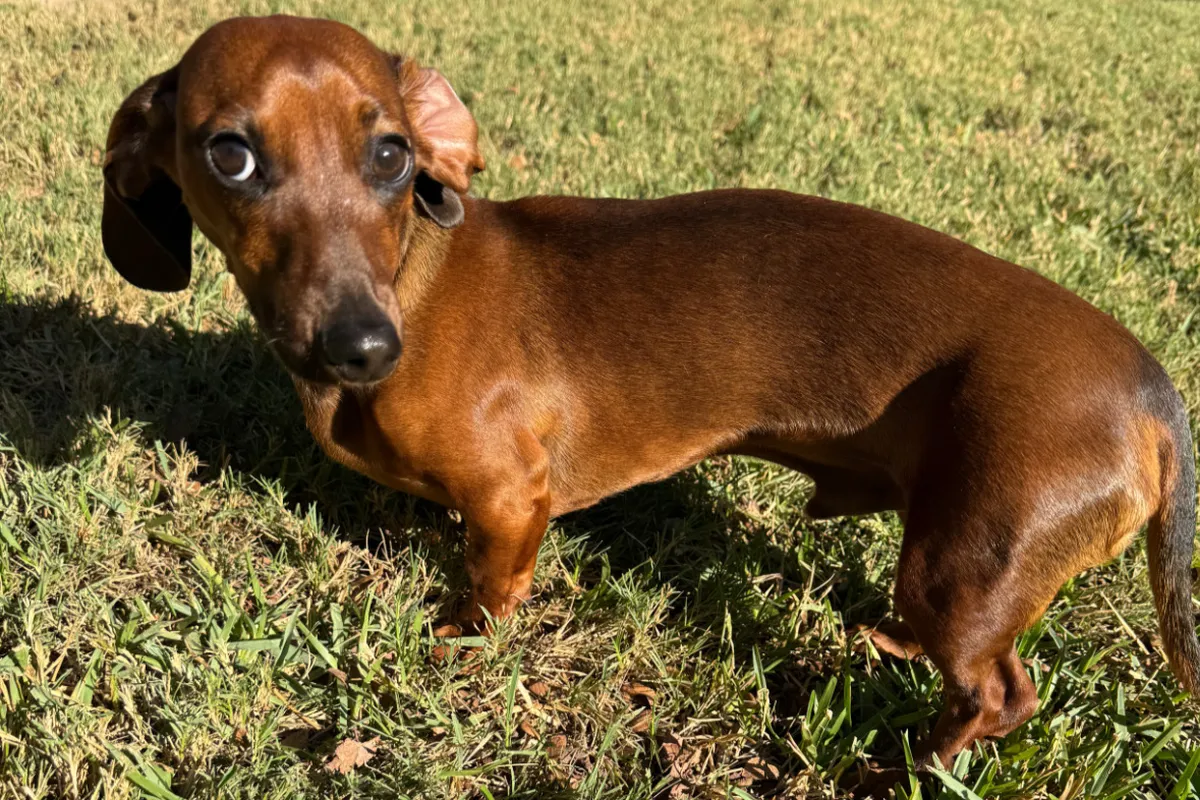
Dachshund at a glance
| Trait | Detail |
|---|---|
| Origin | Germany [1] |
| Breed group | FCI Group 4 (Dachshunds); AKC Hound Group [1, 2] |
| Weight | Standard 7–14.5 kg (16–32 lb); miniature 5 kg (11 lb) and under [2] |
| Size | Three sizes defined by chest circumference: standard 35–47 cm, miniature 30–37 cm, rabbit 25–32 cm, males slightly larger than females [1]. Height about 20–23 cm (8–9 in) for standards and 13–15 cm (5–6 in) for miniatures [2] |
| Life expectancy | Median age at death 13.2 years (Dachshund) and 14.0 years (Miniature Dachshund) in a 2024 UK study [3] |
| Coat | Smooth-haired, wire-haired or long-haired; one-coloured (red), two-coloured (black or brown with tan) or dapple [1] |
Origin
The Dachshund, also called Dackel or Teckel, has been known since the Middle Ages. It was bred from hounds as a dog for hunting below ground, and the oldest breed club, the Deutscher Teckelklub, was founded in 1888 [1]. “Dachshund” is German for “badger dog”: its long, low body was made for digging into badger dens [2].
The breed exists in three sizes (standard, miniature and rabbit) and three coats (smooth, wire and long), which gives nine varieties [1]. It was admitted to the AKC Stud Book in 1885 [2].
Common health problems
- Intervertebral disc disease (IVDD): Dachshunds have a relative risk of IVDD 10–12 times that of other breeds, and an estimated 19–24% show signs during their life [4]. In the DachsLife survey of 2,031 Dachshunds, 15.7% had been diagnosed, from 24.4% of Standard Smooth-haired to 7.1% of Standard Wire-haired Dachshunds. Older and neutered dogs were at higher odds [4].
- What changes the back risk: dogs exercised for more than an hour a day had lower odds of IVDD, and dogs exercised for less than 30 minutes higher odds [4]. In a referral study, relatively longer backs, being overweight and a smaller skeleton raised the risk of disc extrusion: for Miniature Dachshunds, the probability was 0.30 with a back length to height ratio of 1.1 against 0.68 with a ratio of 1.5 [5].
- Cushing’s disease (hyperadrenocorticism): over-represented in Dachshunds in North American teaching hospitals. Dogs with Cushing’s were at higher risk of diabetes, urinary tract infection, bladder stones, high blood pressure, gallbladder mucocele and blood clots [6]. See Cushing’s disease in dogs.
- Lafora disease: one of the most severe forms of canine epilepsy, inherited as a recessive trait in Miniature Wirehaired Dachshunds. Among 733 dogs tested, 7.0% were at risk (two copies of the NHLRC1 mutation) and 31.9% were carriers; with testing, at-risk dogs fell from 10.4% to 2.7% between 2012 and 2017 [7].
- Hypothyroidism: in Norway, the Dachshund was among the breeds at lowest risk [8].
Tests and screening in Dachshunds
- Back problems: disc extrusion is confirmed with diagnostic imaging, sometimes with surgery, not with a blood test [5].
- Cushing’s disease: because the breed is over-represented [6], it helps to know how the diagnosis is tested: see the ACTH stimulation test and high ALP in dogs.
- Glucose and urine: in a dog with Cushing’s, the higher risk of diabetes and urinary infection [6] means blood sugar and urine test results deserve attention. See also diabetes in dogs.
- DNA test for Lafora disease: it identifies Miniature Wirehaired Dachshunds at risk, carriers and dogs free of the NHLRC1 mutation [7].
- Routine blood work: no breed-specific reference values have been published; results are read with the laboratory’s usual dog intervals.
Related articles
En français : Teckel.
Questions to ask your veterinarian
- What can I do day to day to protect my Dachshund’s back?
- Is my dog at a healthy weight?
- Which signs of back pain or weakness need an urgent visit?
- Do my dog’s thirst, appetite and blood results suggest Cushing’s disease or diabetes?
- Should my Miniature Wirehaired Dachshund have a DNA test for Lafora disease?
Get your Dachshund’s blood work explained.
AI DiagAnimals reads the blood count, ALP and the other liver values, glucose, cortisol results and urine tests with your laboratory’s intervals, and prepares the questions for your vet. The service opens soon: leave your email to be told first.
Frequently asked questions
How long do Dachshunds live?
In a 2024 UK study, the median age at death was 13.2 years for Dachshunds and 14.0 years for Miniature Dachshunds [3].
How common is back disease in Dachshunds?
An estimated 19–24% show signs of IVDD during their life [4]; 15.7% had been diagnosed in a survey of 2,031 dogs [4].
How can I lower my Dachshund’s risk of IVDD?
In studies, more daily exercise was linked to lower odds [4], and being overweight to a higher risk [5]. Ask your vet what suits your dog.
Are Dachshunds prone to Cushing’s disease?
Yes, the breed is over-represented among dogs with Cushing’s [6].
What is Lafora disease in Dachshunds?
A severe, late-onset inherited epilepsy of Miniature Wirehaired Dachshunds, caused by an NHLRC1 mutation that a DNA test detects [7].
Sources
- Fédération Cynologique Internationale. FCI Standard No. 148: Dachshund. fci.be/Nomenclature/Standards/148g04-en.pdf
- American Kennel Club. Dachshund: dog breed information. akc.org/dog-breeds/dachshund
- McMillan KM et al. Longevity of companion dog breeds: those at risk from early death. Sci Rep. 2024;14:531 (supplementary Table S3). doi.org/10.1038/s41598-023-50458-w
- Packer RM et al. DachsLife 2015: an investigation of lifestyle associations with the risk of intervertebral disc disease in Dachshunds. Canine Genet Epidemiol. 2016;3:8. doi.org/10.1186/s40575-016-0039-8
- Packer RM et al. How long and low can you go? Effect of conformation on the risk of thoracolumbar intervertebral disc extrusion in domestic dogs. PLoS One. 2013;8(7):e69650. doi.org/10.1371/journal.pone.0069650
- Hoffman JM et al. Canine hyperadrenocorticism associations with signalment, selected comorbidities and mortality within North American veterinary teaching hospitals. J Small Anim Pract. 2018;59(11):681-690. doi.org/10.1111/jsap.12904
- Ahonen S et al. Nationwide genetic testing towards eliminating Lafora disease from Miniature Wirehaired Dachshunds in the United Kingdom. Canine Genet Epidemiol. 2018;5:2. doi.org/10.1186/s40575-018-0058-8
- Ringstad NK et al. Breed distributions for diabetes mellitus and hypothyroidism in Norwegian dogs. Canine Med Genet. 2022;9(1):9. doi.org/10.1186/s40575-022-00121-w
Laboratory methods and reference intervals vary. This article explains; it does not diagnose. For a decision about your pet, use the original report and talk to your veterinarian. Our editorial policy.