
 Français
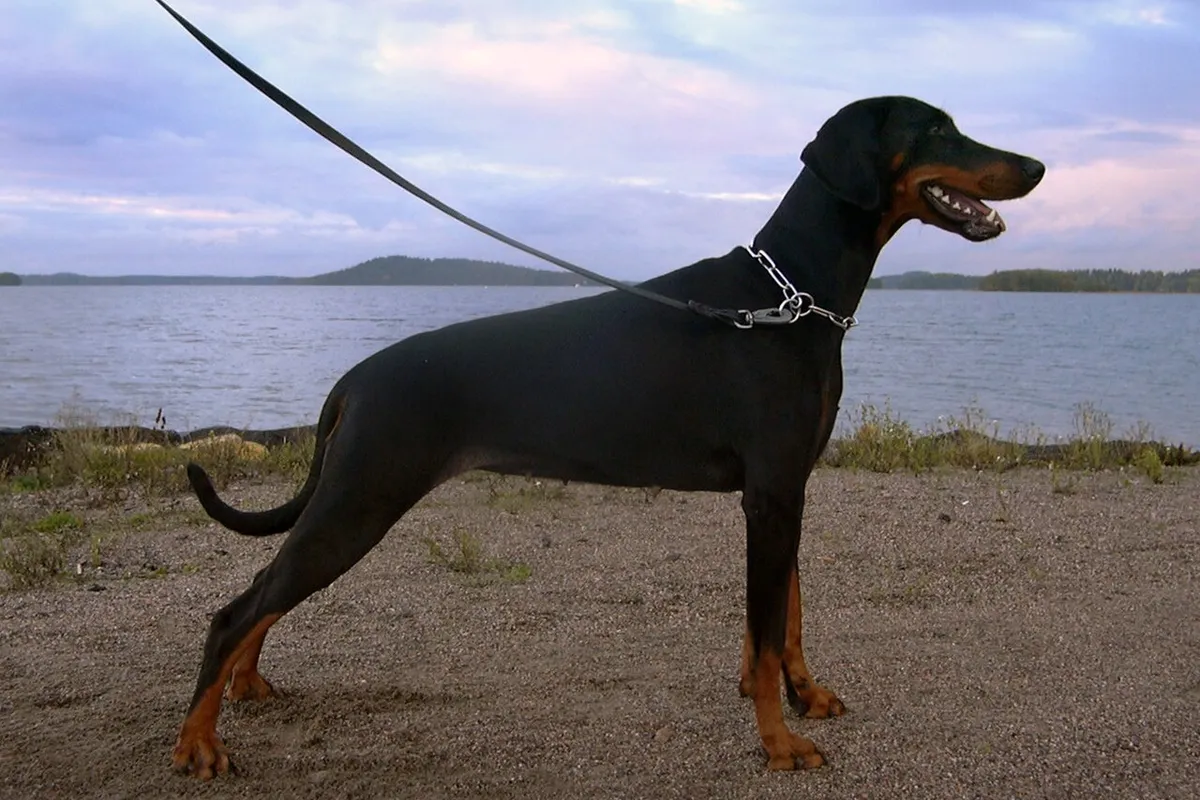
At a glance
| Trait | Detail |
|---|---|
| Origin | Germany [1] |
| Breed group | FCI group 2, section 1 (Pinscher and Schnauzer) [1]; AKC Working Group [2] |
| Weight | Males about 88–99 lb (40–45 kg), females about 71–77 lb (32–35 kg) [1] |
| Height | Males 27–28 in (68–72 cm), females 25–27 in (63–68 cm) [1] |
| Life expectancy | Median 11.2 years in a large UK study [3] |
| Coat | Short, hard, dense and tight, without undercoat; black or brown with rust-red markings [1] |
Origin
The Dobermann is the only German breed named after its original breeder, Friedrich Louis Dobermann (1834–1894), a tax collector, knacker and part-time dog catcher. In the 1870s he bred “butcher’s dogs”, an early type of Rottweiler, with a black-and-tan shepherd type from Thuringia, and obtained alert, protective working and house dogs [1].
The breed was used so much in police work that it was nicknamed the “Gendarme dog”, and it was officially recognized as a police dog by the beginning of the 20th century [1].
Common health problems
- Dilated cardiomyopathy (DCM): an inherited disease of the heart muscle in this breed. In 412 European Dobermans followed with heart ultrasound and Holter recordings, the cumulative prevalence was 58.2%. It rose with age, from 3.3% at 1 to 2 years and 9.9% at 2 to 4 years to 43.6% at 6 to 8 years and 44.1% over 8 years. Males and females were equally affected, but males showed ultrasound changes earlier and females had more irregular beats [4]. See heart failure in dogs.
- Hypothyroidism: in UK practices, 2.52% of standard Dobermans were recorded with hypothyroidism, and the breed had 17.02 times the odds of crossbreeds, the highest of all breeds studied [9]. See hypothyroidism in dogs.
- Chronic hepatitis (copper-associated): of 106 randomly selected 3-year-old Dobermans in the Netherlands, 22 had subclinical hepatitis on liver biopsy, 19 of them females. Their liver copper was about twice that of dogs without liver disease, and in dogs whose hepatitis persisted it kept rising [8]. See liver disease in dogs.
- Von Willebrand disease type 1: von Willebrand disease is the most common inherited bleeding disorder in dogs, particularly in Dobermans. The type 1 form is linked to a variant of the von Willebrand factor gene (c.7437G>A), inherited as a dominant trait with incomplete penetrance: not every dog carrying it bleeds. In Dobermans tested in Buenos Aires, 41% of the gene copies carried the variant [11].
What is special in the Doberman’s blood work
Most Doberman screening targets the heart, the liver, the thyroid and clotting. The table summarizes the tests discussed in the studies below.
| Test | What it is used for in Dobermans |
|---|---|
| Holter (24-hour ECG) and heart ultrasound | Standard yearly DCM screening from 3 years of age [5] |
| NT-proBNP, troponin I | Extra heart tests when Holter and ultrasound are not available [5, 6] |
| ALT, ALP, bile acids | First hint of subclinical hepatitis, confirmed by liver biopsy and copper measurement [8] |
| Thyroid tests | Check for hypothyroidism, for which the breed has the highest odds in UK practices [9] |
| von Willebrand factor antigen, DNA test | Detection of von Willebrand disease and of the type 1 variant [10, 11] |
Heart screening. The European Society of Veterinary Cardiology recommends Holter monitoring and ultrasound every year over the life of the dog, since a single normal screening does not rule out later DCM. Fewer than 50 single premature ventricular beats in 24 hours is considered normal in Dobermans; more than 300, or two recordings within a year with 50 to 300, is diagnostic of hidden (occult) DCM [5].
NT-proBNP. In 328 Dobermans, an NT-proBNP above 400 pmol/L detected all stages of DCM with 81.1% sensitivity and 75.0% specificity. It was also higher in apparently healthy dogs that developed DCM within 1.5 years [6]. A normal result therefore does not replace Holter and ultrasound.
DNA tests for DCM. In a 2026 study of European and North American Dobermans, the PDK4 and TTN variants previously linked to DCM showed no association with the disease, while a signal near the RNF207 gene was shared by both populations. The authors call for validation before such variants are used in genetic testing [7].
Liver values. In the Dutch study, dogs were selected for liver biopsy because of high bile acids, ALP or ALT, or copper granules in a liver aspirate [8]. A raised ALT in a young Doberman is worth discussing with your vet. See high ALT in dogs.
Clotting. Von Willebrand factor is measured as an antigen (vWf:Ag), as a percentage of a pooled standard plasma. A buccal mucosal bleeding time is prolonged mainly when vWf:Ag is below about 20%, so it is not recommended as a screening test for this disease [10]. A DNA test for the type 1 variant complements clinical and clotting tests [11]. See low platelets in dogs for the other common cause of bleeding.
Blood type. Some Dobermans lack the Dal red cell antigen: 5 of 46 Doberman blood donors in Italy (10.9%), against 42.4% in a US study. A Dal-negative dog can be sensitized by a first transfusion, so cross-matching matters for dogs that need repeated transfusions [12].
Related articles
En français : Dobermann.
Questions to ask your veterinarian
- When should my Doberman start yearly Holter and heart ultrasound screening?
- Would an NT-proBNP or troponin I test help between screenings?
- Are my dog’s liver values normal, and should copper be checked?
- Has my dog been tested for von Willebrand disease before surgery?
- Do the thyroid results confirm hypothyroidism, or should more thyroid tests be added?
Get your Doberman’s blood work explained.
AI DiagAnimals reads NT-proBNP, liver values, thyroid results and the blood count together with your laboratory’s intervals, and flags the values that matter in Dobermans. The service opens soon: leave your email to be told first.
Frequently asked questions
How long do Dobermans live?
A large UK study found a median lifespan of 11.2 years [3].
What is the most common health problem in Dobermans?
Dilated cardiomyopathy. In a European study the cumulative prevalence was 58.2%, rising sharply after 6 years of age [4].
When should a Doberman be screened for DCM?
European guidelines advise screening from 3 years of age with Holter monitoring and heart ultrasound, repeated every year, as one normal screening does not rule out later disease [5].
Sources
- FCI. Standard No. 143: Dobermann. 2015. fci.be/Nomenclature/Standards/143g02-en.pdf
- American Kennel Club. Doberman Pinscher: dog breed information. akc.org/dog-breeds/doberman-pinscher
- McMillan KM et al. Longevity of companion dog breeds: those at risk from early death. Sci Rep. 2024;14:531 (supplementary table S3). doi.org/10.1038/s41598-023-50458-w
- Wess G et al. Prevalence of dilated cardiomyopathy in Doberman Pinschers in various age groups. J Vet Intern Med. 2010;24(3):533-538. doi.org/10.1111/j.1939-1676.2010.0479.x
- Wess G et al. European Society of Veterinary Cardiology screening guidelines for dilated cardiomyopathy in Doberman Pinschers. J Vet Cardiol. 2017;19(5):405-415. doi.org/10.1016/j.jvc.2017.08.006
- Wess G et al. Evaluation of N-terminal pro-B-type natriuretic peptide as a diagnostic marker of various stages of cardiomyopathy in Doberman Pinschers. Am J Vet Res. 2011;72(5):642-649. doi.org/10.2460/ajvr.72.5.642
- Hulsman AH et al. A large-scale cross-population evaluation of genetic risk variants for dilated cardiomyopathy in Dobermanns. Anim Genet. 2026;57:e70206. doi.org/10.1002/age.70206
- Mandigers PJ et al. Association between liver copper concentration and subclinical hepatitis in Doberman Pinschers. J Vet Intern Med. 2004;18(5):647-650. doi.org/10.1111/j.1939-1676.2004.tb02600.x
- O’Neill DG et al. Frequency, breed predispositions and other demographic risk factors for diagnosis of hypothyroidism in dogs under primary veterinary care in the UK. Canine Med Genet. 2022;9:11. doi.org/10.1186/s40575-022-00123-8
- eClinPath (Cornell University). Buccal mucosal bleeding time. eclinpath.com/hemostasis/tests/buccal-mucosal-bleeding-time
- Crespi JA et al. von Willebrand disease type 1 in Doberman Pinscher dogs: genotyping and prevalence of the mutation in the Buenos Aires region, Argentina. J Vet Diagn Invest. 2018;30(2):310-314. doi.org/10.1177/1040638717750429
- Proverbio D et al. Prevalence of Dal blood type and dog erythrocyte antigens (DEA) 1, 4, and 7 in canine blood donors in Italy and Spain. BMC Vet Res. 2020;16:126. doi.org/10.1186/s12917-020-02351-1
Laboratory methods and reference intervals vary. This article explains; it does not diagnose. For a decision about your pet, use the original report and talk to your veterinarian. Our editorial policy.