
 Français
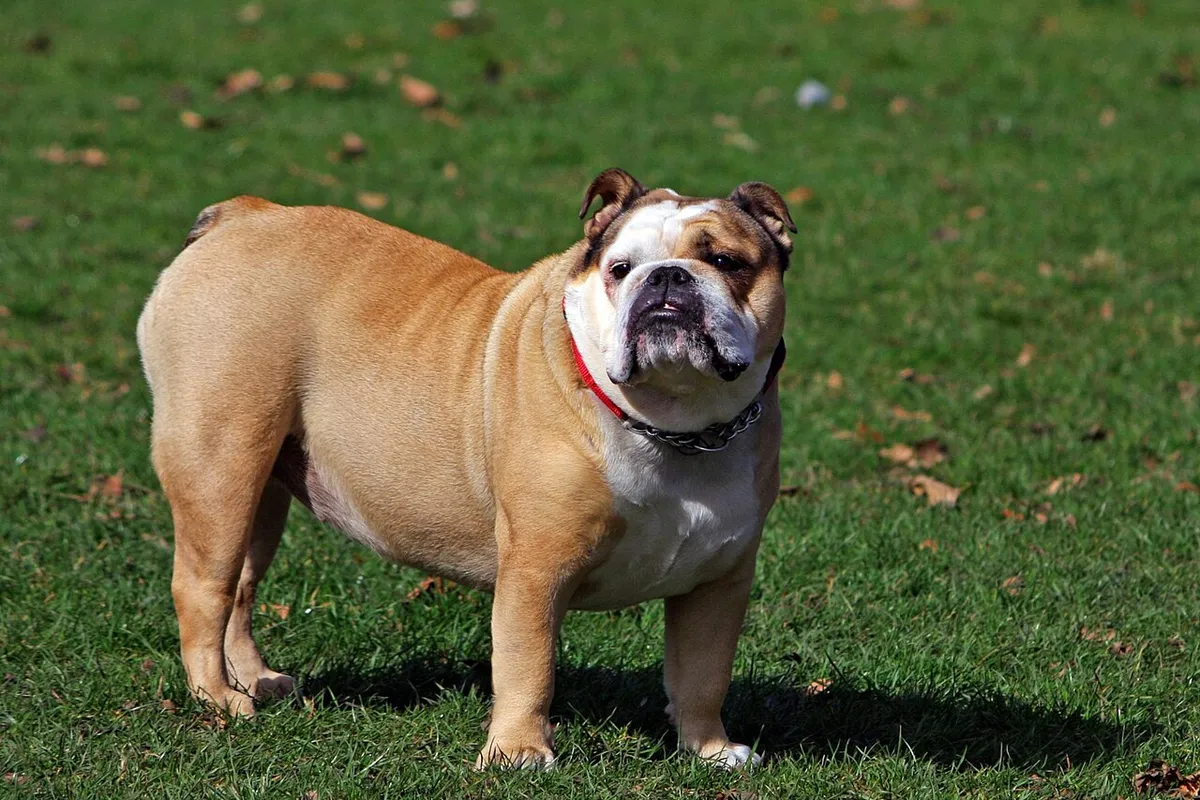
English Bulldog at a glance
| Trait | Detail |
|---|---|
| Origin | Great Britain [1] |
| Breed group | FCI group 2, section 2.1, molossoid breeds of mastiff type [1]; AKC Non-Sporting Group [2] |
| Weight | Males about 55 lb (25 kg), females about 51 lb (23 kg) [1] |
| Height | 14–15 in (36–38 cm) [2] |
| Life expectancy | Median longevity 7.2 years in UK veterinary records [3]; 7.4 years at birth in a UK life table [4] |
| Coat | Short, fine, close and smooth; red, fawn, white, brindle or pied [1] |
Origin
According to the breed standard, the Bulldog was named as such in the 1630s and was first used for bull-baiting. After 1835 it began to evolve into the shorter-faced, lower dog known today, and it entered the show ring in 1860. It is often called the national dog of Great Britain [1].
The current standard states that dogs with breathing distress or excessive breathing noise are unacceptable, and that pinched nostrils are to be heavily penalized [1].
Common health problems
A UK study compared 2,662 English Bulldogs with 22,039 other dogs. Bulldogs had higher odds for 24 of the 43 most common disorders, and lower odds for 6 [5].
- Skin: skin fold dermatitis had 38 times the odds of other dogs [5]. In an earlier study, skin problems as a group affected 28.6% of Bulldogs in one year, with pyoderma in 8.8% [3].
- Eyes: prolapsed third-eyelid gland (cherry eye) had 27 times the odds [5]; eye problems as a group affected 18.0% of Bulldogs in one year [3].
- Breathing (BOAS): 19 times the odds of other dogs [5]. In Bulldogs, narrowed nostrils, a higher body condition score and a thicker neck relative to the chest were linked with BOAS [6].
- Ears and weight: ear infection (12.7%) and overweight or obesity (8.7%) were among the most common problems [3].
- Bladder stones: see the urine tests below [7, 8, 9].
- Fewer dental problems: Bulldogs had lower odds of periodontal disease and retained baby teeth than other dogs [5].
Male Bulldogs had a shorter median longevity (6.7 years) than females (7.9 years) in the same records [3].
Urine tests, blood work and screening in Bulldogs
The Bulldog has no breed-specific blood reference interval in routine use. Its main lab particularities are in the urine.
- Urate stones (hyperuricosuria): the SLC2A9 variant first found in Dalmatians also causes high uric acid in the urine of Bulldogs. Its allele frequency was 0.16, and about 3% of Bulldogs were estimated to be affected. A urine uric acid to creatinine ratio identified affected dogs, and a DNA test exists [7]. See bladder stones in dogs.
- Cystine stones (cystinuria): English Bulldogs are the breed most often affected [8], and they were at increased risk of cystine stones in an analysis of 14,008 UK stones [9]. Variants in SLC3A1 were linked with cystinuria in male Bulldogs; in Denmark, researchers advised using the DNA test to guide preventive care rather than to select breeding dogs [8].
- Stone analysis: the type of a stone is confirmed by laboratory analysis of the stone itself, as for the 14,008 UK stones studied at the Minnesota Urolith Center [9]. Urine findings are read with it on a urinalysis.
- BOAS grading: the Kennel Club and University of Cambridge scheme grades breathing from 0 to 3, at rest and after 3 minutes of exercise, from 12 months of age and every two years [10].
- Blood count in BOAS: flat-faced dogs with BOAS grades 2–3 had a higher hematocrit and all grades a higher blood carbon dioxide than dogs with a normal muzzle, mostly within normal ranges [11]. Creatinine was also slightly higher [11].
Related articles
En français : Bouledogue anglais.
Questions to ask your veterinarian
- Should my Bulldog have a BOAS breathing assessment, and what grade is he or she?
- Has my dog been DNA tested for hyperuricosuria (SLC2A9) and cystinuria?
- Should we check the urine regularly for crystals, and what type are they?
- Is my dog’s weight right for the breed, given the link with breathing problems?
- How should the skin folds and eyes be checked between visits?
Get your Bulldog’s blood and urine tests explained.
AI DiagAnimals reads the blood count, kidney values and urinalysis with your laboratory’s intervals, and prepares the questions for your vet. The service opens soon: leave your email to be told first.
Frequently asked questions
How long do English Bulldogs live?
In UK veterinary records, median longevity was 7.2 years, shorter in males (6.7 years) than females (7.9 years) [3]. A UK life table gave a life expectancy at birth of 7.4 years [4].
What health problems do English Bulldogs have?
Compared with other dogs, the strongest predispositions are skin fold dermatitis, cherry eye, a protruding lower jaw and BOAS [5]. Ear infections, skin infections and obesity are also common [3].
Why do Bulldogs get bladder stones?
Two inherited conditions raise the risk: hyperuricosuria, caused by an SLC2A9 variant that leads to urate stones [7], and cystinuria, which leads to cystine stones and is most often seen in English Bulldogs [8, 9].
Is there a DNA test for Bulldog bladder stones?
Yes. A DNA test detects the SLC2A9 variant behind urate stones [7], and tests exist for SLC3A1 and SLC7A9 variants linked with cystinuria, although their value for breeding decisions is debated [8].
What is BOAS grading for Bulldogs?
A breathing assessment by a trained vet, at rest and after 3 minutes of exercise, graded 0 to 3, from 12 months of age and every two years [10].
Sources
- Fédération Cynologique Internationale. FCI breed standard N° 149: Bulldog. 2026. fci.be/Nomenclature/Standards/149g02-en.pdf
- American Kennel Club. Bulldog: breed information. akc.org/dog-breeds/bulldog
- O’Neill DG et al. Disorders of Bulldogs under primary veterinary care in the UK in 2013. PLoS One. 2019;14(6):e0217928. doi.org/10.1371/journal.pone.0217928
- Teng KT et al. Life tables of annual life expectancy and mortality for companion dogs in the United Kingdom. Sci Rep. 2022;12(1):6415. doi.org/10.1038/s41598-022-10341-6
- O’Neill DG et al. English Bulldogs in the UK: a VetCompass study of their disorder predispositions and protections. Canine Med Genet. 2022;9(1):5. doi.org/10.1186/s40575-022-00118-5
- Liu NC et al. Conformational risk factors of brachycephalic obstructive airway syndrome (BOAS) in pugs, French bulldogs, and bulldogs. PLoS One. 2017;12(8):e0181928. doi.org/10.1371/journal.pone.0181928
- Karmi N et al. Validation of a urine test and characterization of the putative genetic mutation for hyperuricosuria in Bulldogs and Black Russian Terriers. Am J Vet Res. 2010;71(8):909-914. doi.org/10.2460/ajvr.71.8.909
- Fitzwilliams T et al. Evaluation of the value of genetic testing for cystinuria in the Danish population of English bulldogs. Anim Genet. 2023;54(4):566-569. doi.org/10.1111/age.13321
- Roe K et al. Analysis of 14,008 uroliths from dogs in the UK over a 10-year period. J Small Anim Pract. 2012;53(11):634-640. doi.org/10.1111/j.1748-5827.2012.01275.x
- The Royal Kennel Club. Respiratory Function Grading Scheme. royalkennelclub.com/health-and-dog-care/health-dog-care/health/getting-started-with-health-testing-and-screening/respiratory-function-grading-scheme
- Facin AC et al. Evaluation of systemic consequences of brachycephalic obstructive airway syndrome in dogs. Vet Rec. 2025:e70176. doi.org/10.1002/vetr.70176
Laboratory methods and reference intervals vary. This article explains; it does not diagnose. For a decision about your pet, use the original report and talk to your veterinarian. Our editorial policy.