
 Français
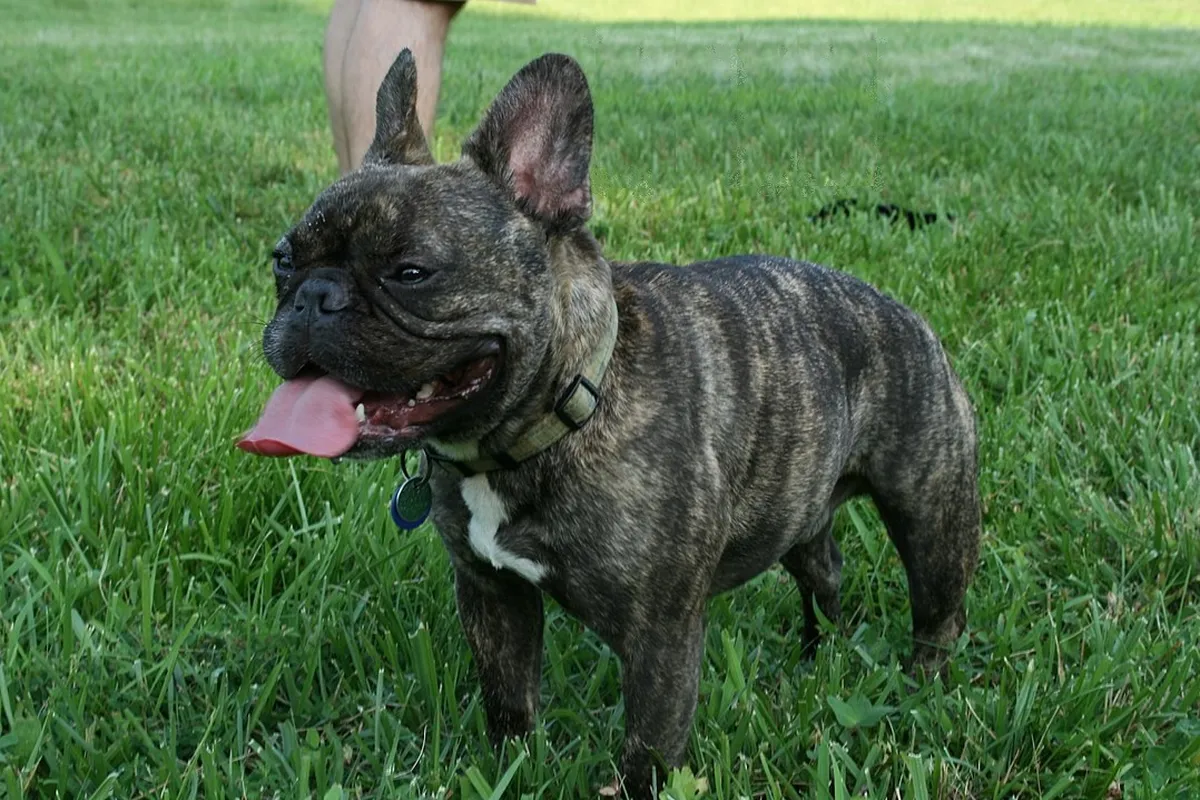
French Bulldog at a glance
| Trait | Detail |
|---|---|
| Origin | France [1] |
| Breed group | FCI group 9 (companion and toy dogs), section 11, small molossian dogs [1]; AKC Non-Sporting Group [2] |
| Weight | Males 20–31 lb (9–14 kg), females 18–29 lb (8–13 kg) [1] |
| Height | Males 10.5–14 in (27–35 cm), females 9.5–12.5 in (24–32 cm) [1] |
| Life expectancy | Median lifespan 9.8 years in a UK study of 584,734 dogs [3]; a UK life table gave 4.5 years at birth, pulled down by a very young population [4] |
| Coat | Short, smooth and glossy, without undercoat; fawn or brindle, with or without white [1] |
Origin
The breed standard describes the French Bulldog as a small molossian, related to the Bulldog of Great Britain, and shaped by breeders in the working-class districts of Paris in the 1880s. It was first the dog of market porters, butchers and coachmen before winning over high society and artists [1].
Its popularity has grown very fast: in UK veterinary records, French Bulldog puppies rose from 0.02% of the dogs born in 2003 to 1.46% in 2013 [5].
Common health problems
In a UK study of 2,781 French Bulldogs compared with 21,850 other dogs, French Bulldogs had higher odds for 20 of the 43 most common disorders and lower odds for 11 [6]. Many of the strongest links come from the breed’s flat face and compact body.
- Breathing (BOAS): narrowed nostrils had 42 times the odds and BOAS 31 times the odds seen in other dogs [6]. Signs range from snoring and poor exercise tolerance to collapse [7].
- Ears: ear infection (otitis externa) was the most common disorder, in 14.0% of French Bulldogs in one year [5]; ear discharge had 14 times the odds of other dogs [6].
- Skin: skin fold dermatitis had 11 times the odds of other dogs [6]; skin problems as a group affected 17.9% of the breed in one year [5].
- Digestive upsets: diarrhea was recorded in 7.5% of French Bulldogs in one year [5].
- Spine: among 439 French Bulldogs seen for spinal disease at a referral hospital, 84% of diagnoses were acute intervertebral disc extrusion [8].
- Kneecaps: French Bulldogs had 5.4 times the odds of patellar luxation compared with crossbred dogs [9].
- Birth: difficult birth (dystocia) had 9 times the odds of other dogs [6].
Blood work and screening in French Bulldogs
There is no French Bulldog-specific reference interval in routine use. Most of what is special shows in the breathing assessment, but blood tests can carry traces of a breathing problem.
- BOAS grading: the Kennel Club and University of Cambridge Respiratory Function Grading Scheme listens to the dog’s breathing at rest, then after 3 minutes of brisk exercise, and gives a grade from 0 (unaffected) to 3 (severe signs). Dogs can be graded from 12 months of age, with a repeat every two years [10]. Adding a 3-minute trot raised the detection of BOAS from 57% to 93% in one study [11].
- Body condition and nostrils: narrowed nostrils were linked with BOAS in French Bulldogs, Pugs and Bulldogs, and a higher body condition score in Pugs and Bulldogs [7].
- Red cells and gases: in a study of 52 flat-faced dogs, those with BOAS grades 2–3 had a higher hematocrit, and all grades had a higher blood carbon dioxide than dogs with a normal muzzle, a sign of under-breathing [12].
- Other values: the same study found higher white cell counts, creatinine and inflammation proteins, and a lower albumin, mostly still within normal ranges [12]. A single result is therefore read with the dog’s breathing grade, not on its own.
Related articles
En français : Bouledogue français.
Questions to ask your veterinarian
- Should my French Bulldog have a BOAS breathing assessment, and what grade is he or she?
- Are my dog’s nostrils narrowed, and is the body condition right for the breed?
- Do the hematocrit and other values fit with my dog’s breathing?
- Are the ear and skin-fold problems linked, and how often should they be checked?
- Which signs of back pain or weakness should make me call you straight away?
Get your French Bulldog’s blood work explained.
AI DiagAnimals reads the blood count, kidney and liver values and proteins with your laboratory’s intervals, and prepares the questions for your vet. The service opens soon: leave your email to be told first.
Frequently asked questions
How long do French Bulldogs live?
In a UK study of 584,734 dogs, the median lifespan of French Bulldogs was 9.8 years, among the shortest of all breeds [3]. A UK life table gave a life expectancy at birth of only 4.5 years, partly because the breed’s population is very young [4].
What health problems do French Bulldogs have?
Compared with other dogs, French Bulldogs are most strongly predisposed to narrowed nostrils, BOAS, ear discharge, skin fold dermatitis and difficult births [6]. Ear infections, diarrhea and eye inflammation are among the most frequent problems seen in practice [5].
What is BOAS grading?
A breathing assessment by a trained vet, at rest and after 3 minutes of exercise, that gives a grade from 0 to 3. It is available from 12 months of age and repeated every two years [10].
Do French Bulldogs have different blood test results?
There are no breed-specific intervals in routine use. Dogs with moderate to severe BOAS had a higher hematocrit and blood carbon dioxide in one study, mostly within normal ranges [12].
Are back problems common in French Bulldogs?
Yes. In a referral study of 439 French Bulldogs with spinal disease, 84% of diagnoses were acute disc extrusions [8].
Sources
- Fédération Cynologique Internationale. FCI breed standard N° 101: French Bulldog. 2023. fci.be/Nomenclature/Standards/101g09-en.pdf
- American Kennel Club. French Bulldog: breed information. akc.org/dog-breeds/french-bulldog
- McMillan KM et al. Longevity of companion dog breeds: those at risk from early death. Sci Rep. 2024;14(1):531. doi.org/10.1038/s41598-023-50458-w
- Teng KT et al. Life tables of annual life expectancy and mortality for companion dogs in the United Kingdom. Sci Rep. 2022;12(1):6415. doi.org/10.1038/s41598-022-10341-6
- O’Neill DG et al. Demography and disorders of the French Bulldog population under primary veterinary care in the UK in 2013. Canine Genet Epidemiol. 2018;5:3. doi.org/10.1186/s40575-018-0057-9
- O’Neill DG et al. French Bulldogs differ to other dogs in the UK in propensity for many common disorders: a VetCompass study. Canine Med Genet. 2021;8(1):13. doi.org/10.1186/s40575-021-00112-3
- Liu NC et al. Conformational risk factors of brachycephalic obstructive airway syndrome (BOAS) in pugs, French bulldogs, and bulldogs. PLoS One. 2017;12(8):e0181928. doi.org/10.1371/journal.pone.0181928
- Kerr S et al. Prevalence and breed predisposition for spinal diseases in pugs and French bulldogs. Vet Rec. 2025;196(4):e5122. doi.org/10.1002/vetr.5122
- O’Neill DG et al. The epidemiology of patellar luxation in dogs attending primary-care veterinary practices in England. Canine Genet Epidemiol. 2016;3:4. doi.org/10.1186/s40575-016-0034-0
- The Royal Kennel Club. Respiratory Function Grading Scheme. royalkennelclub.com/health-and-dog-care/health-dog-care/health/getting-started-with-health-testing-and-screening/respiratory-function-grading-scheme
- Riggs J et al. Validation of exercise testing and laryngeal auscultation for grading brachycephalic obstructive airway syndrome in pugs, French bulldogs, and English bulldogs by using whole-body barometric plethysmography. Vet Surg. 2019;48(4):488-496. doi.org/10.1111/vsu.13159
- Facin AC et al. Evaluation of systemic consequences of brachycephalic obstructive airway syndrome in dogs. Vet Rec. 2025:e70176. doi.org/10.1002/vetr.70176
Laboratory methods and reference intervals vary. This article explains; it does not diagnose. For a decision about your pet, use the original report and talk to your veterinarian. Our editorial policy.