
 Français
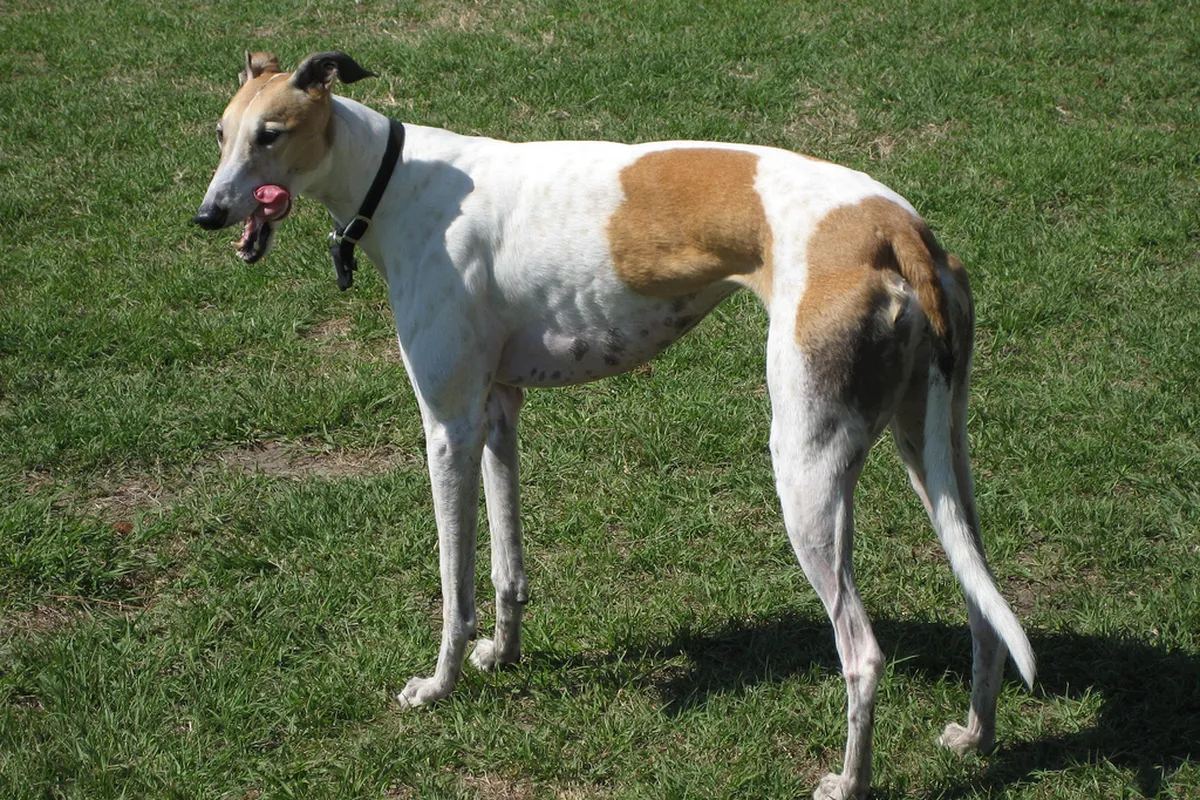
At a glance
| Trait | Detail |
|---|---|
| Origin | Great Britain [1] |
| Breed group | FCI group 10, section 3 (short-haired sighthounds) [1] |
| Weight | Mean adult weight in UK practices 65.5 lb (29.7 kg): males 71 lb (32.3 kg), females 60 lb (27.2 kg) [2] |
| Height | Males 28–30 in (71–76 cm), females 27–28 in (68–71 cm) [1] |
| Life expectancy | Median 11.5 years in a large UK study [3]; median 11.4 years in UK veterinary records, with females outliving males [2] |
| Coat | Fine and close; black, white, red, blue, fawn, brindle, or any of these broken with white [1] |
Origin
Greyhound-type dogs appear on the walls of Ancient Egyptian tombs, and experts think the type may have come from the Middle East. It was in Britain that the breed was developed to a standard. The racing Greyhound was developed from the coursing hound that hunts the live hare [1].
Many Greyhounds now live as pets after their racing careers [2], and more than 180,000 retired racing Greyhounds had been placed in adoptive homes between the early 1990s and 2011 [4].
Common health problems
- Dental disease: periodontal disease affected 39.0% of 2,715 UK Greyhounds in one year, the most common diagnosis, followed by overgrown nails (11.1%), wounds (6.2%), osteoarthritis (4.6%) and claw injuries (4.2%) [2].
- Cancer: neoplasia was the most common cause of death (21.5%) [2]. In UK primary care, 0.62% of Greyhounds were diagnosed with osteosarcoma (bone cancer) in a year, with 11.93 times the odds of crossbreeds after adjustment [5].
- Hookworms: in the USA, multi-drug-resistant hookworms (Ancylostoma caninum) are highly over-represented in Greyhounds. In 219 Greyhounds from adoption kennels, a racing kennel and practices, the mean fecal egg count was 822 eggs per gram despite deworming, and a resistance marker was found in 99% of samples [6]. These worms probably originate from racing Greyhound farms and kennels [7]. See hookworms in dogs.
- Bleeding after surgery: some Greyhounds bleed after surgery despite normal platelet counts for the breed and normal standard clotting tests [4].
What is special in the Greyhound’s blood work
Reference intervals for many tests in retired racing Greyhounds differ from those of other breeds, and most of the blood-count differences are also seen in other sighthounds [4]. The table compares published Greyhound intervals with intervals for other dogs from the same review.
| Test | Greyhounds | Other dogs |
|---|---|---|
| Hematocrit | 50.0–68.0% [4] | 42.0–62.0% [4] |
| Platelets | 145–309 ×10⁹/L [4] | 173–497 ×10⁹/L [4] |
| White blood cells | 3.4–8.5 ×10⁹/L [4] | 5.8–20.3 ×10⁹/L [4] |
| Creatinine | 1.0–1.7 mg/dL [4] | 0.6–1.6 mg/dL [4] |
| ALT | 28–82 U/L [4] | 10–55 U/L [4] |
| Globulins | 1.7–3.0 g/dL [4] | 2.2–2.9 g/dL [4] |
Red cells. Greyhounds have a higher hematocrit, hemoglobin and red cell count than other dogs, long seen as an adaptation to racing [4]. A “normal” hematocrit for another breed may be low for a Greyhound. See anemia in dogs.
Platelets. Lower platelet counts are a breed trait and are not caused by an immune process; platelets also tend to clump in Greyhound samples [4]. See low platelets in dogs.
Creatinine. Greyhounds have a higher creatinine with a higher, not lower, kidney filtration rate; the large muscle mass is the most likely cause. The review authors consider a mild rise (1.2–2.1 mg/dL) in an otherwise healthy Greyhound not worth investigating on its own [4]. See creatinine in dogs.
Thyroid. Greyhounds and other sighthounds have total T4 below non-breed intervals [4]. In one survey of 398 sighthounds diagnosed with hypothyroidism, 71.9% had been diagnosed on low total T4 or T3 alone, and only 16.3% had other findings, such as a high TSH, pointing to true disease [4]. See hypothyroidism in dogs.
Other quirks. Greyhound eosinophils often lack their usual orange granules and can be mistaken for toxic neutrophils on a smear. Only 13.3% of retired racers were DEA 1.1-positive, against 60.6% of other breeds, which makes many of them suitable blood donors [4].
Related articles
En français : Lévrier greyhound.
Questions to ask your veterinarian
- Does the laboratory use Greyhound-specific reference intervals?
- Is the creatinine high for a Greyhound, or only for other breeds?
- Is the low T4 normal for a sighthound, or are there other signs of hypothyroidism?
- Should we repeat the fecal test after deworming to check the hookworms are gone?
- Is my dog’s lameness worth an X-ray, given the breed’s risk of bone cancer?
Get your Greyhound’s blood work explained.
AI DiagAnimals reads the blood count, creatinine, liver values, proteins and thyroid results together with your laboratory’s intervals, and flags the values that differ in Greyhounds. The service opens soon: leave your email to be told first.
Frequently asked questions
How long do Greyhounds live?
A large UK study found a median lifespan of 11.5 years [3]. In UK veterinary records the median was 11.4 years, and females lived slightly longer than males [2].
Why is my Greyhound’s creatinine high?
Greyhounds normally have higher creatinine than other dogs, mainly because of their muscle mass; their kidney filtration is actually higher [4].
Is a low platelet count normal in Greyhounds?
Lower counts are a known breed trait, and platelets also tend to clump in the tube [4]. Your vet will judge the count against Greyhound intervals and any bleeding signs.
Do Greyhounds have low thyroid levels?
Total T4 is normally lower in Greyhounds and other sighthounds, so a low T4 alone does not mean hypothyroidism [4].
Sources
- FCI. Standard No. 158: Greyhound. 2026. fci.be/Nomenclature/Standards/158g10-en.pdf
- O’Neill DG et al. Greyhounds under general veterinary care in the UK during 2016: demography and common disorders. Canine Genet Epidemiol. 2019;6:4. doi.org/10.1186/s40575-019-0072-5
- McMillan KM et al. Longevity of companion dog breeds: those at risk from early death. Sci Rep. 2024;14:531 (supplementary table S3). doi.org/10.1038/s41598-023-50458-w
- Zaldívar-López S et al. Clinical pathology of Greyhounds and other sighthounds. Vet Clin Pathol. 2011;40(4):414-425. doi.org/10.1111/j.1939-165X.2011.00360.x
- O’Neill DG et al. Dog breeds and conformations predisposed to osteosarcoma in the UK: a VetCompass study. Canine Med Genet. 2023;10:8. doi.org/10.1186/s40575-023-00131-2
- Jimenez Castro PD et al. Multiple drug resistance in hookworms infecting greyhound dogs in the USA. Int J Parasitol Drugs Drug Resist. 2021;17:107-117. doi.org/10.1016/j.ijpddr.2021.08.005
- Jimenez Castro PD et al. Multiple drug resistance in the canine hookworm Ancylostoma caninum: an emerging threat? Parasit Vectors. 2019;12:576. doi.org/10.1186/s13071-019-3828-6
Laboratory methods and reference intervals vary. This article explains; it does not diagnose. For a decision about your pet, use the original report and talk to your veterinarian. Our editorial policy.