
 Français
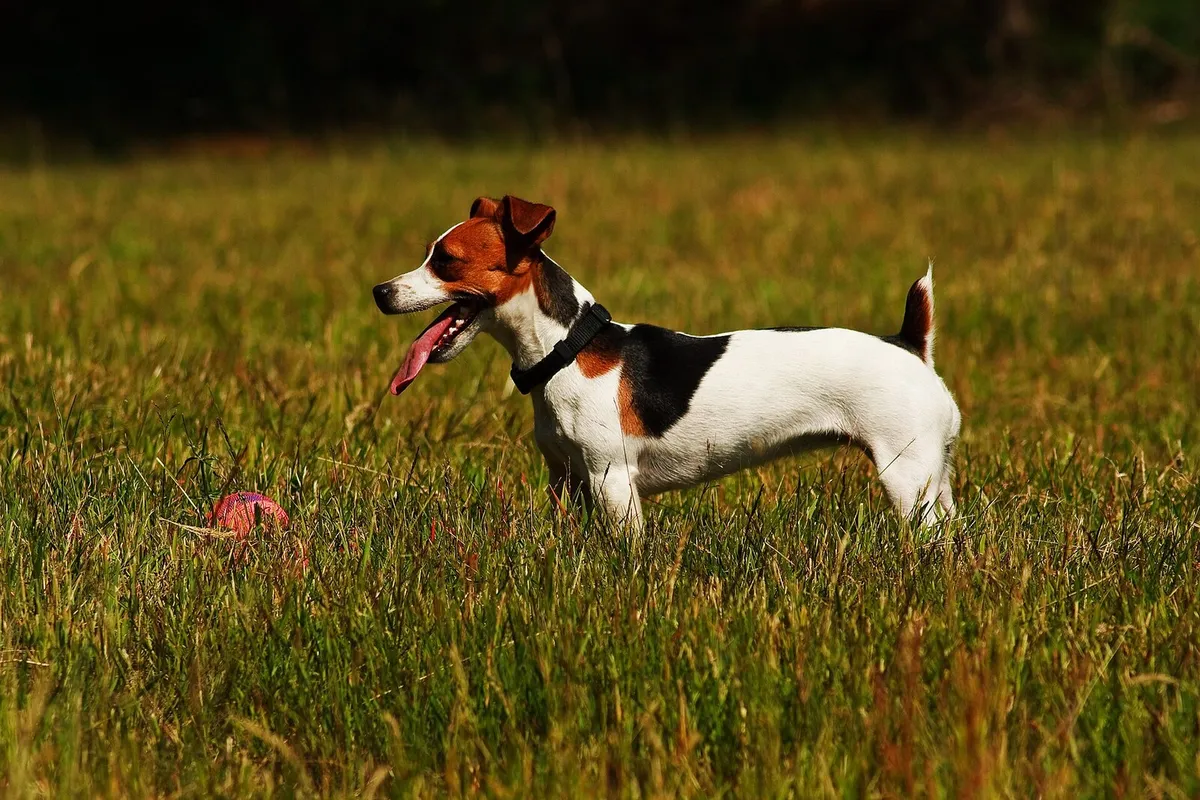
Jack Russell Terrier at a glance
| Trait | Detail |
|---|---|
| Origin | England; developed in Australia [1] |
| Breed group | FCI Group 3 (Terriers), section 2, small terriers [1] |
| Weight | About 1 kg per 5 cm of height: about 5–6 kg (11–13 lb) [1] |
| Height | 25–30 cm (10–12 in) [1] |
| Life expectancy | 12.7 years at birth in a UK life-table study [2]; median age at death 13.3 years in a 2024 UK study [3] |
| Coat | Smooth, broken or rough, weatherproof; mostly white with black and/or tan markings [1] |
Origin
The breed comes from England in the 1800s, from the work of the Reverend John Russell. He developed a strain of Fox Terriers to run with his foxhounds and go to ground to bolt the fox from its den [1].
Two varieties evolved: the taller, more square Parson Russell Terrier and the shorter, slightly longer Jack Russell Terrier. The FCI standard of the Jack Russell lists Australia as the country where the breed was developed [1].
Common health problems
- A long life: Jack Russells had the highest life expectancy at birth (12.72 years) of the 18 breeds in a UK life-table study [2]. In a 2024 UK study of over 580,000 dogs, the median age at death was 13.3 years for Jack Russells and 13.8 years for Parson Russells [3].
- Primary lens luxation (PLL): the lens of the eye moves out of place, which is painful and can blind the dog. A mutation in the ADAMTS17 gene is associated with PLL in Jack Russell Terriers and in many other terrier breeds [4, 5]. Carriers of one copy have a low risk [5].
- Kneecap luxation: in English primary-care practices, Jack Russells had 1.5 times the odds of a patellar luxation diagnosis compared with crossbred dogs; the overall prevalence in all dogs was 1.30% [6].
- Cushing’s syndrome: in a UK study of 905,544 dogs, Jack Russells were the breed most often diagnosed (9.7% of new cases) and had 1.50 times the odds of crossbred dogs [7]. See Cushing’s disease in dogs.
- Hypothyroidism: Jack Russells were among the least affected breeds, with 0.40 times the odds of crossbred dogs [8]. See hypothyroidism in dogs.
- Hereditary ataxia: a progressive loss of coordination. A KCNJ10 gene mutation is associated with spinocerebellar ataxia in Jack Russells and related terriers, but it does not explain every case [9].
Tests and screening in Jack Russells
- No breed-specific reference values have been published for routine blood tests in Jack Russells: results are read with the laboratory’s usual dog intervals.
- Tests for Cushing’s syndrome: the breed is at higher odds [7], so it is worth knowing how the diagnosis is tested: see the ACTH stimulation test and high ALP in dogs.
- DNA test for primary lens luxation (ADAMTS17): it shows whether a dog carries no, one or two copies of the mutation; dogs with two copies are at risk, carriers at low risk [4, 5].
- DNA test for hereditary ataxia (KCNJ10): a German study found that the test does not capture all cases of hereditary ataxia in Parson and Jack Russell Terriers [9].
Related articles
En français : Jack Russell.
Questions to ask your veterinarian
- Should my Jack Russell have a DNA test for primary lens luxation?
- Which eye signs should make me call you the same day?
- Are my dog’s kneecaps stable?
- Do my dog’s thirst, appetite and liver values suggest Cushing’s syndrome?
- Which blood tests should an older Jack Russell have each year?
Get your Jack Russell’s blood work explained.
AI DiagAnimals reads the blood count, liver enzymes such as ALP, glucose, kidney values and adrenal or thyroid results with your laboratory’s intervals, and prepares the questions for your vet. The service opens soon: leave your email to be told first.
Frequently asked questions
How long do Jack Russell Terriers live?
They are among the longest-lived breeds: 12.7 years of life expectancy at birth in one UK study [2] and a median age at death of 13.3 years in another [3].
What health problems do Jack Russells have?
The best documented are primary lens luxation [4, 5], kneecap luxation [6], Cushing’s syndrome [7] and hereditary ataxia [9].
What is lens luxation in Jack Russells?
The lens of the eye slips out of place, which is painful and can lead to blindness. It is linked to a mutation in the ADAMTS17 gene [4, 5].
What DNA tests are there for Jack Russells?
Tests exist for the ADAMTS17 mutation linked to lens luxation [4, 5] and for the KCNJ10 mutation linked to hereditary ataxia, which does not detect every case [9].
Are Jack Russells prone to Cushing’s disease?
Somewhat: in a large UK study they had 1.50 times the odds of crossbred dogs and were the breed most often diagnosed [7].
Sources
- Fédération Cynologique Internationale. FCI Standard No. 345: Jack Russell Terrier. fci.be/Nomenclature/Standards/345g03-en.pdf
- Teng KT et al. Life tables of annual life expectancy and mortality for companion dogs in the United Kingdom. Sci Rep. 2022;12(1):6415. doi.org/10.1038/s41598-022-10341-6
- McMillan KM et al. Longevity of companion dog breeds: those at risk from early death. Sci Rep. 2024;14:531 (supplementary Table S3). doi.org/10.1038/s41598-023-50458-w
- Farias FH et al. An ADAMTS17 splice donor site mutation in dogs with primary lens luxation. Invest Ophthalmol Vis Sci. 2010;51(9):4716-4721. doi.org/10.1167/iovs.09-5142
- Gould D et al. ADAMTS17 mutation associated with primary lens luxation is widespread among breeds. Vet Ophthalmol. 2011;14(6):378-384. doi.org/10.1111/j.1463-5224.2011.00892.x
- O’Neill DG et al. The epidemiology of patellar luxation in dogs attending primary-care veterinary practices in England. Canine Genet Epidemiol. 2016;3:4. doi.org/10.1186/s40575-016-0034-0
- Schofield I et al. Frequency and risk factors for naturally occurring Cushing’s syndrome in dogs attending UK primary-care practices. J Small Anim Pract. 2022;63(4):265-274. doi.org/10.1111/jsap.13450
- O’Neill DG et al. Frequency, breed predispositions and other demographic risk factors for diagnosis of hypothyroidism in dogs under primary veterinary care in the UK. Canine Med Genet. 2022;9(1):11. doi.org/10.1186/s40575-022-00123-8
- Gast AC et al. Genome-wide association study for hereditary ataxia in the Parson Russell Terrier and DNA-testing for ataxia-associated mutations in the Parson and Jack Russell Terrier. BMC Vet Res. 2016;12(1):225. doi.org/10.1186/s12917-016-0862-x
Laboratory methods and reference intervals vary. This article explains; it does not diagnose. For a decision about your pet, use the original report and talk to your veterinarian. Our editorial policy.