
 Français
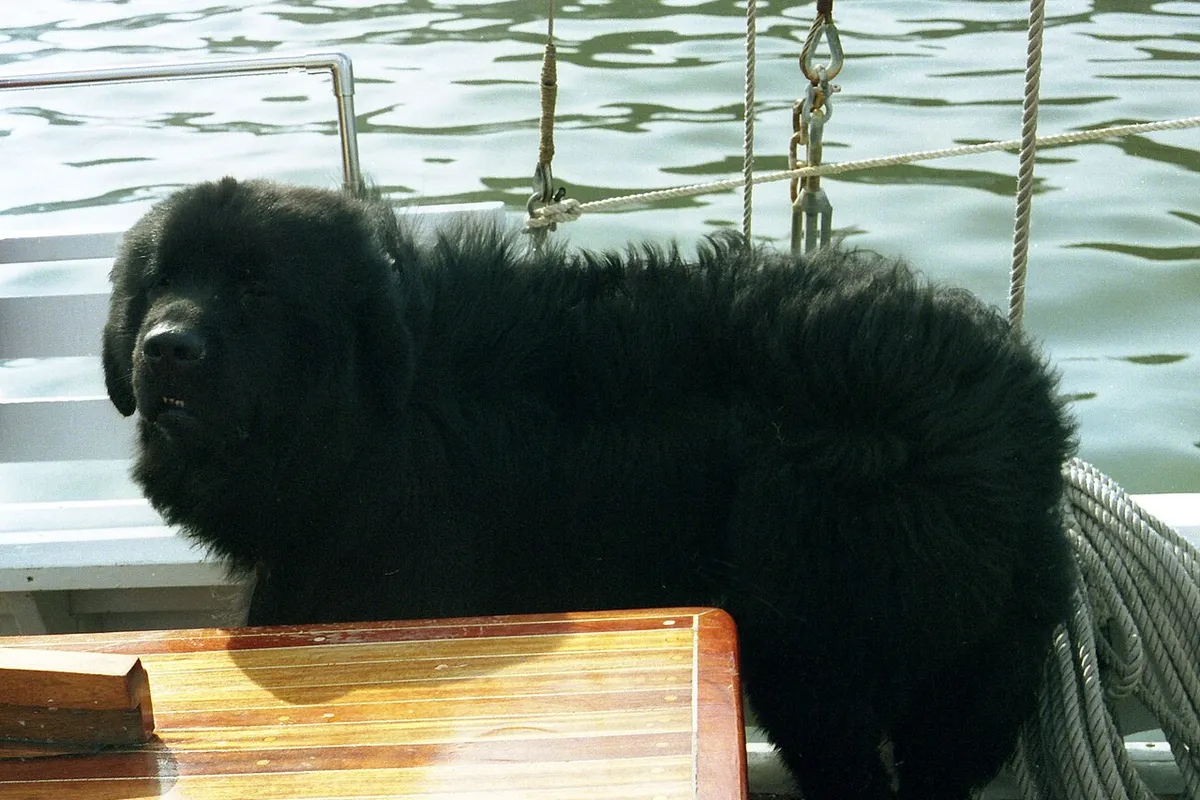
At a glance
| Trait | Detail |
|---|---|
| Origin | Canada [1] |
| Breed group | FCI group 2, section 2.2 (Molossoid, mountain type) [1]; AKC Working Group [2] |
| Weight | Average about 68 kg (150 lb) for males and 54 kg (119 lb) for females [1]; median adult weight 58.8 kg (130 lb) in UK practices [4] |
| Height | Average 71 cm (28 in) for males and 66 cm (26 in) for females [1] |
| Life expectancy | Median 11.0 years in a large UK study [3]; median age at death 10.3 years in UK veterinary records (70 dogs) [4] |
| Coat | Water-resistant double coat; black, white and black, or brown [1] |
Origin
The breed comes from the island of Newfoundland, from local dogs and the big black “bear dog” brought by the Vikings after the year 1100. European fishermen’s dogs later contributed, and by the start of colonization in 1610 the dog already had most of its present build and behavior [1].
It pulled heavy loads on land and served as a water and lifeguard dog; the FCI still lists it as a sledge dog for heavy loads and a water dog [1].
Common health problems
- Hip and elbow dysplasia: in Swedish screening from 2007 to 2016, 41.1% of Newfoundlands had hip dysplasia (grades C to E) and 33.1% had elbow dysplasia [6].
- Cruciate ligament rupture: the Newfoundland was one of the breeds predisposed to rupture of the cranial cruciate ligament before 2 years of age [12].
- Subaortic stenosis: Newfoundlands have a high relative risk of this inherited narrowing below the aortic valve. In a French breed club screening program of 921 adult dogs from 2010 to 2023, 99.1% were free of aortic stenosis and none was detected in the last 3 years [7].
- Dilated cardiomyopathy: its incidence in the breed is estimated at 1.3–2.5% [8]. See heart failure in dogs.
- Cystinuria: an inherited kidney defect that lets cystine leak into the urine and form stones in the bladder and sometimes the kidneys. Urinary obstruction was seen only in males, but both sexes inherit it, as an autosomal recessive trait [10]. See bladder stones in dogs.
- Bloat and bone cancer: in a UK Kennel Club owner survey, Newfoundlands had a higher proportional mortality than other breeds from gastric dilatation-volvulus and from bone cancer [5].
What is special in the Newfoundland’s blood and urine tests
We found no breed-specific reference intervals for routine blood work in the Newfoundland. Two inherited conditions, however, show up on specific tests.
Cystinuria in the urine. Affected Newfoundlands persistently excreted more than 500 nmol of cystine per mg of creatinine, against about 54 in normal dogs, and had typical cystine crystals in acidic urine; ornithine, lysine and arginine were also high. The nitroprusside spot test was used to screen urine, but carriers had normal urine and could not be detected by urinalysis [10]. A mutation-specific DNA test in the SLC3A1 gene identifies affected dogs and carriers [11].
Taurine and the heart. Among 216 privately owned Newfoundlands, 8% had low plasma taurine (40 µmol/L or less), and these dogs also had lower albumin and cyst(e)ine [8]. In a related group of 19 dogs fed lamb meal and rice diets, 12 were taurine deficient; the deficiency was reversed by a change of diet or methionine supplementation [9]. Of 9 taurine-deficient dogs examined in the larger study, 3 had dilated cardiomyopathy that reversed with taurine supplementation [8]. Taurine was measured in plasma in both studies, and also in whole blood in the second [8, 9].
Heart screening. Echocardiography is used to screen for aortic and pulmonic stenosis before breeding [7].
Joint screening. Hip and elbow X-ray scoring tracks dysplasia in the breed [6].
Related articles
En français : Terre-neuve.
Questions to ask your veterinarian
- Have my dog and its parents been DNA-tested for cystinuria?
- Do my dog’s urine results show cystine crystals?
- Has my dog had an echocardiogram to check for subaortic stenosis?
- Should my dog’s blood taurine be measured, given its diet?
- Have my dog’s hips and elbows been X-rayed and scored?
Get your Newfoundland’s blood work explained.
AI DiagAnimals reads the urinalysis, blood count, kidney values and other results together with your laboratory’s intervals, and explains them in plain language. The service opens soon: leave your email to be told first.
Frequently asked questions
How long do Newfoundlands live?
A large UK study found a median lifespan of 11.0 years [3]. In UK veterinary records of giant breeds, Newfoundlands died at a median age of 10.3 years [4].
What health problems do Newfoundlands have?
The best documented are hip and elbow dysplasia [6], cruciate ligament rupture [12], subaortic stenosis [7], dilated cardiomyopathy [8] and cystinuria [10].
What is cystinuria in Newfoundlands?
An inherited defect that makes the kidneys lose cystine into the urine, where it forms crystals and stones. It is caused by a mutation in the SLC3A1 gene, for which a DNA test exists [10, 11].
Sources
- FCI. Standard No. 50: Newfoundland. 1996. fci.be/Nomenclature/Standards/050g02-en.pdf
- American Kennel Club. Newfoundland: dog breed information. akc.org/dog-breeds/newfoundland
- McMillan KM et al. Longevity of companion dog breeds: those at risk from early death. Sci Rep. 2024;14:531 (supplementary table S3). doi.org/10.1038/s41598-023-50458-w
- O’Neill DG et al. Giant dog breeds under primary veterinary care in the UK: demography, common disorders and mortality. Companion Anim Health Genet. 2026;13:4. doi.org/10.1186/s40575-026-00152-7
- Lewis TW et al. Longevity and mortality in Kennel Club registered dog breeds in the UK in 2014. Canine Genet Epidemiol. 2018;5:10. doi.org/10.1186/s40575-018-0066-8
- Engdahl K et al. Prevalence of hip and elbow dysplasia in young adult dogs in Sweden. Vet Rec. 2026;198(12):e560. doi.org/10.1002/vetr.70224
- Chetboul V et al. Congenital pulmonic and aortic stenosis in Newfoundland dogs: results of a 14-year French cardiovascular screening program (921 dogs). PLoS One. 2025;20(1):e0318227. doi.org/10.1371/journal.pone.0318227
- Backus RC et al. Low plasma taurine concentration in Newfoundland dogs is associated with low plasma methionine and cyst(e)ine concentrations and low taurine synthesis. J Nutr. 2006;136(10):2525-2533. doi.org/10.1093/jn/136.10.2525
- Backus RC et al. Taurine deficiency in Newfoundlands fed commercially available complete and balanced diets. J Am Vet Med Assoc. 2003;223(8):1130-1136. doi.org/10.2460/javma.2003.223.1130
- Casal ML et al. Inheritance of cystinuria and renal defect in Newfoundlands. J Am Vet Med Assoc. 1995;207(12):1585-1589. pubmed.ncbi.nlm.nih.gov/7493896
- Henthorn PS et al. Canine cystinuria: polymorphism in the canine SLC3A1 gene and identification of a nonsense mutation in cystinuric Newfoundland dogs. Hum Genet. 2000;107(4):295-303. doi.org/10.1007/s004390000392
- Duval JM et al. Breed, sex, and body weight as risk factors for rupture of the cranial cruciate ligament in young dogs. J Am Vet Med Assoc. 1999;215(6):811-814. pubmed.ncbi.nlm.nih.gov/10496133
Laboratory methods and reference intervals vary. This article explains; it does not diagnose. For a decision about your pet, use the original report and talk to your veterinarian. Our editorial policy.