
 Français
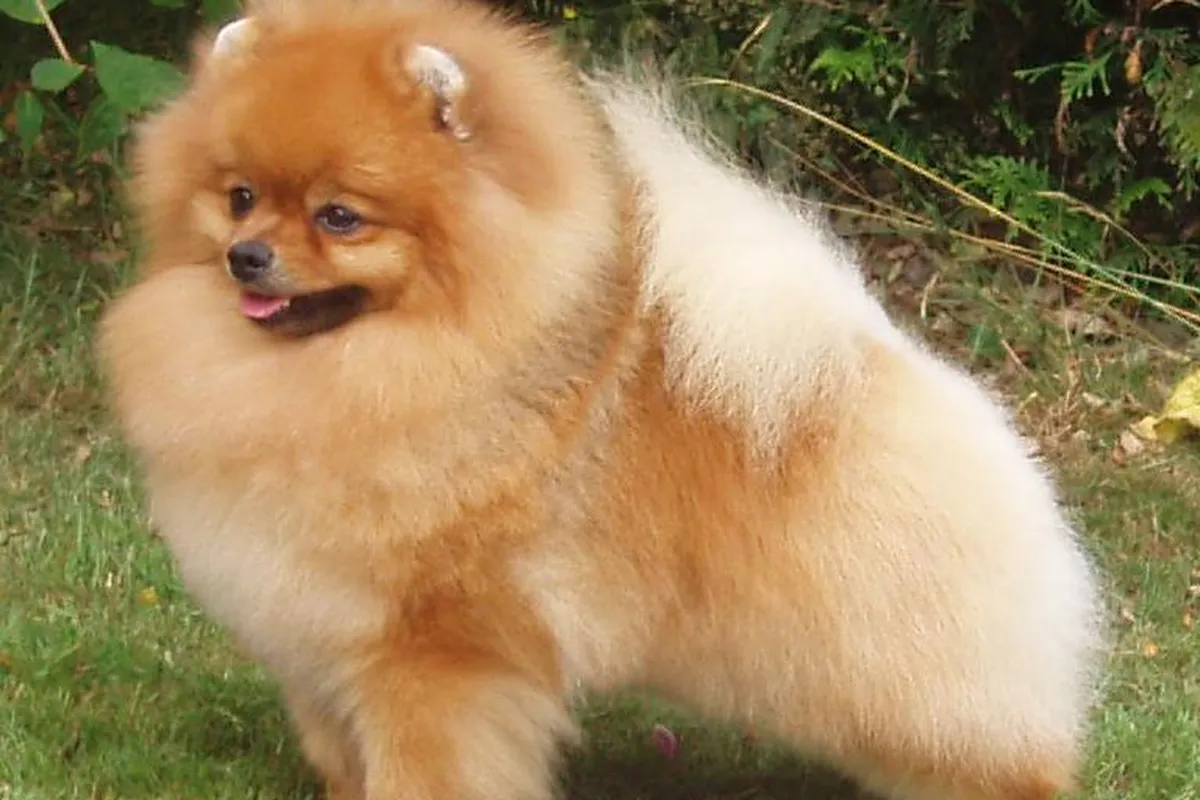
Pomeranian at a glance
| Trait | Detail |
|---|---|
| Origin | Germany [1] |
| Breed group | FCI group 5 (Spitz and primitive types), section 4, European Spitz, as the toy variety of the German Spitz [1]; AKC Toy Group [2] |
| Weight | 3–7 lb (1.4–3.2 kg) [2]; the FCI standard asks for a weight in proportion to size [1] |
| Height | 8.3 in ± 1.2 in (21 cm ± 3 cm) in the FCI standard [1]; 6–7 in (15–18 cm) for the AKC [2] |
| Life expectancy | Median survival 12.2 years in UK veterinary records [3] |
| Coat | Double coat: a long, straight, off-standing topcoat over a short, thick, cotton-wool-like undercoat; white, black, brown, orange, grey-shaded and other colors [1] |
Origin
The FCI standard describes the German Spitz as descending from the Stone Age “peat dog” and the later lake-dwelling Spitz, and as the oldest dog breed of Central Europe. Outside German-speaking countries, the Toy Spitz (Zwergspitz) is known as the Pomeranian [1].
According to the American Kennel Club, the name refers to the region of Pomerania. Queen Victoria bred and showed Pomeranians, exhibiting six of them at Crufts in 1891, and is credited with reducing their size from about 30 lb to today’s toy size [2].
Common health problems
- Kneecaps: in English primary-care practices, 6.5% of Pomeranians had a diagnosis of patellar luxation, and the breed had 6.5 times the odds of crossbred dogs, the highest of the breeds studied [4].
- Coat loss (alopecia X): a common hair loss in Pomeranians that is not inflammatory and whose cause is unknown. In a survey of 211 Pomeranians in the Netherlands and Belgium, males and dogs with a woolly coat had a higher risk [5]. No test can predict it [5].
- Collapsing trachea: among 110 small dogs with tracheal collapse confirmed by fluoroscopy in Korea, Pomeranians were the second most common breed (22.7%), after the Maltese. A higher body condition score was linked with a more severe grade of collapse [6].
- Chiari-like malformation and syringomyelia: these skull and spinal cord changes are commonly found in Pomeranians. In dogs scanned twice by MRI, 20.7% of those free of syringomyelia on the first scan had developed it on the second [7].
- Brain inflammation: at UK referral centers, Pomeranians had 4.9 times the odds of crossbred dogs of meningoencephalitis of unknown origin [8].
- Teeth: in US veterinary records, extra-small breeds (under 6.5 kg, or about 14 lb) were up to five times more likely to be diagnosed with periodontal disease than giant breeds [9].
- Breathing: in a UK study of 51 Pomeranians, none had clinically significant BOAS, the airway disease of flat-faced breeds [10].
Blood work, urine tests and screening in Pomeranians
We found no published Pomeranian-specific reference intervals for routine blood tests. The breed’s lab particularities come from the conditions it is prone to.
- Hormone tests before alopecia X: alopecia X is a diagnosis of exclusion. In a 2026 study, hypothyroidism was ruled out with total T4 and TSH, and Cushing’s syndrome with an ACTH stimulation test or a low-dose dexamethasone suppression test [11]. See Cushing’s disease in dogs.
- IGF-1 is not a test for alopecia X: serum IGF-1 was not lower in 11 Pomeranians with alopecia X than in 19 healthy Pomeranians, and the authors do not recommend measuring it routinely [11].
- Calcium oxalate stones: among 10,444 stones analyzed at the University of California, Davis, Pomeranians had 6.1 times the odds of mixed-breed dogs of calcium oxalate stones [12]. Crystals and urine pH are read on a urinalysis; see bladder stones in dogs.
- Kneecap screening: in US Orthopedic Foundation for Animals data quoted by the UK study, 37.2% of Pomeranians submitted for patellar evaluation were affected [4].
- MRI screening: Chiari-like malformation and syringomyelia are diagnosed and screened for with MRI; a single scan may not be the final picture, as syrinx size can change over time [7].
Related articles
En français : Spitz nain (loulou de Poméranie).
Questions to ask your veterinarian
- Are my Pomeranian’s kneecaps stable, and what grade is any luxation?
- If my dog is losing hair, which blood tests rule out hypothyroidism and Cushing’s syndrome first?
- Does the cough or honking sound suggest tracheal collapse, and does weight play a role?
- Should we check the urine for calcium oxalate crystals?
- Do the teeth need cleaning, and are any baby teeth still in place?
Get your Pomeranian’s blood work explained.
AI DiagAnimals reads T4, TSH, cortisol results, the chemistry panel and the urinalysis with your laboratory’s intervals, and prepares the questions for your vet. The service opens soon: leave your email to be told first.
Frequently asked questions
How long do Pomeranians live?
In a large UK study, the median survival of Pomeranians was 12.2 years, not significantly different from crossbred dogs [3].
What health problems do Pomeranians have?
Patellar luxation is strongly predisposed [4]. Alopecia X [5], Chiari-like malformation with syringomyelia [7] and calcium oxalate bladder stones [12] are also described in the breed, and Pomeranians are among the breeds most often seen with tracheal collapse [6].
What is alopecia X in Pomeranians?
A non-inflammatory hair loss of unknown cause that is common in Pomeranians, with a higher risk in males and woolly-coated dogs [5]. Blood tests are used to rule out hypothyroidism and Cushing’s syndrome before the diagnosis is made [11].
What tests should a Pomeranian have?
A knee examination for patellar luxation [4], a urinalysis when stones or crystals are a concern [12], hormone tests if the coat thins [11], and MRI if signs suggest Chiari-like malformation or syringomyelia [7].
Do Pomeranians get collapsing trachea?
Yes. In a Korean series of 110 small dogs with tracheal collapse, Pomeranians were the second most common breed, and a higher body condition score was linked with more severe collapse [6].
Sources
- Fédération Cynologique Internationale. FCI breed standard N° 97: German Spitz, including Toy Spitz/Pomeranian. 2024. fci.be/Nomenclature/Standards/097g05-en.pdf
- American Kennel Club. Pomeranian: breed information. akc.org/dog-breeds/pomeranian
- McMillan KM et al. Longevity of companion dog breeds: those at risk from early death. Sci Rep. 2024;14:531 (supplementary table S3). doi.org/10.1038/s41598-023-50458-w
- O’Neill DG et al. The epidemiology of patellar luxation in dogs attending primary-care veterinary practices in England. Canine Genet Epidemiol. 2016;3:4. doi.org/10.1186/s40575-016-0034-0
- van Hensbergen I et al. Evaluation of phenotypic risk indicators for the development of alopecia X (hair cycle arrest) in Pomeranian dogs in the Netherlands and Belgium. Vet Dermatol. 2025;36(2):196-204. doi.org/10.1111/vde.13326
- Kim MR et al. A retrospective study of tracheal collapse in small-breed dogs: 110 cases (2022-2024). Front Vet Sci. 2024;11:1448249. doi.org/10.3389/fvets.2024.1448249
- Jansma MR et al. Chiari-like malformation and syringomyelia in Pomeranians: a longitudinal study. Vet Sci. 2025;12(7):677. doi.org/10.3390/vetsci12070677
- Choi Y, O’Neill DG et al. Meningoencephalitis of unknown origin in dogs under veterinary referral care in England (2017-2021): a multicenter case control study. Front Vet Sci. 2025;12:1710593. doi.org/10.3389/fvets.2025.1710593
- Wallis C et al. Association of periodontal disease with breed size, breed, weight, and age in pure-bred client-owned dogs in the United States. Vet J. 2021;275:105717. doi.org/10.1016/j.tvjl.2021.105717
- Tomlinson F et al. A cross-sectional study into the prevalence and conformational risk factors of BOAS across fourteen brachycephalic dog breeds. PLoS One. 2026;21(2):e0340604. doi.org/10.1371/journal.pone.0340604
- Halajian Z et al. Serum insulin-like growth factor-1 concentrations are not reduced in Pomeranian dogs with alopecia X: a case-control study. BMC Vet Res. 2026;22(1):588. doi.org/10.1186/s12917-026-05724-0
- Kopecny L et al. Urolithiasis in dogs: evaluation of trends in urolith composition and risk factors (2006-2018). J Vet Intern Med. 2021;35(3):1406-1415. doi.org/10.1111/jvim.16114
Laboratory methods and reference intervals vary. This article explains; it does not diagnose. For a decision about your pet, use the original report and talk to your veterinarian. Our editorial policy.