
 Français
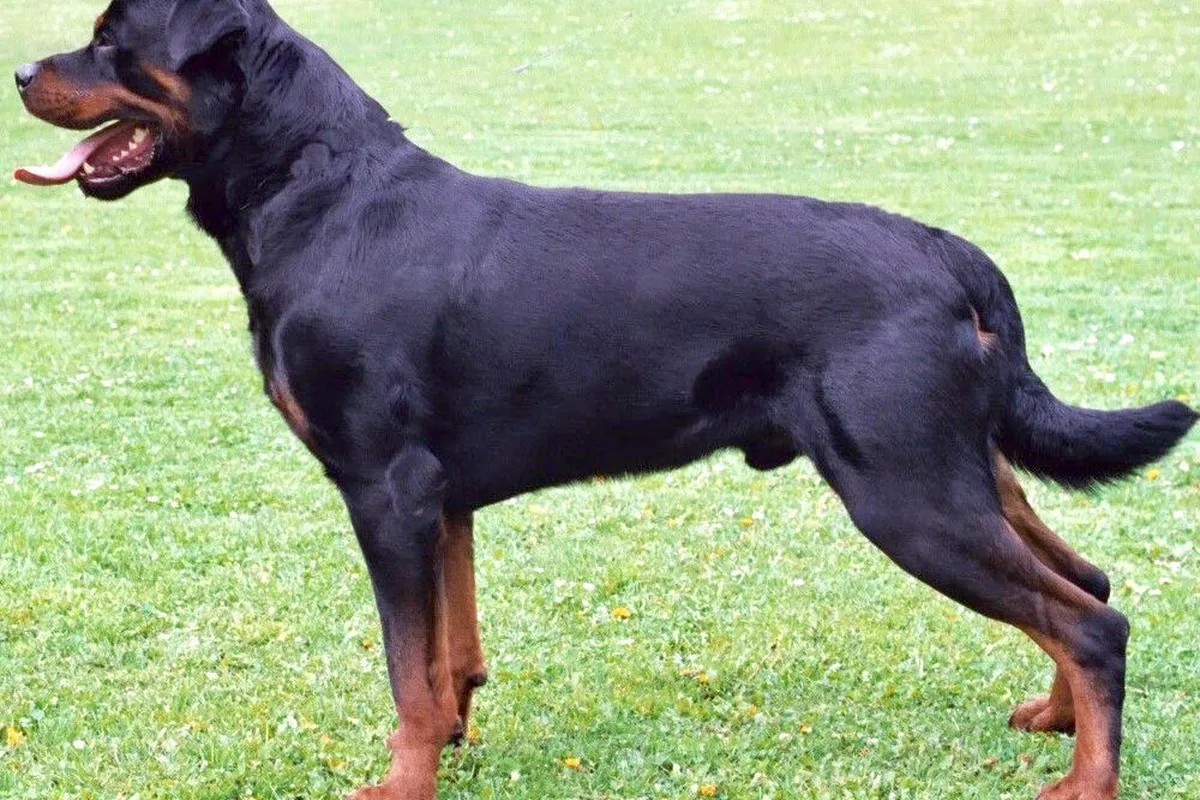
At a glance
| Trait | Detail |
|---|---|
| Origin | Germany [1] |
| Breed group | FCI group 2, section 2.1 (Molossian type, Mastiff type) [1]; AKC Working Group [2] |
| Weight | Standard: males 110 lb (50 kg), females about 93 lb (42 kg) [1]. Median adult weight in UK practices 99 lb (44.9 kg) [3] |
| Height | Males 24–27 in (61–68 cm), females 22–25 in (56–63 cm) [1] |
| Life expectancy | Median 9.0 years in UK veterinary records, 9.5 years in females and 8.7 years in males [3]; median 10.6 years in a large UK study [4] |
| Coat | Medium-length, coarse, dense top coat over an undercoat; black with rich tan markings [1] |
Origin
The Rottweiler is considered one of the oldest dog breeds, with an origin going back to Roman times. Herding dogs marched over the Alps with the Roman legions, and in the region of the town of Rottweil they mixed with local dogs. Known as the “Rottweil butcher’s dog”, the breed was used to drive and guard cattle and as a draught dog [1].
At the beginning of the 20th century it was tested for police service and was officially recognized as a police dog in 1910 [1].
Common health problems
In 2,197 Rottweilers seen in UK practices in 2013, the most common problems were aggression (7.46%), overweight or obesity (7.06%), ear inflammation (6.14%) and degenerative joint disease (4.69%). Neoplasia caused 33.0% of deaths with a known cause [3].
- Osteosarcoma (bone cancer): 0.84% of Rottweilers in UK practices had osteosarcoma in one year, with 26.67 times the odds of crossbreeds [5]. Appendicular osteosarcoma, in the limbs, was recorded in 1.14% of Rottweilers in the breed study [3].
- Other cancers: the breed is reported as predisposed to lymphoma and histiocytic sarcoma [3]. See lymphoma in dogs.
- Cruciate ligament rupture: cruciate disease affected 2.32% of Rottweilers in one year [3]. In a UK study of 1,000 cases, Rottweilers were among the breeds most predisposed to rupture of one cranial cruciate ligament [6].
- Hip and elbow dysplasia: in French screening X-rays of 7,072 Rottweilers, the share with hip dysplasia fell from 23.9% to 17% between 1997 and 2017 [7]. The Rottweiler was also one of the four breeds most affected by elbow dysplasia in French screening from 2002 to 2022 [8].
- Parvovirus enteritis: in a 1985 US study, Rottweilers had 6.0 times the risk of parvovirus enteritis [9], and a Canadian study confirmed a higher risk in Rottweilers [10]. In that study, unvaccinated dogs were 12.7 times more likely to be admitted with the disease [10].
What is special in the Rottweiler’s blood work
We found no published Rottweiler-specific reference intervals for routine blood tests. What matters more is how some common tests are read in this breed.
ALP and bone cancer. Blood alkaline phosphatase (ALP) includes a bone form. In dogs with osteosarcoma of a limb, a high ALP at diagnosis is a significant sign of shorter survival and of a shorter time before the disease returns [11]. ALP is read together with the other results: see high ALP in dogs.
Parvovirus. Given the breed’s higher risk in older studies [9, 10], parvovirus is one of the infections your vet may test for in a young Rottweiler with vomiting or diarrhea. Our parvo article explains the fecal test and what the blood count shows.
Thyroid. In UK practices, Rottweilers had 1.64 times the odds of crossbreeds of being diagnosed with hypothyroidism, a modest increase compared with the most predisposed breeds [12]. See hypothyroidism in dogs.
Screening schemes. In the UK, Rottweiler breeders are strongly advised to take part in the hip dysplasia, elbow dysplasia and eye schemes, and to test for juvenile laryngeal paralysis and polyneuropathy before breeding [3].
Related articles
En français : Rottweiler.
Questions to ask your veterinarian
- If my Rottweiler starts limping, when should we take an X-ray?
- Is the ALP on this report raised, and from bone or from the liver?
- Are my puppy’s parvovirus vaccinations complete?
- Have my dog’s hips and elbows been scored, and what do the grades mean?
- Is my dog at a healthy weight for its joints?
Get your Rottweiler’s blood work explained.
AI DiagAnimals reads the blood count, ALP and other liver values, kidney values and thyroid results together with your laboratory’s intervals, and explains them in plain language. The service opens soon: leave your email to be told first.
Frequently asked questions
How long do Rottweilers live?
In UK veterinary records the median was 9.0 years, with females living longer (9.5 years) than males (8.7 years) [3]. A larger UK study found a median of 10.6 years [4].
What do Rottweilers usually die of?
Neoplasia was the most common cause of death, at 33.0% of deaths with a known cause, ahead of inability to stand (16.0%) [3].
Are Rottweilers prone to bone cancer?
Yes. In UK practices they had 26.67 times the odds of osteosarcoma of crossbreeds, and 0.84% were diagnosed in one year [5].
Are Rottweilers more likely to get parvo?
Older North American studies found a higher risk in Rottweilers [9, 10]. Lack of vaccination was the biggest risk factor, at 12.7 times the odds [10].
What health tests should a Rottweiler have?
UK breeders are advised to use the hip, elbow and eye schemes and to test for juvenile laryngeal paralysis and polyneuropathy [3]. Your vet will advise on blood tests for your own dog.
Sources
- FCI. Standard No. 147: Rottweiler. 2018. fci.be/Nomenclature/Standards/147g02-en.pdf
- American Kennel Club. Rottweiler: dog breed information. akc.org/dog-breeds/rottweiler
- O’Neill DG et al. Rottweilers under primary veterinary care in the UK: demography, mortality and disorders. Canine Genet Epidemiol. 2017;4:13. doi.org/10.1186/s40575-017-0051-7
- McMillan KM et al. Longevity of companion dog breeds: those at risk from early death. Sci Rep. 2024;14:531 (supplementary table S3). doi.org/10.1038/s41598-023-50458-w
- O’Neill DG et al. Dog breeds and conformations predisposed to osteosarcoma in the UK: a VetCompass study. Canine Med Genet. 2023;10:8. doi.org/10.1186/s40575-023-00131-2
- Pegram C et al. Risk factors for unilateral cranial cruciate ligament rupture diagnosis and for clinical management in dogs under primary veterinary care in the UK. Vet J. 2023;292:105952. doi.org/10.1016/j.tvjl.2023.105952
- Baldinger A et al. Prevalence of canine hip dysplasia in 10 breeds in France, a retrospective study of the 1997-2017 radiographic screening period. PLoS One. 2020;15(7):e0235847. doi.org/10.1371/journal.pone.0235847
- Roels J et al. Prevalence of elbow dysplasia in 13 dog breeds in France: a retrospective radiographic study (2002-2022). Am J Vet Res. 2024;85(5). doi.org/10.2460/ajvr.23.12.0290
- Glickman LT et al. Breed-related risk factors for canine parvovirus enteritis. J Am Vet Med Assoc. 1985;187(6):589-594. pubmed.ncbi.nlm.nih.gov/3003015
- Houston DM, Ribble CS, Head LL. Risk factors associated with parvovirus enteritis in dogs: 283 cases (1982-1991). J Am Vet Med Assoc. 1996;208(4):542-546. pubmed.ncbi.nlm.nih.gov/8603904
- Boerman I et al. Prognostic factors in canine appendicular osteosarcoma: a meta-analysis. BMC Vet Res. 2012;8:56. doi.org/10.1186/1746-6148-8-56
- O’Neill DG et al. Frequency, breed predispositions and other demographic risk factors for diagnosis of hypothyroidism in dogs under primary veterinary care in the UK. Canine Med Genet. 2022;9:11. doi.org/10.1186/s40575-022-00123-8
Laboratory methods and reference intervals vary. This article explains; it does not diagnose. For a decision about your pet, use the original report and talk to your veterinarian. Our editorial policy.