
 Français
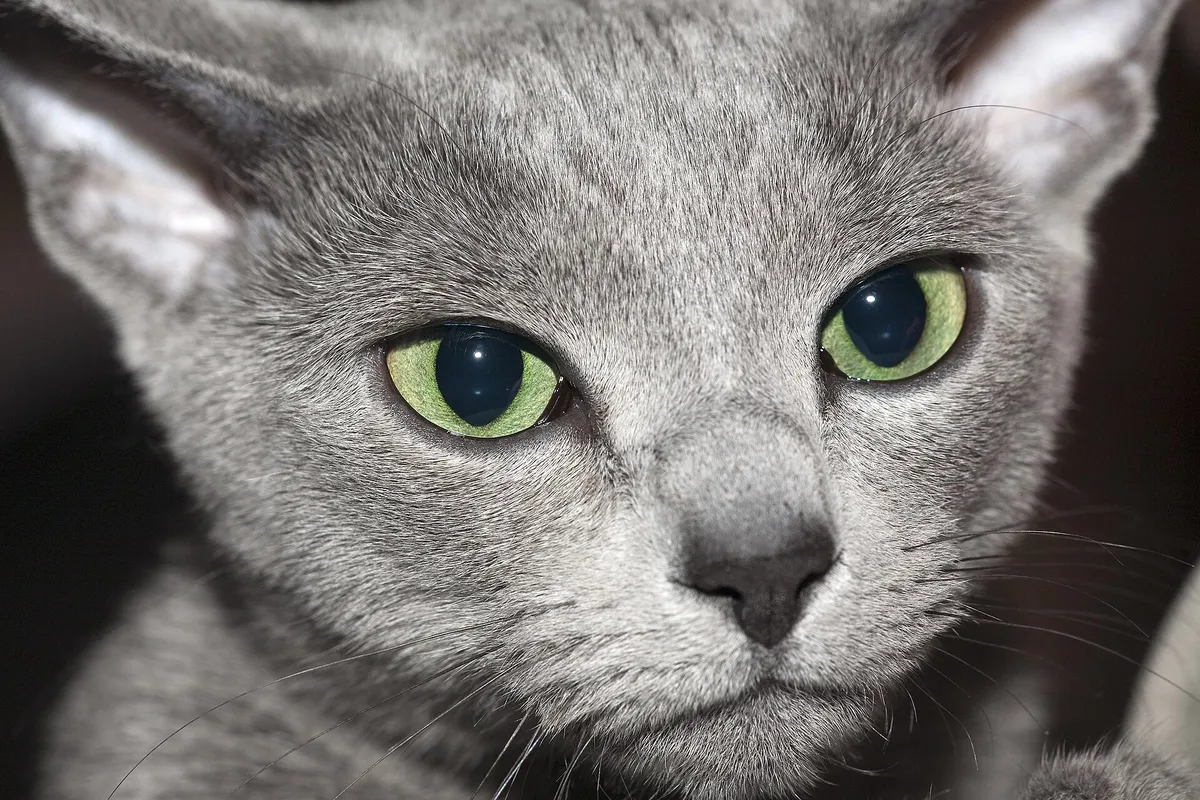
Russian Blue at a glance
| Trait | Detail |
|---|---|
| Origin | Believed to come from the Archangel Isles in northern Russia; developed in England, Scandinavia and later the United States [1] |
| Breed group | FIFe Category 4, recognized since 1949 [2] |
| Build | Medium-sized and graceful; males rarely exceed 10 lb (4.5 kg), females weigh 5–8 lb (2.3–3.6 kg) [1] |
| Life expectancy | 9.65 years at birth for Russian cats (Russian Blue and unspecified Russian) in a 2019 UK study, based on 19 deaths [3] |
| Coat | Short, dense and plush, blue with silver tips; green eyes [1] |
Origin
The Russian Blue is believed to have originated in the Archangel Isles of northern Russia, but its written history before the late 1800s is thin. Probably brought to England by sailors, these cats competed in the early English shows as “Archangel Cats,” alongside all the other solid blue cats [1].
From the early 20th century until the Second World War, Scandinavian breeders took the lead in developing the breed. After the war, breeders in the United States combined English and Scandinavian lines to produce the modern Russian Blue [1]. FIFe has recognized the breed since its foundation in 1949 [2].
Common health problems
- Diabetes mellitus: in a Swedish cohort of 504,688 insured cats, Russian Blues had 44.1 new cases per 10,000 cat-years, against 12.1 in domestic cats; their incidence rate ratio was 3.8 compared with all other cats, and the higher risk remained after adjusting for age [4]. See diabetes in cats.
- Weight gain: the breed has large appetites and, without regular interactive exercise, is at risk of obesity [1]. In the UK life-table study, cats with a non-ideal body weight had a shorter lifespan [3].
- REM sleep behavior disorder with urinary retention: five young adult Russian Blues from two related families had worsening episodes of movement during sleep, often with loss of urine; three also had urinary retention with overflow incontinence, and two had dilated pupils that did not react to light. The disease is recessive and linked to a FAM8A1 variant, found at an allele frequency of 1.5% in 68 West European Russian Blues [5].
- Few other documented problems: the breed is not known to have specific genetic problems, although a small gene pool has been raised as a concern [1].
Tests and screening in Russian Blues
- Glucose and fructosamine: because of the breed’s higher diabetes risk [4], glucose results deserve careful reading. See blood sugar in cats for why stress can raise glucose and how fructosamine helps tell stress from diabetes.
- Body weight: worth tracking in a breed prone to obesity, as a non-ideal body weight was linked to a shorter lifespan [1, 3].
- DNA test for FAM8A1: a genetic test now allows the sleep disorder and urinary retention syndrome to be diagnosed and prevented [5]. For what a urine test shows, see urinalysis for dogs and cats.
- Blood type: data are scarce. In a German genotyping survey, all 6 Russian Blues had the A/A genotype (type A) [7]; in an older study gathered in a 2021 review, 1 of 5 Russian Blues was type B [6]. Typing before a transfusion matters in every cat [6].
- PK deficiency: none of 14 Russian Blues tested carried the pyruvate kinase deficiency variant [8].
- Routine blood panels: read like those of any adult cat. See cat blood work explained and kidney disease in cats.
Related articles
En français : Bleu russe.
Questions to ask your veterinarian
- Is my Russian Blue at a healthy weight, and how should we track it?
- Should my cat’s glucose or fructosamine be checked, given the breed’s diabetes risk?
- If my cat’s glucose is high, how do we tell stress from diabetes?
- Has my cat, or its parents, been tested for the FAM8A1 variant?
- Do we know my cat’s blood type?
Get your Russian Blue’s blood work explained.
AI DiagAnimals reads glucose, fructosamine, kidney values and the urinalysis with your laboratory’s intervals, compares them with earlier results and prepares the questions for your vet. The service opens soon: leave your email to be told first.
Frequently asked questions
How long do Russian Blue cats live?
In a UK study of cats that died in 2019, Russian cats (mostly Russian Blues) had a life expectancy at birth of 9.65 years, against 11.74 years for all cats; the figure rests on only 19 deaths, so it is uncertain [3].
Are Russian Blues prone to diabetes?
In Swedish insurance data, Russian Blues had nearly four times the diabetes incidence of other cats, the second-highest after the Burmese [4].
What health problems do Russian Blues have?
The breed is not known for many inherited diseases; a higher risk of diabetes, a tendency to obesity and a rare FAM8A1 sleep and urinary disorder are documented [1, 4, 5].
What tests should a Russian Blue have?
Regular weight checks, attention to glucose results and, for breeding cats, the FAM8A1 DNA test are the checks most relevant to the breed [1, 4, 5].
Why might a Russian Blue have trouble urinating?
Urinary problems have many causes in cats. In one inherited disorder of Russian Blues, affected young adults had urinary retention with overflow incontinence and episodes of movement during sleep [5].
Sources
- The Cat Fanciers’ Association. Russian Blue: breed profile. cfa.org/breed/russian-blue
- Fédération Internationale Féline. Breeds and standards. fifeweb.org/cats/breeds
- Teng KT et al. Life tables of annual life expectancy and risk factors for mortality in cats in the UK. J Feline Med Surg. 2024;26(5):1098612X241234556. doi.org/10.1177/1098612X241234556
- Öhlund M et al. Incidence of diabetes mellitus in insured Swedish cats in relation to age, breed and sex. J Vet Intern Med. 2015;29(5):1342-1347. doi.org/10.1111/jvim.13584
- Stee K et al. A FAM8A1 frameshift variant is associated with REM sleep behavior disorder, urinary retention, and mydriasis in Russian Blue cats. Anim Genet. 2025;56(3):e70013. doi.org/10.1111/age.70013
- Gavazza A et al. Feline blood groups: a systematic review of phylogenetic and geographical origin. Animals (Basel). 2021;11(12):3339. doi.org/10.3390/ani11123339
- Kehl A et al. CMAH genotyping survey for blood types A, B and C (AB) in purpose-bred cats. Anim Genet. 2019;50(3):303-306. doi.org/10.1111/age.12778
- Grahn RA et al. Erythrocyte pyruvate kinase deficiency mutation identified in multiple breeds of domestic cats. BMC Vet Res. 2012;8:207. doi.org/10.1186/1746-6148-8-207
Laboratory methods and reference intervals vary. This article explains; it does not diagnose. For a decision about your pet, use the original report and talk to your veterinarian. Our editorial policy.