
 Français
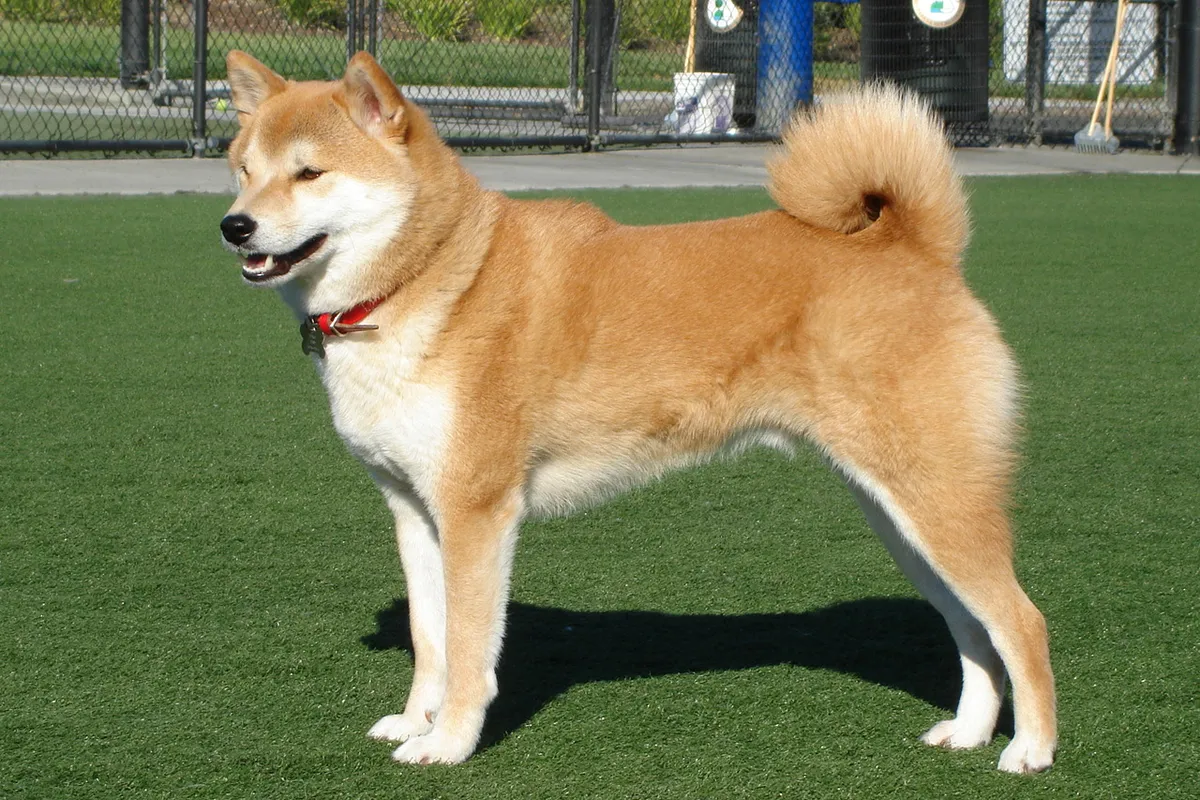
At a glance
| Trait | Detail |
|---|---|
| Origin | Japan [1] |
| Breed group | FCI Group 5 (Spitz and primitive types), section 5, Asian Spitz and related breeds; AKC Non-Sporting Group [1, 2] |
| Weight | About 23 lb (10.4 kg) for males and 17 lb (7.7 kg) for females [2] |
| Height | Males 15.5 in (39.5 cm), females 14.5 in (36.5 cm), with a tolerance of 0.6 in (1.5 cm) [1] |
| Life expectancy | Median 14.6 years in a 2024 UK study, based on only 91 deaths [3]; 15.5 years at birth in a Japanese study, the longest of the breeds analyzed [4] |
| Coat | Harsh, straight outer coat and soft, dense undercoat; red, black and tan, sesame, black sesame or red sesame, always with “urajiro”, whitish hair on the cheeks, underside and inside of the legs [1] |
Origin
The Shiba has been native to Japan since ancient times; “shiba” originally meant something small. It hunted small game and birds in the mountains facing the Sea of Japan. After English Setters and Pointers were imported between 1868 and 1912, crossbreeding made pure Shibas rare. Preservation began around 1928, the breed standard was unified in 1934, and in 1937 the Shiba was designated a “natural monument” [1].
It is now the most popular companion dog in Japan [2].
Common health problems
- Atopic dermatitis: the Shiba Inu is a breed predisposed to canine atopic dermatitis, an allergic skin disease [6]. See eosinophils in dogs and cats for one blood value linked to allergy.
- Glaucoma: Shibas have the highest incidence of glaucoma in Japan, attributed to a high rate of abnormal or narrow drainage angles in the eye, seen even in eyes without glaucoma [7]. In 109 Shibas, a variant of the SIX6 gene was associated with glaucoma (odds ratio 3.56) [7]. In a 2026 survey of 105 Japanese veterinarians practicing ophthalmology, respondents reported glaucoma as a prevalent condition in Shiba Inus [8].
- GM1 gangliosidosis: a fatal inherited storage disease of the nervous system. In Japan, 6 of 590 healthy Shibas (1.02%) were carriers, and 23 affected dogs were identified between 1997 and 2013, all closely related where pedigrees were available [12].
- A long life: in Japanese pet cemetery data, senility was the most common cause of death, Shibas had higher odds of dying of senility, and lower odds of dying of urinary system diseases, than other breeds [5]. See kidney disease in dogs.
What is special in the Shiba’s blood work
The Shiba’s best-documented lab quirk lies in its red blood cells. Most dogs have red cells low in potassium, but 11 of 24 Shibas in a Japanese study had red cells high in potassium and low in sodium, with about five times more glutathione. None of 79 dogs of 24 other breeds had them [9].
How common. This high-potassium red-cell type is inherited as an autosomal recessive trait. It was found in 26% to 38% of dogs in two Japanese Shiba populations and in the Akita, and also in Korean breeds such as the Jindo [10].
Falsely high potassium. Japanese and other Asian breeds such as the Akita and the Shiba Inu have high potassium in their red cells, so potassium leaks into the serum if the sample is not separated from the cells in time or is hemolyzed, giving a falsely high result [11]. A high potassium in a Shiba is therefore read together with the sample’s handling and any hemolysis. See potassium in dogs and cats and CBC for dogs.
GM1 DNA test. A genotyping test identifies carriers of GM1 gangliosidosis, and the authors of the Japanese survey recommend testing as many breeding dogs as possible [12].
Eye pressure and angles. Because the breed’s glaucoma is linked to narrow drainage angles [7], an eye examination by an ophthalmologist may include gonioscopy, used by 69% of the Japanese specialists surveyed [8].
Related articles
En français : Shiba inu.
Questions to ask your veterinarian
- Could my Shiba’s high potassium come from the sample rather than from disease?
- Was the blood sample hemolyzed, or left long before the serum was separated?
- Should my Shiba’s eye pressure be checked regularly, given the breed’s risk of glaucoma?
- Are my dog’s itching and ear problems signs of atopic dermatitis?
- Have my dog’s parents been DNA-tested for GM1 gangliosidosis?
Get your Shiba’s blood work explained.
AI DiagAnimals reads the blood count, electrolytes including potassium, and the chemistry panel together with your laboratory’s intervals, and flags the results that can be skewed in Shibas. The service opens soon: leave your email to be told first.
Frequently asked questions
How long do Shiba Inus live?
A 2024 UK study found a median lifespan of 14.6 years, from a small number of deaths [3]. In Japan, Shibas had the longest life expectancy of the breeds studied: 15.5 years at birth [4].
What health problems do Shiba Inus have?
The breed is predisposed to atopic dermatitis [6] and has the highest incidence of glaucoma in Japan [7]. GM1 gangliosidosis is a rare, fatal inherited disease of the breed [12].
Why is my Shiba’s potassium high on a blood test?
Many Shibas have red cells rich in potassium [9, 10]. If the sample is hemolyzed or the serum is not separated in time, potassium leaks out and the result can be falsely high [11].
Are Shiba Inus prone to glaucoma?
Yes. In Japan the breed has the highest incidence of glaucoma, linked to narrow drainage angles in the eye [7].
What DNA test should a Shiba Inu have?
A genotyping test identifies carriers of GM1 gangliosidosis; about 1% of healthy Shibas tested in Japan were carriers [12].
Sources
- FCI. Standard No. 257: Shiba. 2017. fci.be/Nomenclature/Standards/257g05-en.pdf
- American Kennel Club. Shiba Inu: dog breed information. akc.org/dog-breeds/shiba-inu
- McMillan KM et al. Longevity of companion dog breeds: those at risk from early death. Sci Rep. 2024;14:531 (supplementary Table S3). doi.org/10.1038/s41598-023-50458-w
- Inoue M et al. Estimating the life expectancy of companion dogs in Japan using pet cemetery data. J Vet Med Sci. 2018;80(7):1153-1158. doi.org/10.1292/jvms.17-0384
- Inoue M et al. Identifying causes of death of companion dogs in Japan using data from pet cemeteries. J Vet Med Sci. 2021;83(7):1039-1043. doi.org/10.1292/jvms.21-0171
- Thomsen M et al. A comprehensive analysis of gut and skin microbiota in canine atopic dermatitis in Shiba Inu dogs. Microbiome. 2023;11:232. doi.org/10.1186/s40168-023-01671-2
- Baba S et al. Genetic link across species: SIX6, a major human glaucoma gene, confers susceptibility to glaucoma in Shiba-Inu dogs. Invest Ophthalmol Vis Sci. 2026;67(1):5. doi.org/10.1167/iovs.67.1.5
- Caballero V et al. Common ophthalmic conditions in popular dog breeds in Japan: insights from a survey of 105 veterinarians practicing ophthalmology. Vet Ophthalmol. 2026;29(4):e70203. doi.org/10.1111/vop.70203
- Maede Y et al. Hereditary high-potassium erythrocytes with high Na, K-ATPase activity in Japanese shiba dogs. Res Vet Sci. 1991;50(1):123-125. doi.org/10.1016/0034-5288(91)90067-x
- Fujise H et al. Incidence of dogs possessing red blood cells with high K in Japan and East Asia. J Vet Med Sci. 1997;59(6):495-497. doi.org/10.1292/jvms.59.495
- eClinPath, Cornell University College of Veterinary Medicine. Potassium. eclinpath.com/chemistry/electrolytes/potassium
- Uddin MM et al. Molecular epidemiology of canine GM1 gangliosidosis in the Shiba Inu breed in Japan: relationship between regional prevalence and carrier frequency. BMC Vet Res. 2013;9:132. doi.org/10.1186/1746-6148-9-132
Laboratory methods and reference intervals vary. This article explains; it does not diagnose. For a decision about your pet, use the original report and talk to your veterinarian. Our editorial policy.