
 Français
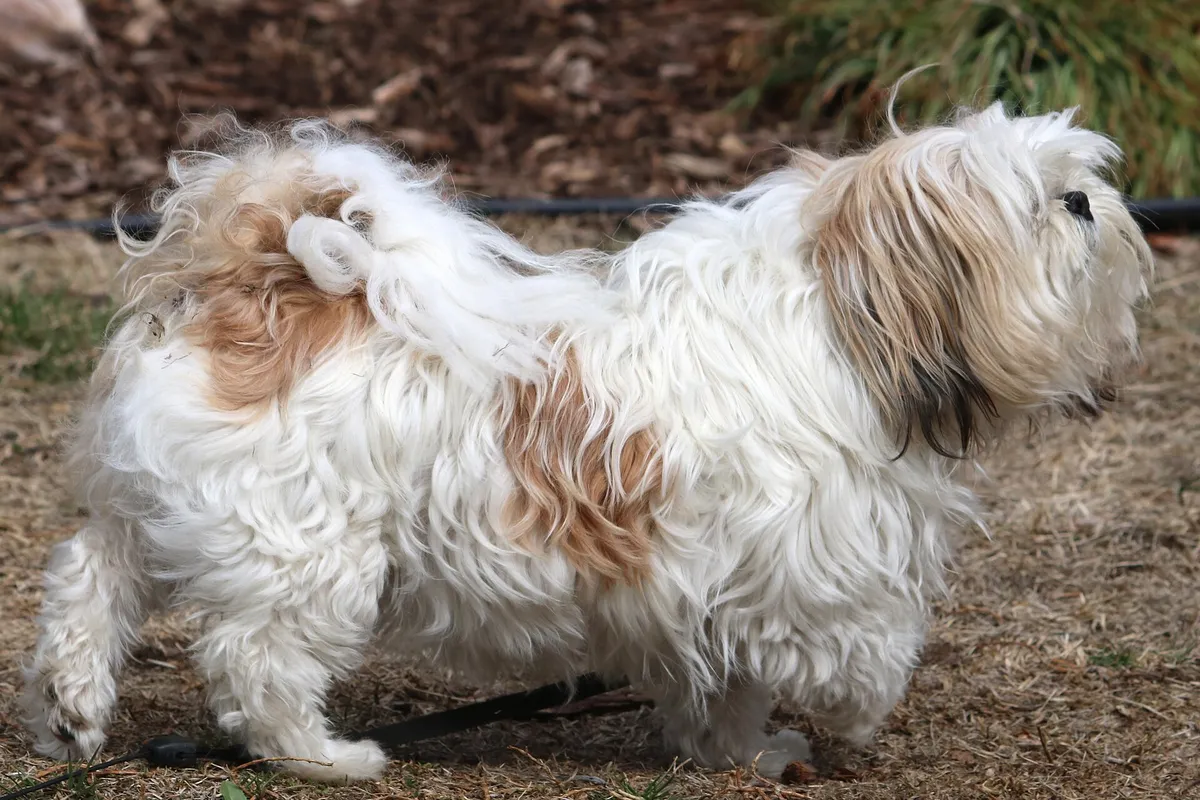
At a glance
| Trait | Detail |
|---|---|
| Origin | Tibet (China), with Great Britain as patron country of the standard [1] |
| Breed group | FCI group 9, section 5 (Tibetan breeds) [1] |
| Weight | 10–18 lb (4.5–8 kg) in the standard [1]; mean adult weight in UK practices 17.4 lb (7.9 kg) [2] |
| Height | Not more than 10.6 in (27 cm) at the withers [1] |
| Life expectancy | Median 12.8 years in a large UK study [3]; median age at death 12.7 years in UK veterinary records [2] |
| Coat | Long, dense outer coat with a moderate undercoat; all colours except merle [1] |
Origin
The breed has its roots in Tibet but was developed in China, where dogs like these lived in the imperial palaces. After China became a republic in 1912, Shih Tzus reached the West; the first recorded import to Britain was in 1931, the breed was recognised as separate from other Oriental breeds in 1934 and given its own Kennel Club register in 1940 [1].
Common health problems
- Teeth, anal sacs and ears: among 2,423 UK Shih Tzus followed for a year, periodontal disease affected 9.5%, anal sac impaction 7.4% and ear disorders 5.5% [2].
- Eyes: eye disorders as a group affected 11.9% of Shih Tzus in a year [2]. In English practices, 3.45% of Shih Tzus had a corneal ulcer, one of the highest rates of any breed; flat-faced breeds had 11.18 times the odds of crossbreeds [4]. Dry eye (keratoconjunctivitis sicca) was recorded in 1.2% [2].
- Breathing (BOAS): in a UK study using respiratory function grading in 14 flat-faced breeds, the Shih Tzu was in the moderate-risk group, with 25–50% of dogs free of signs. Overweight Shih Tzus had 5 times the odds of BOAS [5].
- Bladder stones: in a German series, 62.2% of Shih Tzu stones were struvite [6]. In Ireland, Shih Tzus were more likely to have compound stones (odds ratio 1.7) [7]. See bladder stones in dogs and urinary tract infection.
- Umbilical hernia: recorded in 3.9% of Shih Tzus, usually diagnosed young (median age 1.4 years) [2].
- Causes of death: the most common recorded causes were gut disease, heart disease and poor quality of life (7.9% each) [2]. See heart failure in dogs.
What is special in the Shih Tzu’s blood work
No known breed-specific values. We found no published Shih Tzu reference intervals or blood-count quirks, so results are read against the usual dog intervals.
Thyroid. In UK primary care, the Shih Tzu was one of the breeds least likely to be diagnosed with hypothyroidism (odds ratio 0.38 compared with crossbreeds) [8]. A low T4 in a Shih Tzu therefore deserves careful confirmation. See hypothyroidism in dogs.
Urine. Because struvite and compound stones are common in the breed [6, 7], a urinalysis with sediment is useful when there are urinary signs.
Screening. The respiratory function grading used in research assesses breathing before and after exercise and was adapted for the Shih Tzu [5]. Body condition is part of that picture, since overweight raised the odds of BOAS [5].
Related articles
En français : Shih tzu.
Questions to ask your veterinarian
- Does my dog’s breathing at rest and after exercise suggest BOAS?
- Is my Shih Tzu at a healthy weight for its breathing?
- Does the urinalysis show crystals or bacteria, and should we check for stones?
- Are my dog’s eyes producing enough tears, and are the corneas healthy?
- If the T4 is low, what other tests confirm hypothyroidism?
Get your Shih Tzu’s blood and urine tests explained.
AI DiagAnimals reads the blood count, chemistry, thyroid values and urinalysis together with your laboratory’s intervals, and prepares the questions for your vet. The service opens soon: leave your email to be told first.
Frequently asked questions
How long do Shih Tzus live?
A large UK study found a median lifespan of 12.8 years [3]. In UK veterinary records, the median age at death was 12.7 years, with some dogs living past 19 [2].
What health problems do Shih Tzus have?
The most common are dental disease, anal sac impaction, ear disorders and eye problems [2]. The breed is also prone to corneal ulcers, breathing problems and bladder stones [4, 5, 6].
Do Shih Tzus have breathing problems?
Some do. In a UK study, the Shih Tzu was at moderate risk of BOAS, and overweight dogs had 5 times the odds [5].
Sources
- FCI. Standard No. 208: Shih Tzu. 2026. fci.be/Nomenclature/Standards/208g09-en.pdf
- Dale F et al. Demography, common disorders and mortality of Shih Tzu dogs under primary veterinary care in the UK. Canine Med Genet. 2024;11:2. doi.org/10.1186/s40575-023-00135-y
- McMillan KM et al. Longevity of companion dog breeds: those at risk from early death. Sci Rep. 2024;14:531 (supplementary table S3). doi.org/10.1038/s41598-023-50458-w
- O’Neill DG et al. Corneal ulcerative disease in dogs under primary veterinary care in England: epidemiology and clinical management. Canine Genet Epidemiol. 2017;4:5. doi.org/10.1186/s40575-017-0045-5
- Tomlinson F et al. A cross-sectional study into the prevalence and conformational risk factors of BOAS across fourteen brachycephalic dog breeds. PLoS One. 2026;21(2):e0340604. doi.org/10.1371/journal.pone.0340604
- Breu D et al. Occurrence of uroliths: age-, breed- and gender-specific differences in dogs from Germany (in German). Tierarztl Prax Ausg K Kleintiere Heimtiere. 2021;49(1):6-12. doi.org/10.1055/a-1334-0733
- Stavroulaki EM et al. Trends in urolith composition and factors associated with different urolith types in dogs from the Republic of Ireland and Northern Ireland between 2010 and 2020. J Small Anim Pract. 2024;65(1):30-38. doi.org/10.1111/jsap.13676
- O’Neill DG et al. Frequency, breed predispositions and other demographic risk factors for diagnosis of hypothyroidism in dogs under primary veterinary care in the UK. Canine Med Genet. 2022;9:11. doi.org/10.1186/s40575-022-00123-8
Laboratory methods and reference intervals vary. This article explains; it does not diagnose. For a decision about your pet, use the original report and talk to your veterinarian. Our editorial policy.