
 Français
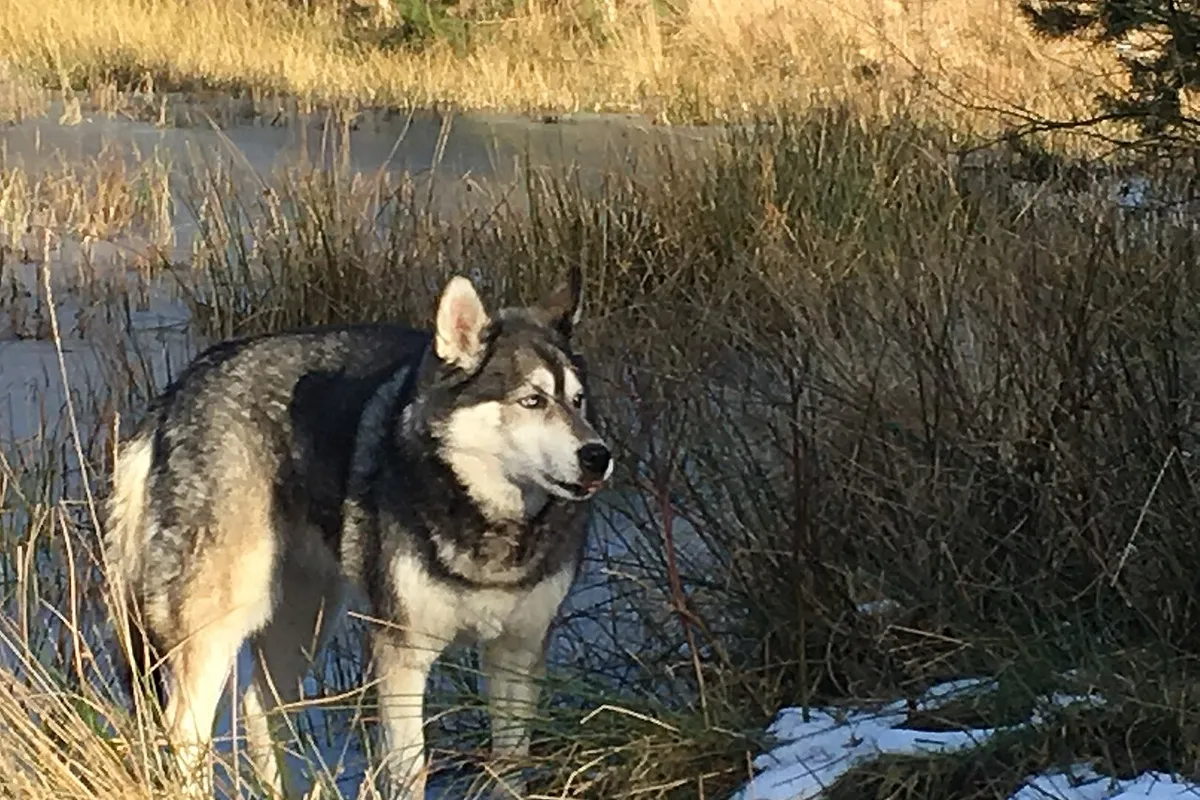
At a glance
| Trait | Detail |
|---|---|
| Origin | United States, from sled dogs brought from Siberia to Alaska from 1908 [1, 5] |
| Breed group | FCI Group 5 (Spitz and primitive types), section 1, Nordic sledge dogs; AKC Working Group [1, 2] |
| Weight | Males 45–62 lb (20.5–28 kg), females 34–51 lb (15.5–23 kg) [1] |
| Height | Males 21–23.5 in (53.5–60 cm), females 20–22 in (50.5–56 cm) [1] |
| Life expectancy | Median 11.9 years in a 2024 UK study [3]; 9.5 years at birth in UK life tables, from a small sample of Huskies [4] |
| Coat | Double and medium length, with a soft, dense undercoat; colors from black to pure white, merle and brindle excluded [1] |
Origin
The first team of these Siberian sled dogs reached Nome, Alaska, in 1908, imported by the fur trader William Goosak for the 408-mile All Alaska Sweepstakes race. Smaller than their rivals, they placed third in 1909. In 1910, teams built from about 60 dogs brought from the Anadyr River area of Siberia took first and second place [5].
In January 1925, during a diphtheria epidemic, Leonhard Seppala’s Siberians, led by Togo, carried the serum across Norton Sound in a blizzard as part of a dog-team relay to Nome; a team led by Balto completed the last leg [5]. The FCI lists the United States as the breed’s country of origin [1].
Common health problems
- Eye disease: hereditary (juvenile) cataract, corneal dystrophy and progressive retinal atrophy are the three inherited eye diseases of current concern in the breed [6].
- Cataract: in four US university hospitals, Huskies seen for cataracts were on average 3.5 years old, against 9.5 years for other breeds. Their cataracts were more often hereditary (84% against 52%) and less often caused by diabetes (16% against 48%) [9]. See diabetes in dogs.
- Corneal dystrophy: a hazy or crystalline opacity of the cornea caused by fat deposits, usually seen in young adults; vision is seldom affected [6].
- Progressive retinal atrophy: an X-linked form of PRA (XLPRA1), caused by a mutation in the RPGR gene, occurs in the Siberian Husky and the Samoyed [10].
- Zinc-responsive dermatosis: in 41 dogs with this skin disease, the Siberian Husky was the predominant breed. Crusts around the eyes were the most common sign [8].
- Hypothyroidism: in UK practices, Huskies had 2.53 times the odds of crossbred dogs [11]. See hypothyroidism in dogs.
What is special in the Husky’s blood work
We found no published breed-specific reference intervals for routine blood values in adult Siberian Huskies. One quirk is well documented in puppies.
High ALP in puppies. In a colony of Siberian Huskies, 17 of 42 puppies from 8 related litters had a markedly high serum alkaline phosphatase, on average over 5 times that of unaffected littermates at 11 and 16 weeks of age. The excess came from bone, and the puppies had no other abnormality: a benign, familial trait [12]. See high ALP in dogs.
Thyroid. The breed is predisposed to hypothyroidism [11], so thyroid results are worth discussing with your vet when signs fit. See hypothyroidism in dogs.
Skin. Zinc-responsive dermatosis was confirmed by skin biopsy, which showed parakeratosis in every dog of the series [8].
Screening. The Siberian Husky Club of America asks breeders for a yearly eye examination by a board-certified ophthalmologist from 12 months of age, a hip evaluation, and DNA tests for shaking puppy syndrome type 1 (SPS1) and Siberian Husky polyneuropathy type 1 (SHPN1) in breeding dogs [7].
Related articles
En français : Husky sibérien.
Questions to ask your veterinarian
- Is my puppy’s high ALP likely to be the harmless family trait described in Huskies?
- Should my Husky have a yearly eye examination by a veterinary ophthalmologist?
- Is this cloudy eye a cataract or corneal dystrophy, and does it affect vision?
- Could my dog’s crusts around the eyes be zinc-responsive dermatosis, and is a skin biopsy needed?
- Should we test the thyroid, given the breed’s predisposition to hypothyroidism?
Get your Husky’s blood work explained.
AI DiagAnimals reads the blood count, ALP and other liver values, glucose and thyroid results together with your laboratory’s intervals, and explains them in the light of the Husky’s known health issues. The service opens soon: leave your email to be told first.
Frequently asked questions
How long do Siberian Huskies live?
A large 2024 UK study found a median lifespan of 11.9 years [3]. UK life tables, based on a small number of Huskies, gave 9.5 years at birth [4].
What health problems do Siberian Huskies have?
Inherited eye disease (cataract, corneal dystrophy and PRA) is the main concern of the breed club [6]. Huskies were also the predominant breed in a series of 41 dogs with zinc-responsive dermatosis [8] and are predisposed to hypothyroidism [11].
Do Huskies get cataracts young?
Yes. Huskies seen for cataracts in US university hospitals were on average 3.5 years old, and most of their cataracts were hereditary [9].
Why is my Husky puppy’s ALP so high?
In some Husky families, puppies have a very high bone ALP with no illness, a benign familial trait [12]. Your vet will still look at the other results and the puppy’s health.
What health tests should a Siberian Husky have?
The US breed club asks for a yearly eye examination from 12 months, a hip evaluation, and DNA tests for SPS1 and SHPN1 in breeding dogs [7].
Sources
- FCI. Standard No. 270: Siberian Husky. 2022. fci.be/Nomenclature/Standards/270g05-en.pdf
- American Kennel Club. Siberian Husky: dog breed information. akc.org/dog-breeds/siberian-husky
- McMillan KM et al. Longevity of companion dog breeds: those at risk from early death. Sci Rep. 2024;14:531 (supplementary Table S3). doi.org/10.1038/s41598-023-50458-w
- Teng KT et al. Life tables of annual life expectancy and mortality for companion dogs in the United Kingdom. Sci Rep. 2022;12:6415. doi.org/10.1038/s41598-022-10341-6
- Siberian Husky Club of America. Siberian Husky history. shca.org/siberian-husky-history
- Siberian Husky Club of America. Genetic defects of the eye. shca.org/eye-testing
- Siberian Husky Club of America. Health statement. 2024. shca.org/health
- White SD et al. Zinc-responsive dermatosis in dogs: 41 cases and literature review. Vet Dermatol. 2001;12(2):101-109. doi.org/10.1046/j.1365-3164.2001.00233.x
- Uhl LK et al. Cataracts and phacoemulsification in the Siberian Husky: a retrospective and multicentric study (2008-2018). Vet Ophthalmol. 2021;24(3):252-264. doi.org/10.1111/vop.12883
- Zangerl B et al. Independent origin and restricted distribution of RPGR deletions causing XLPRA. J Hered. 2007;98(5):526-530. doi.org/10.1093/jhered/esm060
- O’Neill DG et al. Frequency, breed predispositions and other demographic risk factors for diagnosis of hypothyroidism in dogs under primary veterinary care in the UK. Canine Med Genet. 2022;9:11. doi.org/10.1186/s40575-022-00123-8
- Lawler DF et al. Benign familial hyperphosphatasemia in Siberian huskies. Am J Vet Res. 1996;57(5):612-617. pubmed.ncbi.nlm.nih.gov/8723869
Laboratory methods and reference intervals vary. This article explains; it does not diagnose. For a decision about your pet, use the original report and talk to your veterinarian. Our editorial policy.