
 Français
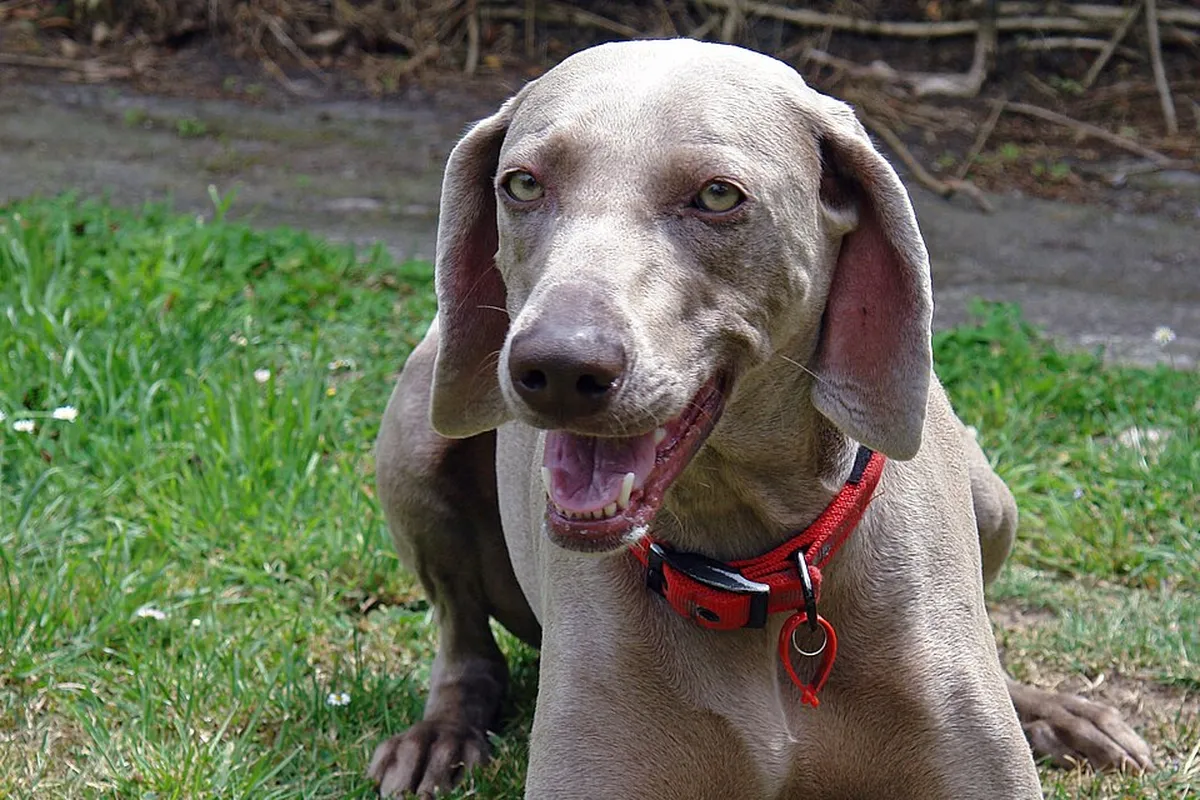
At a glance
| Trait | Detail |
|---|---|
| Origin | Germany [1] |
| Breed group | FCI group 7, section 1.1 (continental pointing dogs, braque type) [1]; AKC Sporting Group [2] |
| Weight | Males about 66–88 lb (30–40 kg), females about 55–77 lb (25–35 kg) [1] |
| Height | Males 23–27.5 in (59–70 cm), females 22.5–25.5 in (57–65 cm) [1] |
| Life expectancy | Median 12.8 years in a large UK study [3] |
| Coat | Short-haired or long-haired; silver, roe or mouse grey and shades of these colors [1] |
Origin
The Weimaraner was already kept at the court of Weimar in the first third of the 19th century. It was bred mainly by professional hunters and gamekeepers in central Germany, around Weimar and in Thuringia, and has been bred to a plan since about 1890 [1].
Pure-bred since 1900 and mostly free of crosses with other breeds, it is probably the oldest German pointing breed. It is a versatile hunting dog for work in field, wood and water. A long-haired variety has existed alongside the short-haired one since the turn of the 20th century [1].
Common health problems
- Lipomas: in UK primary care, 7.84% of Weimaraners were diagnosed with a lipoma (a benign fatty lump) in one year, the highest prevalence of all breeds; dogs heavier than their breed and sex average had higher odds [5]. In the 2014 Kennel Club survey of 372 live Weimaraners, lipoma was reported in 17.47%, again the highest of the 41 breeds analysed, followed by skin cysts (5.38%) [4].
- Bloat (gastric dilatation-volvulus, GDV): the Weimaraner was among the breeds at greatest risk of GDV in a survey of UK pedigree dogs [6]. It was one of 11 large and giant breeds followed in a US study, in which 5.7% of all dogs developed GDV over the study period and 28.6% of those that did died [7].
- Hypertrophic osteodystrophy (HOD): in 53 Weimaraner puppies with HOD, signs included fever, lethargy and bone pain, sometimes with digestive, eye or skin signs. More than half (52.8%) had affected littermates, and all had been vaccinated 1 to 30 days before the onset. Of the 33 dogs followed to adulthood, 84.8% were healthy [8].
- Low immunoglobulins: 25 young Weimaraners (median age 4 months) with recurrent infections or inflammatory disease all had low levels of one or more classes of antibodies (IgG, IgM or IgA). Of 10 with a full vaccination history, 9 had fallen ill within 5 days of a vaccination [9].
- Inflammatory bowel disease: at a UK referral hospital, Weimaraners had 3.7 times the odds of inflammatory bowel disease compared with mixed-breed dogs [11]. See chronic diarrhea in dogs.
- Steroid-responsive meningitis-arteritis (SRMA): Weimaraners had higher odds of SRMA in a UK study of dogs up to 2 years old, although with only 2 affected dogs [10].
What is special in the Weimaraner’s tests
- An inflammatory blood count in HOD. In 52 Weimaraners with HOD that had a blood count, 32 had a high white cell count, 31 a monocytosis, 21 a neutrophilia with a left shift and 26 a mild non-regenerative anemia. Of 26 dogs with a chemistry panel, 20 had a high ALP, 11 a low albumin and 13 a low creatinine [8]. A high ALP is also normal in growing puppies [8]. See white blood cell count in dogs and high ALP in dogs.
- Measuring immunoglobulins. In the 25 young Weimaraners with recurrent illness, the mean IgG concentration was significantly lower than in 15 healthy Weimaraners [9]. In these dogs, IgG, IgM and IgA were each measured. See albumin and globulin in dogs.
- Urate DNA test. The hyperuricosuria mutation, which predisposes dogs to urate bladder stones, has been found in Weimaraners. A DNA test is available, and vets can also use it to find the cause of urate stones [12]. See bladder stones in dogs.
- SRMA. There is no single blood test for SRMA: the diagnosis rests on the signs, laboratory findings including a spinal fluid sample, and the exclusion of other diseases [10].
For routine results, our guide to the blood count explains what each value means.
Related articles
En français : Braque de Weimar.
Questions to ask your veterinarian
- Is my dog at risk of bloat, and what signs should make me call at once?
- My puppy has a fever and painful legs after a vaccination: could it be HOD?
- Should my young dog’s immunoglobulins be measured, given the recurrent infections?
- Has my dog, or have its parents, been DNA-tested for hyperuricosuria?
- Should this lump be sampled to check it is a lipoma?
Get your Weimaraner’s blood work explained.
AI DiagAnimals reads the blood count, ALP, albumin, globulins and urine results together with your laboratory’s intervals, and explains them in plain language. The service opens soon: leave your email to be told first.
Frequently asked questions
How long do Weimaraners live?
A large UK study found a median lifespan of 12.8 years [3].
What health problems do Weimaraners have?
Lipomas are very common in the breed [4, 5]. Weimaraners are also at high risk of bloat [6] and of inflammatory bowel disease [11], and puppies can develop hypertrophic osteodystrophy [8] or low immunoglobulins [9].
Are Weimaraners prone to bloat?
Yes. The breed was among those at greatest risk of gastric dilatation-volvulus in a UK survey of pedigree dogs [6].
Do Weimaraner puppies react to vaccines?
In 53 puppies with hypertrophic osteodystrophy, all had been vaccinated 1 to 30 days before the illness began [8], and in young Weimaraners with low immunoglobulins, most fell ill within days of a vaccination [9]. These studies show a timing link, not proof that the vaccine is the cause.
What blood tests show HOD in a Weimaraner?
Most affected puppies have a high white cell count with monocytes and neutrophils, often a mild anemia, and often a high ALP. X-rays confirm the diagnosis [8].
Sources
- FCI. Standard No. 99: Weimaraner. 2015. fci.be/Nomenclature/Standards/099g07-en.pdf
- American Kennel Club. Weimaraner: dog breed information. akc.org/dog-breeds/weimaraner
- McMillan KM et al. Longevity of companion dog breeds: those at risk from early death. Sci Rep. 2024;14:531 (supplementary table S3). doi.org/10.1038/s41598-023-50458-w
- Wiles BM et al. Large-scale survey to estimate the prevalence of disorders for 192 Kennel Club registered breeds. Canine Genet Epidemiol. 2017;4:8 (additional file 4). doi.org/10.1186/s40575-017-0047-3
- O’Neill DG et al. Lipoma in dogs under primary veterinary care in the UK: prevalence and breed associations. Canine Genet Epidemiol. 2018;5:9. doi.org/10.1186/s40575-018-0065-9
- Evans KM, Adams VJ. Mortality and morbidity due to gastric dilatation-volvulus syndrome in pedigree dogs in the UK. J Small Anim Pract. 2010;51(7):376-381. doi.org/10.1111/j.1748-5827.2010.00949.x
- Glickman LT et al. Incidence of and breed-related risk factors for gastric dilatation-volvulus in dogs. J Am Vet Med Assoc. 2000;216(1):40-45. doi.org/10.2460/javma.2000.216.40
- Safra N et al. Clinical manifestations, response to treatment, and clinical outcome for Weimaraners with hypertrophic osteodystrophy: 53 cases (2009–2011). J Am Vet Med Assoc. 2013;242(9):1260-1266. doi.org/10.2460/javma.242.9.1260
- Foale RD et al. Retrospective study of 25 young weimaraners with low serum immunoglobulin concentrations and inflammatory disease. Vet Rec. 2003;153(18):553-558. doi.org/10.1136/vr.153.18.553
- Rose JH et al. The impact of demographic, social, and environmental factors on the development of steroid-responsive meningitis-arteritis (SRMA) in the United Kingdom. J Vet Intern Med. 2014;28(4):1199-1202. doi.org/10.1111/jvim.12360
- Kathrani A et al. Canine breeds at high risk of developing inflammatory bowel disease in the south-eastern UK. Vet Rec. 2011;169(24):635. doi.org/10.1136/vr.d5380
- Karmi N et al. Estimated frequency of the canine hyperuricosuria mutation in different dog breeds. J Vet Intern Med. 2010;24(6):1337-1342. doi.org/10.1111/j.1939-1676.2010.0631.x
Laboratory methods and reference intervals vary. This article explains; it does not diagnose. For a decision about your pet, use the original report and talk to your veterinarian. Our editorial policy.