
 Français
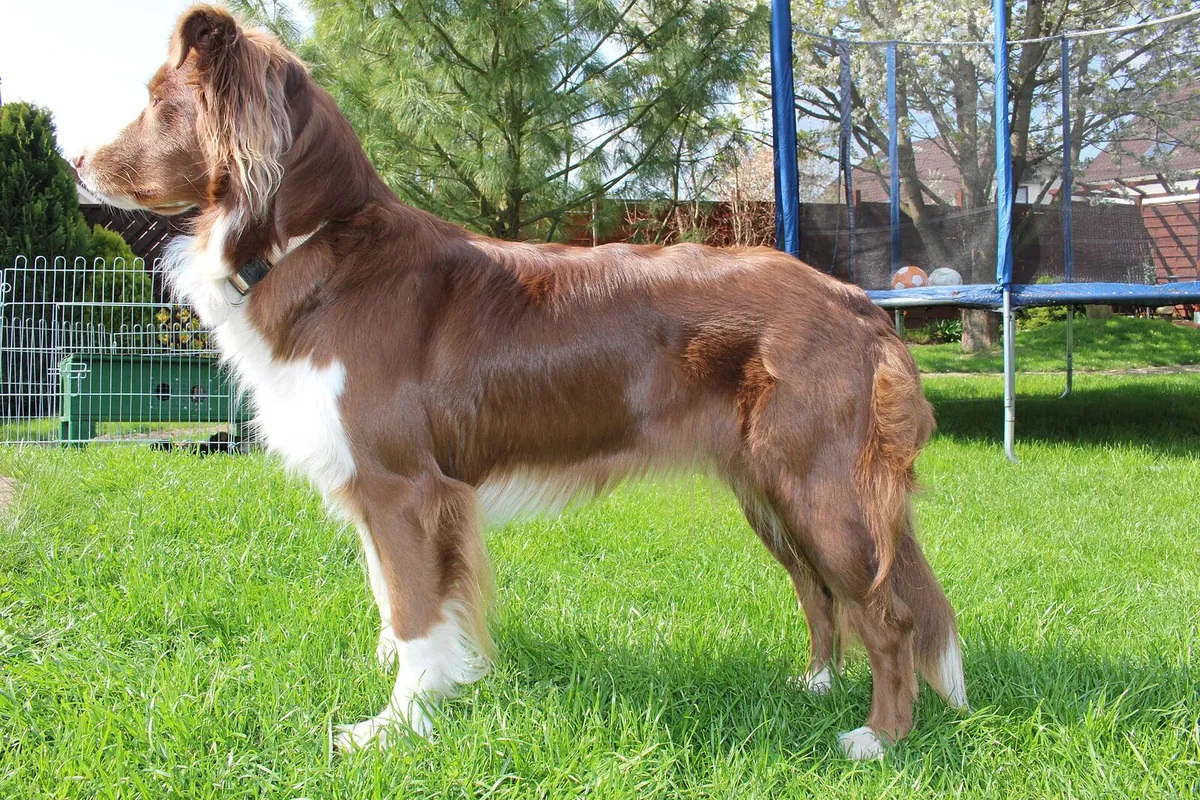
Australian Shepherd at a glance
| Trait | Detail |
|---|---|
| Origin | United States [1] |
| Breed group | FCI Group 1 (Sheepdogs and Cattle dogs), section 1, sheepdogs; AKC Herding Group [1, 2] |
| Weight | 23–29 kg (50–65 lb) for males, 18–25 kg (40–55 lb) for females [2] |
| Height | 51–58 cm (20–23 in) for males, 46–53 cm (18–21 in) for females [1] |
| Life expectancy | Median age at death 13.7 years in a 2024 UK study, based on only 62 deaths [3] |
| Coat | Medium length, straight to wavy, weather resistant; blue merle, black, red merle or red, with or without white and tan markings [1] |
Origin
There are many theories about its origin, but the Australian Shepherd as we know it developed in the United States. Its name comes from its link with Basque sheepherders who came to the United States from Australia in the 1800s [1].
The breed became popular after World War II with western horseback riding, rodeos, horse shows, films and television, and American stockmen kept developing it as a herding dog [1].
Common health problems
- MDR1 (ABCB1) mutation: it affects P-glycoprotein, a pump at the blood-brain barrier [11], and makes dogs sensitive to some common drugs [5]. In Germany, the mutant allele frequency was 22% in Australian Shepherds and 24% in Miniature Australian Shepherds [4]; Washington State University lists an approximate frequency of 50% for both [5]. Ivermectin toxicity has been reported in an Australian Shepherd with the mutation [6].
- Epilepsy: in a study of 50 epileptic Australian Shepherds, the disease often took a moderate or severe course, with clusters of seizures and status epilepticus. Seizures were poorly controlled in 56%, regardless of the MDR1 genotype, and poor control was linked to shorter survival [7].
- Hereditary cataract: a dog carrying an HSF4 gene mutation is about 17 times more likely to develop cataracts in both eyes than a dog without it; other genes are probably involved too [8].
- Other inherited conditions found by DNA testing: in European Australian Shepherds tested between 2012 and 2022, mutant allele frequencies were 9.71% for collie eye anomaly, 11.64% for hereditary cataract, 11.77% for degenerative myelopathy, 1.58% for progressive rod-cone degeneration and 0.53% for canine multifocal retinopathy type 1 [9].
- Cobalamin (vitamin B12) malabsorption: Imerslund-Gräsbeck syndrome is caused by AMN gene mutations in Australian Shepherds. In Beagles, a related form caused failure to thrive, low neutrophils, low blood cobalamin and protein in the urine, and the Australian Shepherd form is described as similarly severe [10].
Tests and screening in Australian Shepherds
- MDR1 DNA test: the only way to know whether a dog carries the mutation is to test it [5]. Washington State University advises that loperamide be avoided in all dogs with the mutation, and gives dose advice for drugs such as acepromazine, butorphanol, some chemotherapy drugs, cyclosporine and ondansetron [5].
- Heartworm and flea products: WSU lists several products, including ivermectin (Heartgard), milbemycin, moxidectin and selamectin products, as tested safe in MDR1 dogs at label doses [5]. See the heartworm test for dogs.
- Cortisol: dogs with two copies of the MDR1 mutation have lower plasma cortisol and lower cortisol metabolites in their urine than normal dogs [11]. If an ACTH stimulation test or another cortisol test is planned, mention your dog’s MDR1 status.
- Cobalamin: in a young dog that fails to thrive, low cobalamin, low neutrophils and protein in the urine fit Imerslund-Gräsbeck syndrome [10]. See the white blood cell count and protein in urine.
- Eye DNA tests: the HSF4 test for hereditary cataract [8] and a test for collie eye anomaly are among the DNA tests used in the breed [9].
Related articles
En français : Berger australien.
Questions to ask your veterinarian
- Has my Australian Shepherd been tested for the MDR1 mutation, and what is the result?
- Which drugs should be avoided or given at a different dose for my dog?
- Is my heartworm and flea prevention safe for an MDR1 dog?
- What should I do if my dog has a seizure?
- Which eye checks or DNA tests are worth doing for my dog?
Get your Australian Shepherd’s blood work explained.
AI DiagAnimals reads the blood count, the chemistry, cortisol results and urine tests with your laboratory’s intervals, and prepares the questions for your vet. The service opens soon: leave your email to be told first.
Frequently asked questions
How long do Australian Shepherds live?
A 2024 UK study found a median age at death of 13.7 years, but it was based on only 62 deaths [3].
What is the MDR1 gene in Australian Shepherds?
A mutation in the MDR1 (ABCB1) gene makes dogs sensitive to some drugs, such as loperamide. In Germany, 22% of the breed’s MDR1 genes carried it [4, 5].
Do all Australian Shepherds have the MDR1 mutation?
No. Many do, but the only way to know is a DNA test [5].
Are Australian Shepherds prone to epilepsy?
Epilepsy occurs in the breed and is often severe: seizures were poorly controlled in 56% of epileptic dogs in one study [7].
Sources
- Fédération Cynologique Internationale. FCI Standard No. 342: Australian Shepherd. fci.be/Nomenclature/Standards/342g01-en.pdf
- American Kennel Club. Australian Shepherd: dog breed information. akc.org/dog-breeds/australian-shepherd
- McMillan KM et al. Longevity of companion dog breeds: those at risk from early death. Sci Rep. 2024;14:531 (supplementary Table S3). doi.org/10.1038/s41598-023-50458-w
- Gramer I et al. Breed distribution of the nt230(del4) MDR1 mutation in dogs. Vet J. 2011;189(1):67-71. doi.org/10.1016/j.tvjl.2010.06.012
- Washington State University, Program in Individualized Medicine. MDR1: problem medications and affected dog breeds. vcpl.vetmed.wsu.edu/problem-drugs
- Nelson OL et al. Ivermectin toxicity in an Australian Shepherd dog with the MDR1 mutation associated with ivermectin sensitivity in Collies. J Vet Intern Med. 2003;17(3):354-356. pubmed.ncbi.nlm.nih.gov/12774979
- Weissl J et al. Disease progression and treatment response of idiopathic epilepsy in Australian Shepherd dogs. J Vet Intern Med. 2012;26(1):116-125. doi.org/10.1111/j.1939-1676.2011.00853.x
- Mellersh CS et al. Mutation in HSF4 is associated with hereditary cataract in the Australian Shepherd. Vet Ophthalmol. 2009;12(6):372-378. doi.org/10.1111/j.1463-5224.2009.00735.x
- Majchrakova Z et al. The incidence of genetic disease alleles in Australian Shepherd dog breed in European countries. PLoS One. 2023;18(2):e0281215. doi.org/10.1371/journal.pone.0281215
- Fyfe JC et al. Selective intestinal cobalamin malabsorption with proteinuria (Imerslund-Gräsbeck syndrome) in juvenile Beagles. J Vet Intern Med. 2014;28(2):356-362. doi.org/10.1111/jvim.12284
- Gramer I et al. Urinary cortisol metabolites are reduced in MDR1 mutant dogs in a pilot targeted GC-MS urinary steroid hormone metabolome analysis. J Vet Pharmacol Ther. 2022;45(3):265-272. doi.org/10.1111/jvp.13050
Laboratory methods and reference intervals vary. This article explains; it does not diagnose. For a decision about your pet, use the original report and talk to your veterinarian. Our editorial policy.