
 Français
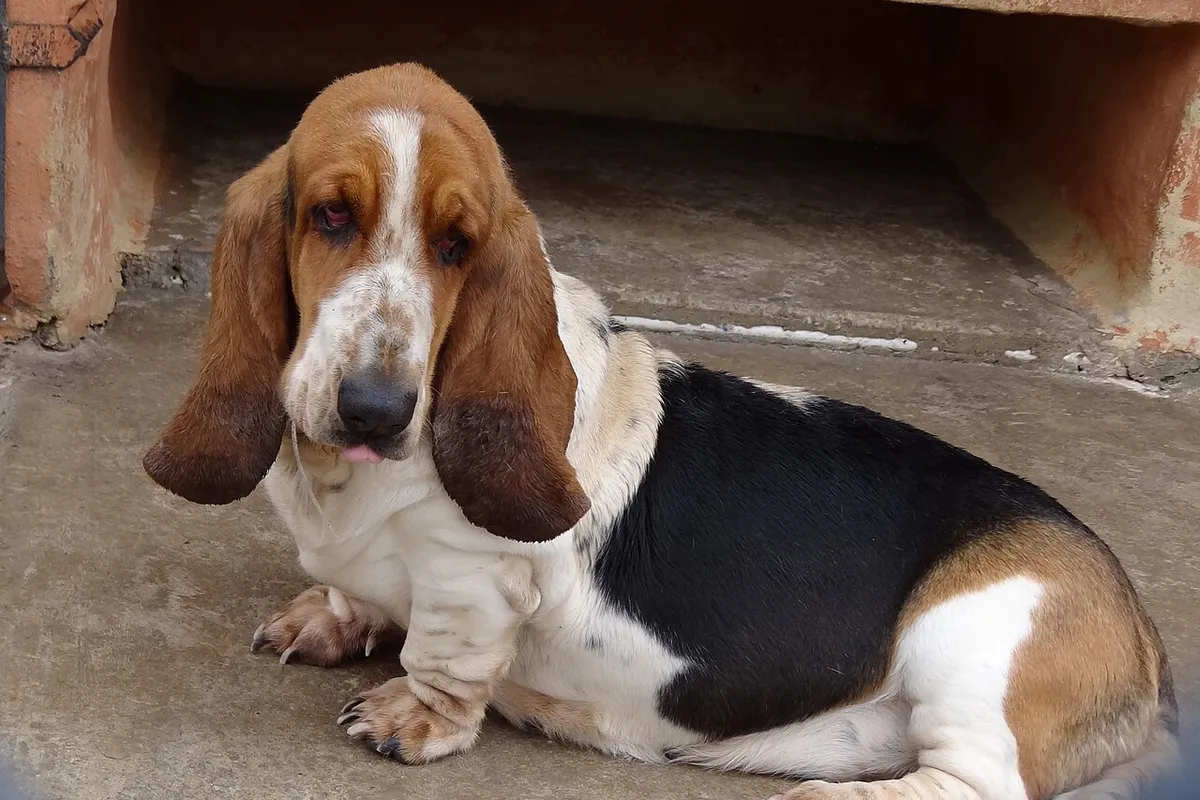
At a glance
| Trait | Detail |
|---|---|
| Origin | Great Britain, from French basset hounds [1] |
| Breed group | FCI group 6, section 1.3 (small-sized scent hounds) [1]; AKC Hound Group [2] |
| Weight | 40–65 lb (18–29 kg) [2] |
| Height | 13–15 in (33–38 cm) [1] |
| Life expectancy | Median 12.5 years in a 2024 UK study of over 580,000 dogs [3] |
| Coat | Smooth, short and close; usually black, white and tan, or lemon and white [1] |
Origin
The Basset was reputedly bred by monks in France in the Middle Ages to hunt in heavy cover with its nose close to the ground. Although closely related to the French bassets, the breed was developed in Britain, as a hound that follows the hare persistently, at a slow pace, over long distances [1].
The breed standard describes a short-legged hound of considerable substance with a deep voice and long, low-set ears, and insists that it must stay fit for purpose as a working hound [1].
Common health problems
- Ear infections: in UK practices in 2016, Basset Hounds had 5.87 times the odds of otitis externa of crossbred dogs, the highest of all breeds, ahead of the Shar Pei and the Beagle. Pendulous ears were a risk factor overall [4].
- Skin yeast: healthy Basset Hounds carry larger populations of the yeast Malassezia on the skin and mucosa than mixed-breed dogs, and Basset Hounds with seborrhoea carry even more, which may explain the breed’s tendency to Malassezia dermatitis [5].
- Glaucoma: in North American teaching hospitals from 1994 to 2002, 5.44% of Basset Hounds had primary glaucoma, the second-highest rate of all breeds [6]. In UK screening, 38.4% of 198 Basset Hounds had moderate or severe pectinate ligament dysplasia, a drainage-angle defect linked to glaucoma, and it became more common with age [7].
- Ectropion: a lower eyelid that rolls outwards affected 1.59% of Basset Hounds a year in UK practices, the third-highest rate of all breeds [8].
- Back disc disease: among 188 Basset Hounds seen by three neurology referral services, 36.2% had a thoracolumbar disc extrusion, against 77.4% of Dachshunds. Basset Hounds were older when they presented, more often affected in the middle of the lower back and more often able to walk at discharge [9].
What is special in the Basset Hound’s blood work
We found no breed-specific reference intervals for routine blood tests in Basset Hounds. One inherited disease, however, can hide behind normal results.
Basset Hound thrombopathia. In this inherited platelet disorder, dogs have nosebleeds, bleeding gums and small skin bleeds, yet the platelet count, von Willebrand factor and coagulation screening tests are all normal. Only the bleeding time is prolonged, because the platelets do not stick together properly. The disease is caused by mutations in the CalDAG-GEFI gene [10]. A Basset Hound and Shar Pei cross puppy with normal screening tests was diagnosed by a DNA test for this mutation [11]. So a normal blood count does not rule it out; see low platelets in dogs for the opposite situation.
DNA test for open-angle glaucoma. All affected Basset Hounds in a UK study carried two copies of a deletion in the ADAMTS17 gene. In 223 Basset Hounds, the variant’s frequency was 0.081, and about 0.7% of dogs were predicted to be affected [12].
Eye screening. Gonioscopy examines the drainage angle of the eye. Pectinate ligament dysplasia worsens with age, so one normal result in a young dog does not exclude later changes [7].
Related articles
En français : Basset hound.
Questions to ask your veterinarian
- How should I care for my dog’s ears, and how often should they be checked?
- Should my dog have its eye pressure measured or a gonioscopy?
- Were the parents DNA-tested for open-angle glaucoma and for thrombopathia?
- If my dog bleeds easily, which tests can check platelet function when the count is normal?
- What signs of back pain should make me call you straight away?
Get your Basset Hound’s blood work explained.
AI DiagAnimals reads the blood count, including the platelets, the liver and kidney values and other results together with your laboratory’s intervals, and explains them in plain language. The service opens soon: leave your email to be told first.
Frequently asked questions
How long do Basset Hounds live?
A 2024 UK study of over 580,000 dogs found a median lifespan of 12.5 years for Basset Hounds [3].
Why do Basset Hounds get so many ear infections?
In UK practices, Basset Hounds had 5.87 times the odds of otitis externa of crossbred dogs, and pendulous ears were a risk factor across breeds [4].
Are Basset Hounds prone to glaucoma?
Yes. They had the second-highest rate of primary glaucoma in North American teaching hospitals, 5.44% [6], and a DNA test exists for open-angle glaucoma in the breed [12].
What is Basset Hound thrombopathia?
An inherited platelet disorder causing nosebleeds and gum bleeding, with a normal platelet count and normal clotting tests. It is confirmed by a DNA test [10, 11].
Do Basset Hounds have back problems?
Yes. In neurology services, 36.2% of Basset Hounds had a thoracolumbar disc extrusion, fewer than Dachshunds but still a common problem [9].
Sources
- FCI. Standard No. 163: Basset Hound. 2026. fci.be/Nomenclature/Standards/163g06-en.pdf
- American Kennel Club. Basset Hound: dog breed information. akc.org/dog-breeds/basset-hound
- McMillan KM et al. Longevity of companion dog breeds: those at risk from early death. Sci Rep. 2024;14:531 (supplementary table S3). doi.org/10.1038/s41598-023-50458-w
- O’Neill DG et al. Frequency and predisposing factors for canine otitis externa in the UK - a primary veterinary care epidemiological view. Canine Med Genet. 2021;8:7. doi.org/10.1186/s40575-021-00106-1
- Bond R, Lloyd DH. Skin and mucosal populations of Malassezia pachydermatis in healthy and seborrhoeic Basset Hounds. Vet Dermatol. 1997;8(2):101-106. doi.org/10.1046/j.1365-3164.1997.d01-4.x
- Gelatt KN, MacKay EO. Prevalence of the breed-related glaucomas in pure-bred dogs in North America. Vet Ophthalmol. 2004;7(2):97-111. doi.org/10.1111/j.1463-5224.2004.04006.x
- Oliver JA et al. Prevalence of pectinate ligament dysplasia and associations with age, sex and intraocular pressure in the Basset hound, Flatcoated retriever and Dandie Dinmont terrier. Canine Genet Epidemiol. 2016;3:1. doi.org/10.1186/s40575-016-0033-1
- O’Neill DG et al. Conformational eyelid disorders in dogs under primary veterinary care in the UK - Epidemiology and clinical management. PLoS One. 2025;20(6):e0326526. doi.org/10.1371/journal.pone.0326526
- Thatcher H et al. Incidence and clinical characterisation of thoracolumbar intervertebral disc extrusions in Basset Hounds compared with Dachshunds. Vet Rec. 2024;194(1):e3212. doi.org/10.1002/vetr.3212
- Boudreaux MK et al. Calcium-diacylglycerol guanine nucleotide exchange factor I gene mutations associated with loss of function in canine platelets. Transl Res. 2007;150(2):81-92. doi.org/10.1016/j.trsl.2007.03.006
- Christopherson PW et al. Basset Hound thrombopathia in a 4-month-old female Ba-Shar (Sharp Asset). Vet Clin Pathol. 2016;45(2):229-231. doi.org/10.1111/vcp.12346
- Oliver JA et al. Two independent mutations in ADAMTS17 are associated with primary open angle glaucoma in the Basset Hound and Basset Fauve de Bretagne breeds of dog. PLoS One. 2015;10(10):e0140436. doi.org/10.1371/journal.pone.0140436
Laboratory methods and reference intervals vary. This article explains; it does not diagnose. For a decision about your pet, use the original report and talk to your veterinarian. Our editorial policy.