
 Français
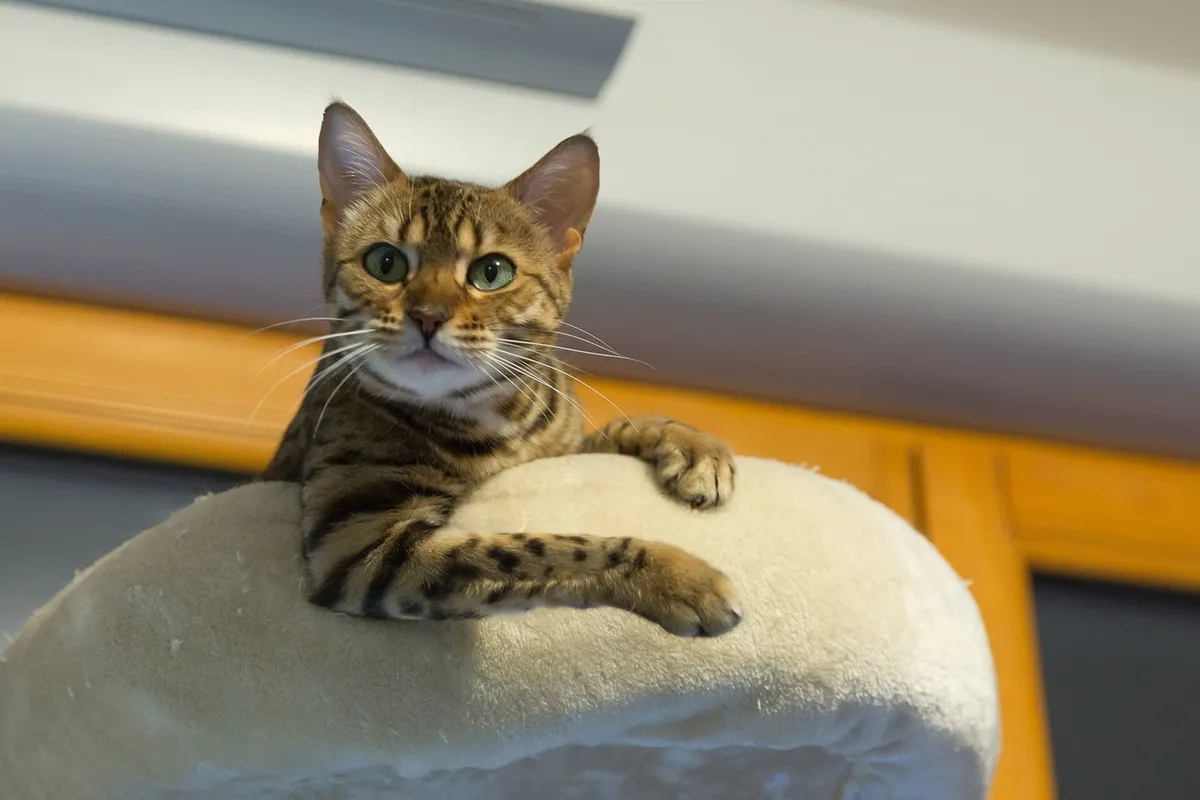
Bengal cat at a glance
| Trait | Detail |
|---|---|
| Origin | Developed from crosses between domestic cats and the Asian leopard cat, starting in 1963; CFA requires five generations of domestic ancestry [1] |
| Breed group | FIFe Category 3 [2] |
| Build | Medium to large, long and substantial body with robust bone, very muscular [3] |
| Life expectancy | 8.51 years at birth in a 2019 UK study of 7,936 cat deaths, against 11.74 years for all cats [4] |
| Coat | Short, thick and unusually soft, preferably with “glitter”; spotted, rosetted or marbled patterns [1, 3] |
Origin
In 1963, the conservationist Jean Mill crossed a domestic tom with a female Asian leopard cat. At the same time, Dr Willard Centerwall was producing similar crosses for research. Mill later used cats from Centerwall, together with spotted domestic cats, to develop the breed [1].
FIFe recognized the Bengal in 1999 [3]. The Cat Fanciers’ Association accepted it for registration in 2016, requiring five generations of pure domestic ancestry, and granted championship status in 2018 [1].
Common health problems
- Pyruvate kinase deficiency (PK deficiency): an inherited hemolytic anemia caused by a variant of the PKLR gene. Red cells live shorter lives, and signs can include severe lethargy, weakness, weight loss, jaundice and an enlarged abdomen, with very variable onset and severity. It is recessive. Among 320 Bengals sampled for unrelated tests, 73 carried one copy of the variant and 5 had two copies [5]. See anemia in cats.
- Early retinal degeneration (PRA): a recessive retinal disease was described in a family of Bengals. Changes were visible from 9 weeks of age, vision loss was obvious by 1 year, and the disease progressed rapidly to blindness. It is not caused by the CEP290 or CRX variants found in Abyssinians and Siamese [6].
- Hypertrophic cardiomyopathy (HCM): the Bengal is reported to develop HCM [7]. It needs a heart ultrasound to detect, and most breeders have breeding cats scanned by a cardiologist before the first litter and at regular intervals [1].
- Polyneuropathy of young Bengals: a chronic, relapsing nerve disease with weakness was described in 37 young Bengals. Recovery was common, but relapses and residual weakness were possible [8].
- Chest wall deformity in kittens: in Sweden, kittens with a flat chest or other rib cage changes were reported in 38 of 311 Bengal litters (12%), and stillbirths and deaths in the first day were more frequent in those litters [9].
- FIP: at a US veterinary teaching hospital, Bengals were among the breeds with a significantly higher risk of feline infectious peritonitis [10]. See FIP in cats.
Tests and screening in Bengals
- DNA test for PK deficiency: the authors of the variant study recommend PK testing for Bengals [5]. A cat with two copies can have anemia and jaundice, which appear on the blood count and the bilirubin result [5]. See anemia in cats and high liver enzymes in cats for bilirubin.
- Heart ultrasound: reference intervals for heart measurements have been established specifically for Bengals, to help cardiologists who screen the breed tell normal from abnormal [7].
- Eye examination: in the affected Bengal family, retinal changes could be seen on eye examination from 9 weeks, and the electroretinogram showed reduced rod and cone function from 7 to 9 weeks [6].
- Other genetic tests: genetic testing lets Bengal breeders screen for several inherited diseases and remove carriers from breeding [1].
- Routine blood work: for the full picture of a cat’s blood count and chemistry panel, see cat blood work explained.
Related articles
En français : Bengal.
Questions to ask your veterinarian
- Has my cat, or its parents, been DNA tested for pyruvate kinase deficiency?
- Does my cat’s blood count show any sign of anemia, and should reticulocytes be checked?
- Should my Bengal have a heart ultrasound, and at what age?
- Are my cat’s eyes and vision normal for its age?
- Which signs of FIP or of weakness should make me call you?
Get your Bengal’s blood work explained.
AI DiagAnimals reads the blood count, the reticulocytes, the bilirubin, the globulins and the rest of the chemistry with your laboratory’s cat intervals, and prepares the questions for your vet. The service opens soon: leave your email to be told first.
Frequently asked questions
How long do Bengal cats live?
In a UK study of cats that died in 2019, the life expectancy at birth of Bengals was 8.51 years, one of the shortest of the breeds analysed [4].
What health problems do Bengal cats have?
Documented problems include PK deficiency [5], early retinal degeneration [6], hypertrophic cardiomyopathy [1, 7], a relapsing polyneuropathy in young cats [8], chest wall deformities in kittens [9] and a higher risk of FIP [10].
What is PK deficiency in Bengal cats?
An inherited lack of the red-cell enzyme pyruvate kinase. Red cells are destroyed too early, which causes anemia; signs vary from none to severe lethargy, weight loss and jaundice [5].
Can Bengal cats go blind?
Yes. A recessive retinal degeneration described in Bengals starts in the first weeks of life and progresses rapidly to blindness [6].
Sources
- The Cat Fanciers’ Association. Bengal: breed profile. cfa.org/breed/bengal
- Fédération Internationale Féline. Breeds and standards. fifeweb.org/cats/breeds
- Fédération Internationale Féline. Breed standard: Bengal (BEN). fifeweb.org/wp-content/uploads/2023/10/BEN.pdf
- Teng KT et al. Life tables of annual life expectancy and risk factors for mortality in cats in the UK. J Feline Med Surg. 2024;26(5):1098612X241234556. doi.org/10.1177/1098612X241234556
- Grahn RA et al. Erythrocyte pyruvate kinase deficiency mutation identified in multiple breeds of domestic cats. BMC Vet Res. 2012;8:207. doi.org/10.1186/1746-6148-8-207
- Ofri R et al. Characterization of an early-onset, autosomal recessive, progressive retinal degeneration in Bengal cats. Invest Ophthalmol Vis Sci. 2015;56(9):5299-5308. doi.org/10.1167/iovs.15-16585
- Scansen BA, Morgan KL. Reference intervals and allometric scaling of echocardiographic measurements in Bengal cats. J Vet Cardiol. 2015;17 Suppl 1:S282-S295. doi.org/10.1016/j.jvc.2015.02.001
- Bensfield AC et al. Recurrent demyelination and remyelination in 37 young Bengal cats with polyneuropathy. J Vet Intern Med. 2011;25(4):882-889. doi.org/10.1111/j.1939-1676.2011.0740.x
- Holst BS et al. Thoracic wall deformity in Bengal cats: morphological findings and results from a breeder questionnaire. Vet J. 2026;317:106669. doi.org/10.1016/j.tvjl.2026.106669
- Pesteanu-Somogyi LD et al. Prevalence of feline infectious peritonitis in specific cat breeds. J Feline Med Surg. 2006;8(1):1-5. doi.org/10.1016/j.jfms.2005.04.003
Laboratory methods and reference intervals vary. This article explains; it does not diagnose. For a decision about your pet, use the original report and talk to your veterinarian. Our editorial policy.