
 Français
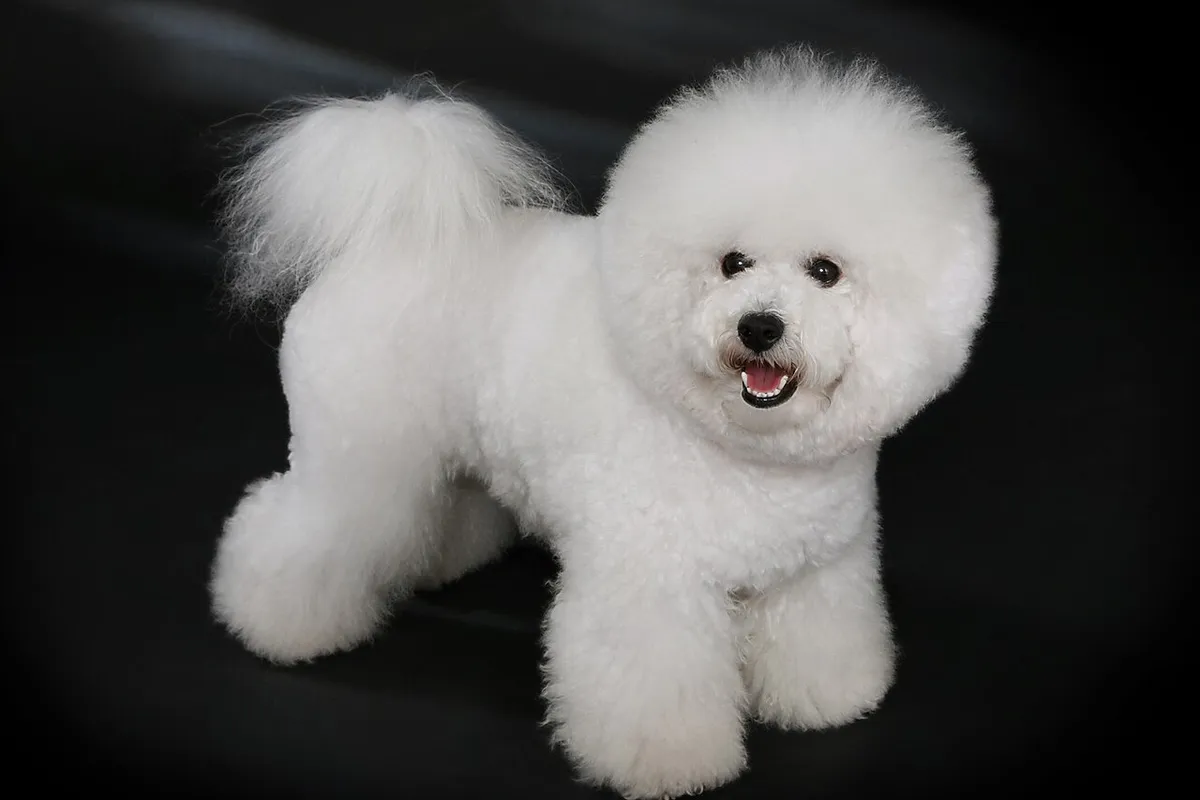
Bichon Frise at a glance
| Trait | Detail |
|---|---|
| Origin | France and Belgium (Franco-Belgian breed) [1] |
| Breed group | FCI group 9 (companion and toy dogs), section 1, bichons and related breeds [1]; AKC Non-Sporting Group [2] |
| Weight | About 11 lb (5 kg) in the FCI standard [1]; 12–18 lb (5.4–8.2 kg) for the AKC [2] |
| Height | 9.8–11.4 in (25–29 cm) [1] |
| Life expectancy | Median survival 12.5 years in UK veterinary records [3] |
| Coat | Profuse, with loose corkscrew curls over a soft, dense undercoat; pure white [1] |
Origin
According to the FCI standard, the Bichon was brought to France from Italy during the Renaissance. It looked like a very small Barbet and was called “barbichon”, later shortened to “bichon”. Painters of the 17th and 18th centuries showed it at the side of kings and nobles, and it returned to fashion under Napoleon III as the “Ténériffe” [1].
The breed nearly disappeared after the two world wars and was rebuilt by a few French and Belgian breeders. The first dog was registered in Belgium in 1932 and the first in France in 1934; the name Bichon à poil frisé dates from 1978 [1].
Common health problems
- Cushing’s syndrome: in UK primary-care practices, Bichons had 6.5 times the odds of crossbred dogs of hyperadrenocorticism in records from 2009 to 2014 [4], and 6.2 times the odds of Cushing’s syndrome in 2016, the highest of all breeds [5]. See Cushing’s disease in dogs.
- Calcium oxalate bladder stones: Bichons were among the breeds at increased risk in a US case-control study of 1,074 dogs with these stones [6]. They also had 1.4 times the odds of mixed-breed dogs at a California laboratory [7] and 1.7 times the odds of other breeds in Ireland [8]. See bladder stones in dogs.
- Diabetes: in Australian primary-care clinics, Bichons and their crosses had 3.4 times the odds of diabetes mellitus [9]. See diabetes in dogs.
- Kneecaps: Bichons had 3.0 times the odds of crossbred dogs of patellar luxation in England [10]. In Swedish Kennel Club screening records, 12% of Bichons were affected [11].
- Cataracts: cataract appears to be inherited in the Bichon. In US eye registry data, 6% of 8,222 Bichons examined had cataracts, and dogs aged 2 to 8 years were most often affected. Retinal detachment before or after surgery was not rare in university hospital patients [12].
Blood work, urine tests and screening in Bichons
We found no published Bichon-specific reference intervals for routine blood tests. The breed’s predispositions, however, show clearly on blood and urine tests.
- Cortisol tests: Bichons are the most predisposed breed for Cushing’s syndrome in UK primary care [5]. Older age and a bodyweight above the breed mean also raised the odds [4, 5]. Suggestive signs or blood changes in a Bichon are worth discussing with the vet; see the ACTH stimulation test.
- Glucose: given the breed’s increased risk of diabetes [9], blood and urine glucose are worth reading closely. See blood sugar in dogs.
- Urinalysis and stone analysis: calcium oxalate stones were more common in middle-aged, castrated male and overweight dogs in the US case-control study [6]. Bichons have also been reported at increased risk of struvite stones by other laboratories, although the California laboratory found no breed predisposition for struvite [7]. The type of a stone is confirmed by analyzing the stone itself [7].
- Kneecap screening: the heritability of patellar luxation was 0.21 in Swedish Bichons, and the authors suggest selection using breeding values from veterinary screening records [11].
Related articles
En français : Bichon frisé.
Questions to ask your veterinarian
- Do my Bichon’s blood results or signs suggest Cushing’s syndrome, and is a cortisol test needed?
- Should we check the urine regularly for crystals, and which type are they?
- Is my dog’s weight right, given the links with stones and Cushing’s syndrome?
- Should blood glucose be checked if my dog drinks or urinates more?
- Are the kneecaps stable, and should the eyes be checked for cataracts?
Get your Bichon’s blood and urine tests explained.
AI DiagAnimals reads ALP, cholesterol, glucose, cortisol results and the urinalysis with your laboratory’s intervals, and prepares the questions for your vet. The service opens soon: leave your email to be told first.
Frequently asked questions
How long do Bichon Frises live?
In a large UK study, the median survival of Bichons was 12.5 years, with a slightly lower hazard of death than crossbred dogs [3].
What health problems do Bichon Frises have?
Cushing’s syndrome [4, 5], calcium oxalate bladder stones [6, 7, 8], diabetes [9], patellar luxation [10, 11] and inherited cataracts [12] are the best documented.
Are Bichons prone to Cushing’s disease?
Yes. In UK primary-care practices, Bichons had about 6 times the odds of crossbred dogs of Cushing’s syndrome, the highest of all breeds in a 2016 study [4, 5].
Sources
- Fédération Cynologique Internationale. FCI breed standard N° 215: Bichon Frise. 2016. fci.be/Nomenclature/Standards/215g09-en.pdf
- American Kennel Club. Bichon Frise: breed information. akc.org/dog-breeds/bichon-frise
- McMillan KM et al. Longevity of companion dog breeds: those at risk from early death. Sci Rep. 2024;14:531 (supplementary table S3). doi.org/10.1038/s41598-023-50458-w
- O’Neill DG et al. Epidemiology of hyperadrenocorticism among 210,824 dogs attending primary-care veterinary practices in the UK from 2009 to 2014. J Small Anim Pract. 2016;57(7):365-373. doi.org/10.1111/jsap.12523
- Schofield I et al. Frequency and risk factors for naturally occurring Cushing’s syndrome in dogs attending UK primary-care practices. J Small Anim Pract. 2022;63(4):265-274. doi.org/10.1111/jsap.13450
- Lekcharoensuk C et al. Patient and environmental factors associated with calcium oxalate urolithiasis in dogs. J Am Vet Med Assoc. 2000;217(4):515-519. doi.org/10.2460/javma.2000.217.515
- Kopecny L et al. Urolithiasis in dogs: evaluation of trends in urolith composition and risk factors (2006-2018). J Vet Intern Med. 2021;35(3):1406-1415. doi.org/10.1111/jvim.16114
- Stavroulaki EM et al. Trends in urolith composition and factors associated with different urolith types in dogs from the Republic of Ireland and Northern Ireland between 2010 and 2020. J Small Anim Pract. 2024;65(1):30-38. doi.org/10.1111/jsap.13676
- Yoon S et al. Epidemiological study of dogs with diabetes mellitus attending primary care veterinary clinics in Australia. Vet Rec. 2020;187(3):e22. doi.org/10.1136/vr.105467
- O’Neill DG et al. The epidemiology of patellar luxation in dogs attending primary-care veterinary practices in England. Canine Genet Epidemiol. 2016;3:4. doi.org/10.1186/s40575-016-0034-0
- Nilsson K et al. Heritability of patellar luxation in the Chihuahua and Bichon Frise breeds of dogs and effectiveness of a Swedish screening programme. Vet J. 2018;234:136-141. doi.org/10.1016/j.tvjl.2018.01.010
- Gelatt KN et al. Cataracts in the Bichon Frise. Vet Ophthalmol. 2003;6(1):3-9. doi.org/10.1046/j.1463-5224.2003.00258.x
Laboratory methods and reference intervals vary. This article explains; it does not diagnose. For a decision about your pet, use the original report and talk to your veterinarian. Our editorial policy.