
 Français
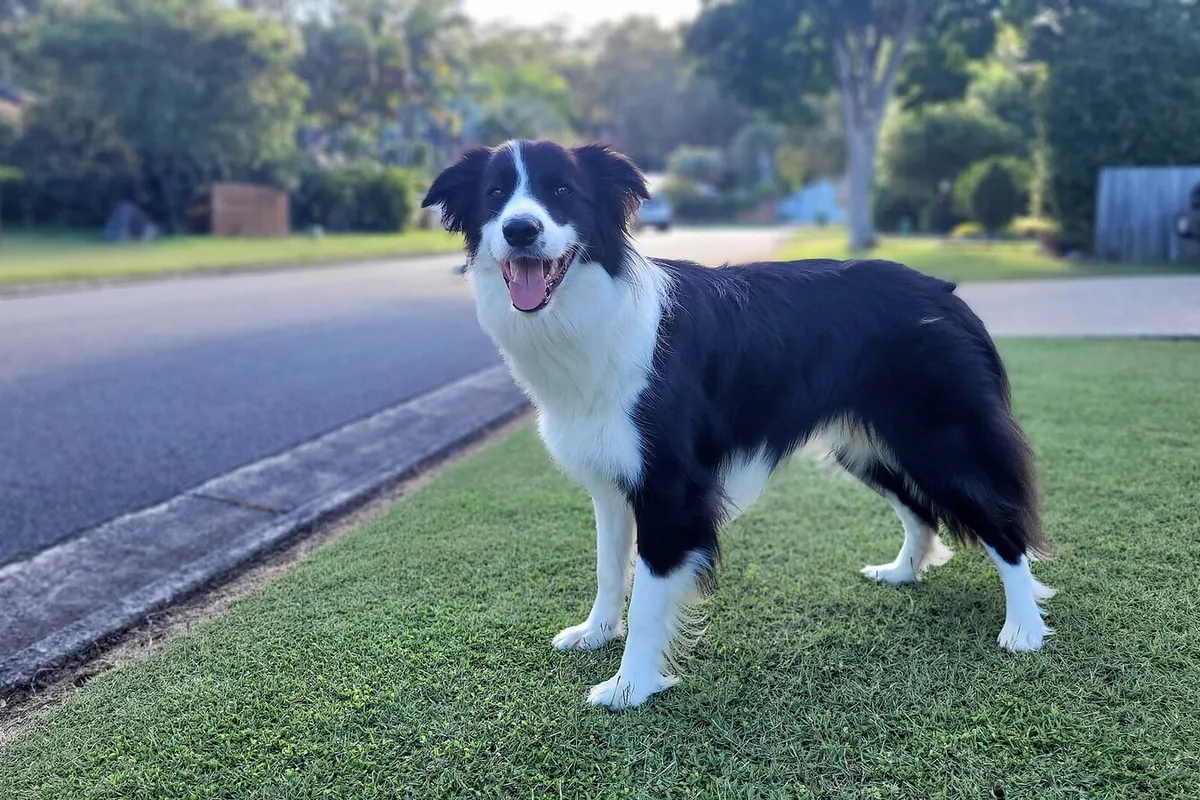
Border Collie at a glance
| Trait | Detail |
|---|---|
| Origin | Great Britain [1] |
| Breed group | FCI Group 1 (Sheepdogs and Cattle dogs), section 1, sheepdogs; AKC Herding Group [1, 2] |
| Weight | 14–25 kg (30–55 lb) [2] |
| Height | Ideal 53 cm (21 in) for males, slightly less for females [1]; 48–56 cm (19–22 in) for males and 46–53 cm (18–21 in) for females in the AKC description [2] |
| Life expectancy | Median age at death 13.1 years in a 2024 UK study [3] |
| Coat | Two varieties, moderately long or smooth, with a dense undercoat; many colours, but white should never predominate [1] |
Origin
The Border Collie is a British sheepdog, and its FCI standard still includes a working trial [1]. The American Kennel Club traces it to crosses between the herding dogs brought by the Romans and the smaller spitz-type herders of the Vikings, which gave compact, agile dogs for the hills of Scotland and Wales [2].
“Collie” is a Scottish dialect word for sheepdogs. Border Collies have dominated sheepdog trials in the British Isles for more than a hundred years, and the breed joined the AKC Herding Group in 1995 [2].
Common health problems
- Epilepsy: in a German study of 49 Border Collies with idiopathic epilepsy, the course was moderate in 33% and severe in 49%, with frequent clusters of seizures; 71% of the dogs given more than two drugs were drug-resistant, and only 18% went into remission [4]. In UK primary care, 1.45% of Border Collies had at least one seizure recorded in a year [5].
- Trapped neutrophil syndrome (TNS): an inherited recessive neutropenia caused by a VPS13B gene mutation [7]. Affected young dogs had fever, an abnormal gait and digestive signs; six of 12 dogs were alive six months after diagnosis [6]. In Japan, 11.1% of Border Collies tested were carriers [7].
- Neuronal ceroid lipofuscinosis (NCL): a recessive storage disease that mainly affects nerve cells, caused by a CLN5 mutation; 8.1% of Border Collies tested in Japan were carriers [8].
- Imerslund-Gräsbeck syndrome: a recessive inability to absorb vitamin B12 (cobalamin), caused in Border Collies by a CUBN gene mutation [9].
- Collie eye anomaly: an inherited eye malformation. In worldwide genetic testing data, Border Collies showed a strong decline in affected dogs, carriers and the disease allele over time [10].
- MDR1 drug sensitivity: rare in the breed: the mutant allele frequency was 1% in a German study [11].
- Cushing’s syndrome: less common than in crossbred dogs, with 0.32 times the odds [12]. See Cushing’s disease in dogs and the ACTH stimulation test.
Tests and screening in Border Collies
- White cell count in trapped neutrophil syndrome: neutrophils are not always low. In 12 affected dogs, the segmented neutrophil count was below the interval in seven, within it in four and above it in one [6]. A normal count does not rule out TNS in a young Border Collie with fever and lameness. See the white blood cell count in dogs.
- Vitamin B12 (cobalamin): a low blood cobalamin in a young Border Collie can point to Imerslund-Gräsbeck syndrome, which a DNA test for the CUBN mutation can confirm [9].
- DNA tests: genotyping tests exist for TNS [7], NCL [8], Imerslund-Gräsbeck syndrome [9], collie eye anomaly [10] and MDR1 [11]. They tell whether a dog is clear, a carrier or affected.
- Routine blood work: no breed-specific reference values have been published; results are read with the laboratory’s usual dog intervals, starting with the CBC.
Related articles
En français : Border collie.
Questions to ask your veterinarian
- Have my dog’s parents or my dog been DNA tested for TNS, NCL, Imerslund-Gräsbeck syndrome and collie eye anomaly?
- Is my young dog’s neutrophil count normal, and could TNS still be possible?
- Should we measure vitamin B12 (cobalamin)?
- What should I do if my dog has a seizure, and when is treatment started?
- Does my dog need an MDR1 test before certain drugs?
Get your Border Collie’s blood work explained.
AI DiagAnimals reads the blood count, neutrophils, cobalamin and the chemistry with your laboratory’s intervals, and prepares the questions for your vet. The service opens soon: leave your email to be told first.
Frequently asked questions
How long do Border Collies live?
The median age at death was 13.1 years in a 2024 UK study [3].
What health problems do Border Collies have?
Epilepsy [4], collie eye anomaly [10] and rare recessive diseases such as trapped neutrophil syndrome [6], neuronal ceroid lipofuscinosis [8] and Imerslund-Gräsbeck syndrome [9].
What is trapped neutrophil syndrome?
An inherited recessive neutropenia of young Border Collies, caused by a VPS13B mutation [7], with fever, lameness and digestive signs; neutrophils are often but not always low [6].
What DNA tests should a Border Collie have?
Tests exist for TNS [7], NCL [8], Imerslund-Gräsbeck syndrome [9], collie eye anomaly [10] and MDR1 [11].
Do Border Collies get epilepsy?
Yes. In a German study the disease was often severe and drug-resistant, and pedigrees suggested a genetic cause [4].
Sources
- Fédération Cynologique Internationale. FCI Standard No. 297: Border Collie. fci.be/Nomenclature/Standards/297g01-en.pdf
- American Kennel Club. Border Collie: dog breed information. akc.org/dog-breeds/border-collie
- McMillan KM et al. Longevity of companion dog breeds: those at risk from early death. Sci Rep. 2024;14:531 (supplementary Table S3). doi.org/10.1038/s41598-023-50458-w
- Hülsmeyer V et al. Epilepsy in Border Collies: clinical manifestation, outcome, and mode of inheritance. J Vet Intern Med. 2010;24(1):171-178. doi.org/10.1111/j.1939-1676.2009.0438.x
- Erlen A et al. Seizure occurrence in dogs under primary veterinary care in the UK: prevalence and risk factors. J Vet Intern Med. 2018;32(5):1665-1676. doi.org/10.1111/jvim.15290
- Suciu A et al. Clinical findings, treatment and outcome of trapped neutrophil syndrome in Border Collies: 12 cases (2011-2022). J Small Anim Pract. 2024;65(7):560-568. doi.org/10.1111/jsap.13726
- Mizukami K et al. Real-time PCR genotyping assay for canine trapped neutrophil syndrome and high frequency of the mutant allele in Border collies. Vet J. 2013;195(2):260-261. doi.org/10.1016/j.tvjl.2012.06.014
- Mizukami K et al. Novel rapid genotyping assays for neuronal ceroid lipofuscinosis in Border Collie dogs and high frequency of the mutant allele in Japan. J Vet Diagn Invest. 2011;23(6):1131-1139. doi.org/10.1177/1040638711425590
- Owczarek-Lipska M et al. A frameshift mutation in the cubilin gene (CUBN) in Border Collies with Imerslund-Gräsbeck syndrome (selective cobalamin malabsorption). PLoS One. 2013;8(4):e61144. doi.org/10.1371/journal.pone.0061144
- Clark JA et al. Global frequency analyses of canine progressive rod-cone degeneration-progressive retinal atrophy and collie eye anomaly using commercial genetic testing data. Genes (Basel). 2023;14(11):2093. doi.org/10.3390/genes14112093
- Gramer I et al. Breed distribution of the nt230(del4) MDR1 mutation in dogs. Vet J. 2011;189(1):67-71. doi.org/10.1016/j.tvjl.2010.06.012
- Schofield I et al. Frequency and risk factors for naturally occurring Cushing’s syndrome in dogs attending UK primary-care practices. J Small Anim Pract. 2022;63(4):265-274. doi.org/10.1111/jsap.13450
Laboratory methods and reference intervals vary. This article explains; it does not diagnose. For a decision about your pet, use the original report and talk to your veterinarian. Our editorial policy.