
 Français
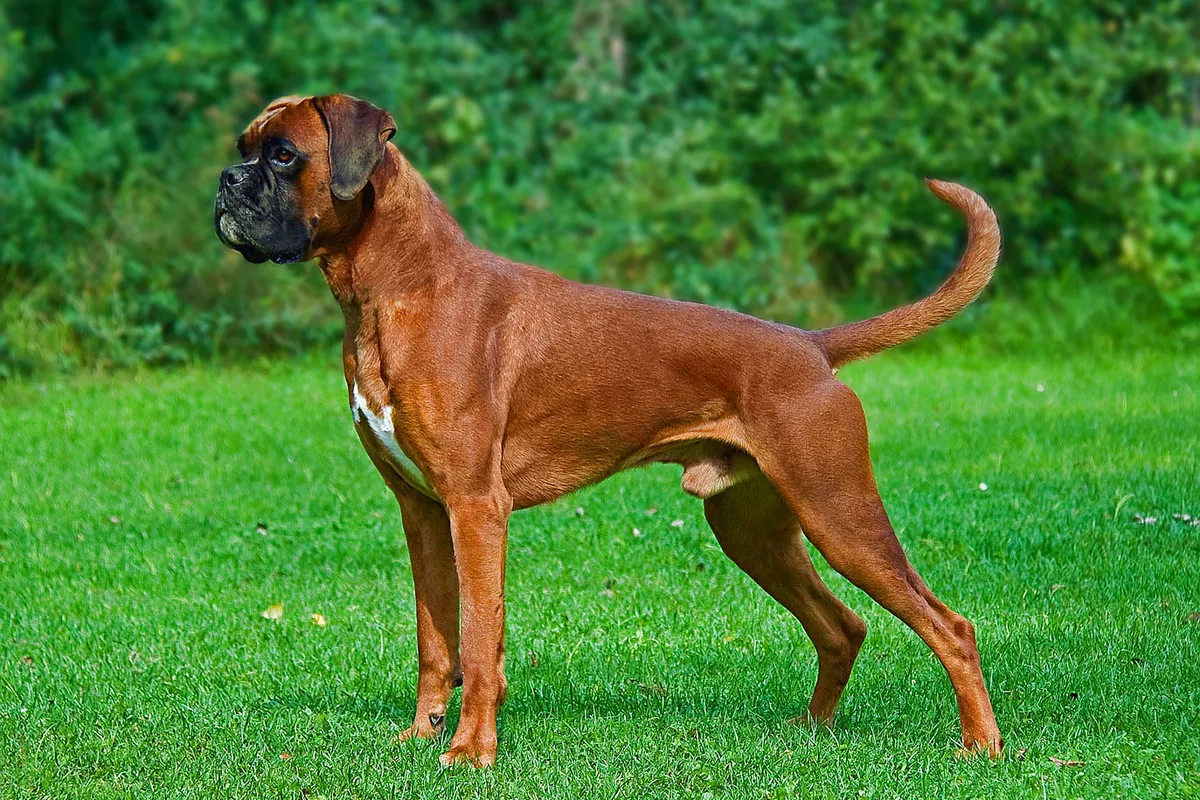
Boxer at a glance
| Trait | Detail |
|---|---|
| Origin | Germany [1] |
| Breed group | FCI Group 2 (Pinscher and Schnauzer type, Molossoid breeds, Swiss Mountain and Cattle Dogs); AKC Working Group [1, 2] |
| Weight | Males over 30 kg (66 lb) at about 60 cm, females about 25 kg (55 lb) at about 56 cm [1]; adult average 30.4 kg (67 lb) in a UK study [3] |
| Height | 57–63 cm (22.5–25 in) for males, 53–59 cm (21–23 in) for females [1] |
| Life expectancy | Median 10.5 years in a UK primary-care study [3]; 11.3 years in a 2024 UK study of over 580,000 dogs [4] |
| Coat | Short, hard, glossy and close-fitting; fawn or brindle with a black mask [1] |
Origin
The breed standard names the small Brabant Bullenbeisser as the Boxer’s direct ancestor. These dogs helped hunters by seizing game and holding it until the hunter arrived, and breeding for this job produced a dog with a wide muzzle and an upturned nose [1].
In the UK, about 1 Boxer in 10 is white; white and non-white Boxers showed no meaningful difference in the common disorders or in lifespan [3].
Common health problems
In a UK study of 3,219 Boxers seen by primary-care vets, the most common disorders were ear infections (7.15%), epulis, a gum growth (5.84%), corneal ulcers (5.00%) and dental disease (4.63%). Tumors as a group affected 14.2% of Boxers in a year, and cancer (12.4%) and brain disorders (9.5%) were the most common recorded causes of death [3].
- Mast cell tumors: 1.95% of Boxers in English primary care, the highest of any breed type in the study and about 7 times the rate in all dogs (0.27%) [5]. See mast cell tumors in dogs.
- Hypothyroidism: 1.95% of Boxers in a large UK study, with 10.4 times the odds of crossbreds [6]. See hypothyroidism in dogs.
- Arrhythmogenic right ventricular cardiomyopathy (ARVC): an inherited heart muscle disease that causes ventricular arrhythmias, fainting and sometimes heart failure. A variant in the striatin gene is found in many affected dogs [7]. Fainting occurred in about a third of affected Boxers; in that study their survival did not differ from that of unaffected Boxers, and the outlook was good for many [8]. See heart failure in dogs.
- Aortic and pulmonic stenosis: narrowings of the heart’s outflow tracts, the most common inborn heart diseases in dogs, with Boxers predominantly affected. A French screening program of 3,001 Boxers since 2005 may have helped reduce them [9].
- Degenerative myelopathy: a spinal cord disease linked to a SOD1 variant in several breeds including the Boxer [10].
- Hip dysplasia: 29.1% of young Boxers screened in Sweden had hip dysplasia (grades C–E), while elbow dysplasia was rare (1.0%) [11].
Tests and screening in Boxers
- Thyroid tests: because of the strong predisposition [6], a thyroid panel is often part of the work-up when a Boxer gains weight, is tired or has skin changes.
- Holter (24-hour ECG): in a prospective study, ARVC was defined as 300 or more ventricular premature beats in 24 hours with no other disease, and healthy controls had fewer than 50 [8].
- Striatin DNA test: dogs with one copy have a variable outlook, many staying free of signs; dogs with two copies seem to do worse [7].
- Heart screening by ultrasound: in France, Boxers are screened for aortic and pulmonic stenosis with an examination, echocardiography and ECG. A heart murmur was heard in every affected dog, but also in 7.4% of dogs with healthy hearts [9].
- Lumps: mast cell tumors are diagnosed on a needle sample of the lump, not on a routine blood test; see mast cell tumors.
- DNA test for degenerative myelopathy (SOD1): in the original study, the disease was associated with carrying two copies of the variant [10].
Routine results are explained in the CBC for dogs.
Related articles
En français : Boxer.
Questions to ask your veterinarian
- Should my Boxer have a Holter (24-hour ECG), and from what age?
- Is a heart murmur present, and does it need an ultrasound?
- Do my dog’s signs justify a thyroid test?
- Should this new lump be sampled with a needle?
- Are the striatin or SOD1 DNA tests useful for my dog?
Get your Boxer’s blood work explained.
AI DiagAnimals reads the blood count, thyroid values and the rest of the chemistry with your laboratory’s intervals, and prepares the questions for your vet. The service opens soon: leave your email to be told first.
Frequently asked questions
How long do Boxers live?
The median lifespan was 10.46 years in a UK primary-care study, with no difference between sexes or between white and non-white Boxers [3]. A 2024 UK study found a median of 11.3 years [4].
What health problems are common in Boxers?
Ear infections, gum growths (epulis), corneal ulcers and dental disease were the most frequent in UK primary care [3]. Mast cell tumors, hypothyroidism and heart disease are well-known breed predispositions [5, 6, 7, 9].
What is Boxer cardiomyopathy?
Arrhythmogenic right ventricular cardiomyopathy: an inherited disease of the heart muscle that causes abnormal heart rhythms, fainting and sometimes heart failure, often linked to a striatin gene variant [7].
Sources
- Fédération Cynologique Internationale. FCI Standard No. 144: Boxer. fci.be/Nomenclature/Standards/144g02-en.pdf
- American Kennel Club. Boxer: dog breed information. akc.org/dog-breeds/boxer
- O’Neill DG et al. Demography, common disorders and mortality of Boxer dogs under primary veterinary care in the UK. Canine Med Genet. 2023;10:6. doi.org/10.1186/s40575-023-00129-w
- McMillan KM et al. Longevity of companion dog breeds: those at risk from early death. Sci Rep. 2024;14:531. doi.org/10.1038/s41598-023-50458-w
- Shoop SJ et al. Prevalence and risk factors for mast cell tumours in dogs in England. Canine Genet Epidemiol. 2015;2:1. doi.org/10.1186/2052-6687-2-1
- O’Neill DG et al. Frequency, breed predispositions and other demographic risk factors for diagnosis of hypothyroidism in dogs under primary veterinary care in the UK. Canine Med Genet. 2022;9:11. doi.org/10.1186/s40575-022-00123-8
- Meurs KM. Arrhythmogenic right ventricular cardiomyopathy in the Boxer dog: an update. Vet Clin North Am Small Anim Pract. 2017;47(5):1103-1111. doi.org/10.1016/j.cvsm.2017.04.007
- Meurs KM et al. Natural history of arrhythmogenic right ventricular cardiomyopathy in the boxer dog: a prospective study. J Vet Intern Med. 2014;28(4):1214-1220. doi.org/10.1111/jvim.12385
- Chetboul V et al. Congenital ventricular outflow tract obstructions in Boxer dogs: results of a 17-year cardiovascular breed screening program in France (3126 dogs). PLoS One. 2023;18(5):e0285458. doi.org/10.1371/journal.pone.0285458
- Awano T et al. Genome-wide association analysis reveals a SOD1 mutation in canine degenerative myelopathy that resembles amyotrophic lateral sclerosis. Proc Natl Acad Sci U S A. 2009;106(8):2794-2799. doi.org/10.1073/pnas.0812297106
- Engdahl K et al. Prevalence of hip and elbow dysplasia in young adult dogs in Sweden. Vet Rec. 2026;198(12):e560-e573. doi.org/10.1002/vetr.70224
Laboratory methods and reference intervals vary. This article explains; it does not diagnose. For a decision about your pet, use the original report and talk to your veterinarian. Our editorial policy.