
 Français
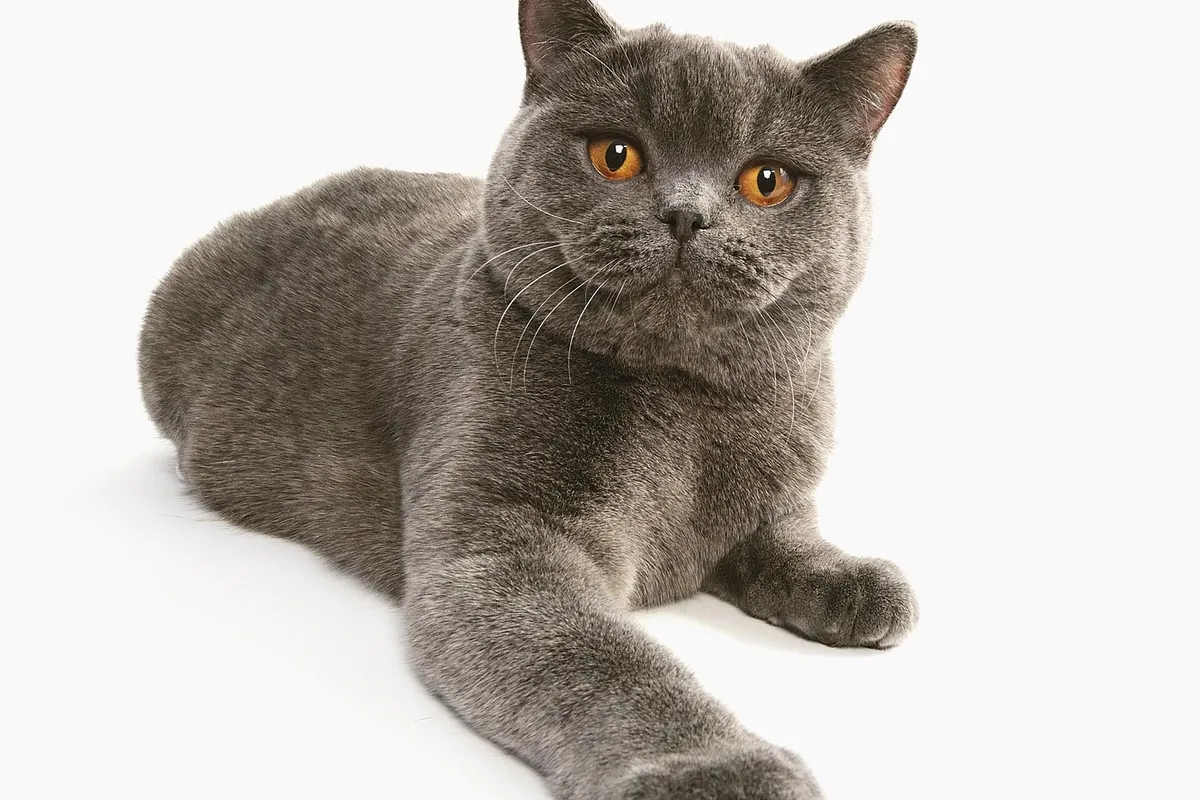
British Shorthair at a glance
| Trait | Detail |
|---|---|
| Origin | Great Britain [1] |
| Breed group | FIFe Category 3 [2] |
| Build | Robust and muscular, with a broad chest; reaches full size at about 3 years; males up to about 17 lb (7.7 kg), females smaller [1] |
| Life expectancy | 9.58 years at birth for British cats (including British Blue and British Longhair) in a 2019 UK study [3] |
| Coat | Short and very dense; blue is the classic color, with many other solids, bicolors and tabbies [1] |
Origin
British Shorthairs first came to public attention at London’s Crystal Palace cat shows at the turn of the 20th century. Both World Wars depleted the breed, and crosses to Persians and domestic shorthairs were used to rebuild it [1].
In the 1950s, a blue male, Brynbuboo Little Monarch, became the first Grand Champion of any breed in the UK’s Governing Council of the Cat Fancy; many British Shorthairs today trace back to him. The first cats exported to the United States were registered as “British Blues” [1].
Common health problems
- Hypertrophic cardiomyopathy (HCM): of 329 British Shorthairs screened by heart ultrasound in Denmark, 28 (8.5%) had HCM and 14 (4.3%) were equivocal. Males were affected far more often (20.4%) than females (2.1%), and the median age at diagnosis was 2.7 years [7]. The breed is among those considered at increased risk [8].
- Kidney and ureter stones: British Shorthairs were among the breeds at higher risk of upper urinary tract stones in UK referral practice (odds 1.92 to 3.31 times those of non-pedigree cats across the breeds at risk) [10]. See kidney disease in cats.
- Neonatal isoerythrolysis: kittens born to a type B queen mated with a type A or AB tom can have their red cells destroyed by the queen’s antibodies; it is rare, but mortality is high [5]. See anemia in cats.
- Ringworm (dermatophytosis): diagnosed in 25.6% of British Shorthairs seen at an Italian dermatology referral practice, against 2.1% of domestic shorthairs [11].
- Body weight: in the UK life-table study, cats with a non-ideal body weight had a shorter lifespan [3].
Tests and screening in British Shorthairs
- Blood typing: 58.7% of 121 British Shorthairs typed in the UK were type B, 39.7% type A and 1.6% type AB [4]; pooled data from other countries give about 36% type B [5]. All type B cats older than 3 months carry high levels of anti-A antibodies, so a mismatched transfusion can cause a severe reaction [5]. The Cat Fanciers’ Association also advises owners to know their cat’s blood type [1].
- DNA blood-type test: genetic tests for the CMAH gene predict types A, B and AB; breed-specific variants have been found in British Shorthairs, and the newer test panel assigned all 2,145 cats tested correctly [6].
- Heart ultrasound: the Danish authors recommend echocardiographic screening in this breed, especially in breeding cats [7].
- NT-proBNP: in 227 cats, a value above 46 pmol/L separated hidden cardiomyopathy from normal hearts with 85.8% sensitivity and 91.2% specificity [9], but it is not recommended to tell normal cats from mild to moderate HCM [8].
- Thyroid and blood pressure: recommended in a cat with thickened heart walls, to look for hyperthyroidism or hypertension [8]. See hyperthyroidism in cats.
- Kidney values and urine: see creatinine and BUN in cats and urinalysis.
Related articles
En français : British shorthair.
Questions to ask your veterinarian
- Do we know my cat’s blood type, and is it written in its records?
- Should my British Shorthair have a heart ultrasound, and at what age?
- Would an NT-proBNP test be useful for my cat?
- Is my cat’s weight ideal for its frame?
- Do my cat’s urine tests or kidney values suggest stones?
Get your British Shorthair’s blood work explained.
AI DiagAnimals reads the blood count, kidney values, urine results, T4 and NT-proBNP with your laboratory’s intervals, compares them with earlier results and prepares the questions for your vet. The service opens soon: leave your email to be told first.
Frequently asked questions
How long do British Shorthairs live?
In a UK study of cats that died in 2019, British cats had a life expectancy at birth of 9.58 years, against 11.74 years for all cats [3].
Are British Shorthairs blood type B?
Many are: 58.7% of British Shorthairs typed in a UK study were type B [4]. That is far more than in non-pedigree cats [4].
What health problems do British Shorthairs have?
Hypertrophic cardiomyopathy, especially in males, kidney and ureter stones and ringworm are documented, alongside the blood type B issues in transfusions and breeding [5, 7, 10, 11].
Do British Shorthairs get heart disease?
Yes. In Denmark, 8.5% of screened British Shorthairs had HCM, often from a young age; males had about 8 times the odds of females after adjustment [7].
Sources
- The Cat Fanciers’ Association. British Shorthair: breed profile. cfa.org/breed/british-shorthair
- Fédération Internationale Féline. Breeds and standards. fifeweb.org/cats/breeds
- Teng KT et al. Life tables of annual life expectancy and risk factors for mortality in cats in the UK. J Feline Med Surg. 2024;26(5):1098612X241234556. doi.org/10.1177/1098612X241234556
- Knottenbelt CM et al. Determination of the prevalence of feline blood types in the UK. J Small Anim Pract. 1999;40(3):115-118. doi.org/10.1111/j.1748-5827.1999.tb03051.x
- Silvestre-Ferreira AC, Pastor J. Feline neonatal isoerythrolysis and the importance of feline blood types. Vet Med Int. 2010;2010:753726. doi.org/10.4061/2010/753726
- Kehl A et al. CMAH genotyping survey for blood types A, B and C (AB) in purpose-bred cats. Anim Genet. 2019;50(3):303-306. doi.org/10.1111/age.12778
- Granström S et al. Prevalence of hypertrophic cardiomyopathy in a cohort of British Shorthair cats in Denmark. J Vet Intern Med. 2011;25(4):866-871. doi.org/10.1111/j.1939-1676.2011.0751.x
- Luis Fuentes V et al. ACVIM consensus statement guidelines for the classification, diagnosis, and management of cardiomyopathies in cats. J Vet Intern Med. 2020;34(3):1062-1077. doi.org/10.1111/jvim.15745
- Fox PR et al. Multicenter evaluation of plasma N-terminal probrain natriuretic peptide (NT-pro BNP) as a biochemical screening test for asymptomatic (occult) cardiomyopathy in cats. J Vet Intern Med. 2011;25(5):1010-1016. doi.org/10.1111/j.1939-1676.2011.00776.x
- Geddes RF et al. Risk factors for upper urinary tract uroliths and ureteral obstruction in cats under referral veterinary care in the United Kingdom. J Vet Intern Med. 2023;37(2):567-577. doi.org/10.1111/jvim.16659
- Colombo S et al. Epidemiological and clinical features of dermatophytosis in a referral practice in Italy: a retrospective study in different feline breeds. Vet Dermatol. 2026;37(3):399-404. doi.org/10.1111/vde.70050
Laboratory methods and reference intervals vary. This article explains; it does not diagnose. For a decision about your pet, use the original report and talk to your veterinarian. Our editorial policy.