
 Français
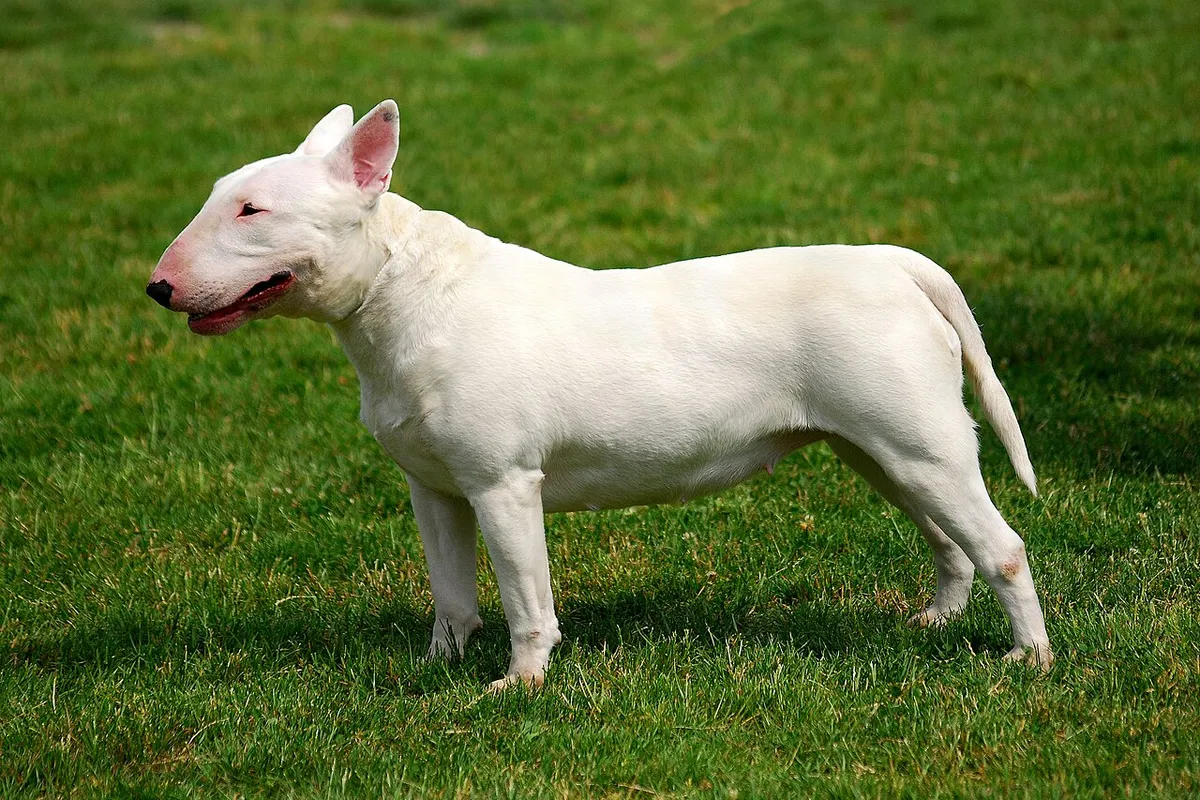
At a glance
| Trait | Detail |
|---|---|
| Origin | Great Britain [1] |
| Breed group | FCI group 3, section 3 (bull type terriers) [1]; AKC Terrier Group [2] |
| Weight | 50–70 lb (23–32 kg) [2]; the FCI standard sets no weight limit [1] |
| Height | 21–22 in (53–56 cm) [2]; no height limit in the FCI standard, except for the Miniature Bull Terrier [1] |
| Life expectancy | Median 12.0 years in a 2024 UK study of over 580,000 dogs [3] |
| Coat | Short, flat and harsh with a fine gloss; white, or coloured such as brindle, red, fawn or tricolour [1] |
Origin
James Hinks first standardised the breed in the 1850s, selecting the egg-shaped head. The Bull Terrier was first shown in its present form in Birmingham in 1862, and the Bull Terrier Club was formed in 1887 [1].
A smaller type has existed since the early 19th century. It was removed from the Kennel Club register in 1918 and revived from 1938 as the Miniature Bull Terrier, whose standard is the same apart from a height limit [1].
Common health problems
- Hereditary nephritis: a high prevalence of kidney failure was reported in Australian Bull Terriers. In one family of 33 dogs, 10 had kidney disease, seen as protein in the urine, basement membrane changes in the kidney, kidney failure or end-stage kidneys, and the pattern fitted an autosomal dominant gene [4]. See kidney disease in dogs.
- Polycystic kidney disease: ultrasound screening of 150 apparently healthy Bull Terriers found the disease in 39. It is inherited in a highly penetrant autosomal dominant way [6] and is linked to a mutation in the Pkd1 gene [7].
- Deafness: of 1,060 English Bull Terrier puppies tested in England, 10.19% were deaf, 8.21% in one ear and 1.98% in both. Of the deaf puppies, 96.29% had a white coat, and 19.29% of white puppies were deaf [9].
- Heart disease: of 101 English Bull Terriers in a Danish university study, 65% had heart disease, mostly mitral valve abnormalities (47%) and aortic stenosis (29%). Healthy Bull Terriers also had a smaller mitral valve than other dogs of the same size [10]. See heart failure in dogs.
- Lethal acrodermatitis: an autosomal recessive disease of Bull Terriers and Miniature Bull Terriers, with poor growth, immune deficiency and skin lesions, especially on the paws. It is caused by a variant of the MKLN1 gene, which allows genetic testing [11].
What is special in the Bull Terrier’s blood work
We found no breed-specific reference intervals for the Bull Terrier. The breed’s kidney diseases, however, show on urine and blood tests, often before a dog looks ill.
Urine protein to creatinine ratio (UPC). A UK breed club scheme for Miniature Bull Terriers screens with the UPC at 12 months of age and then every year. A ratio up to 0.5 is considered not at risk and anything above 0.5 should be investigated; a lower cut-off of 0.3, suggested by Australian research, has not been endorsed by the Kennel Club. The urine should be free of blood and inflammation, ideally a mid-stream sample taken first thing in the morning, before food [8]. See protein in urine.
When the kidneys fail. In 15 Bull Terriers aged 1 to 8 years with chronic kidney failure, blood tests showed raised urea and creatinine, phosphate and cholesterol, all 13 dogs tested had protein in the urine, and the urine was poorly concentrated, with a specific gravity of 1.011 to 1.017 [5]. Our guides to creatinine and urinalysis explain these values.
Polycystic kidneys. Abnormal urine sediment and proteinuria were common in affected dogs [6]. The Pkd1 mutation was found in all 47 affected Bull Terriers tested and in none of 102 unaffected dogs over one year old, so young dogs can be tested before breeding [7].
Hearing test. Deafness is diagnosed with the brainstem auditory evoked response (BAER) test, used in the English study on whole litters at about 6 weeks of age [9].
Zinc and lethal acrodermatitis. Many signs suggest zinc deficiency, but blood zinc levels are of limited diagnostic value; a skin biopsy with typical findings confirms the disease [12].
Related articles
En français : Bull terrier.
Questions to ask your veterinarian
- Should my Bull Terrier have a urine protein to creatinine ratio every year?
- Should my dog’s kidneys be checked by ultrasound for cysts?
- Was my puppy BAER-tested for deafness in both ears?
- Does my dog have a heart murmur, and does it need an echocardiogram?
- Were the parents DNA-tested for lethal acrodermatitis and polycystic kidney disease?
Get your Bull Terrier’s blood work explained.
AI DiagAnimals reads the urine protein to creatinine ratio, creatinine, urea, phosphate and other results together with your laboratory’s intervals, and explains them in plain language. The service opens soon: leave your email to be told first.
Frequently asked questions
How long do Bull Terriers live?
A 2024 UK study of over 580,000 dogs found a median lifespan of 12.0 years for Bull Terriers [3].
Do Bull Terriers have kidney problems?
Yes. Hereditary nephritis [4] and polycystic kidney disease [6] are both inherited in the breed, and both can cause protein in the urine.
What is a UPC test for Bull Terriers?
A urine test comparing protein with creatinine. A UK breed club scheme uses it from 12 months of age and then yearly, and investigates ratios above 0.5 [8].
Are white Bull Terriers often deaf?
Yes. In English puppies, 19.29% of white puppies were deaf in one or both ears, and almost all deaf puppies were white [9].
What heart problems do Bull Terriers have?
Mitral valve abnormalities and aortic stenosis were the most common in a Danish study, where 65% of Bull Terriers had heart disease [10].
Sources
- FCI. Standard No. 11: Bull Terrier. 2026. fci.be/Nomenclature/Standards/011g03-en.pdf
- American Kennel Club. Bull Terrier: dog breed information. akc.org/dog-breeds/bull-terrier
- McMillan KM et al. Longevity of companion dog breeds: those at risk from early death. Sci Rep. 2024;14:531 (supplementary table S3). doi.org/10.1038/s41598-023-50458-w
- Hood JC et al. Hereditary nephritis in the bull terrier: evidence for inheritance by an autosomal dominant gene. Vet Rec. 1990;126(18):456-459. pubmed.ncbi.nlm.nih.gov/2356601
- Robinson WF et al. Chronic renal disease in bull terriers. Aust Vet J. 1989;66(7):193-195. doi.org/10.1111/j.1751-0813.1989.tb09805.x
- O’Leary CA et al. Polycystic kidney disease in bull terriers: an autosomal dominant inherited disorder. Aust Vet J. 1999;77(6):361-366. doi.org/10.1111/j.1751-0813.1999.tb10304.x
- Gharahkhani P et al. A non-synonymous mutation in the canine Pkd1 gene is associated with autosomal dominant polycystic kidney disease in Bull Terriers. PLoS One. 2011;6(7):e22455. doi.org/10.1371/journal.pone.0022455
- The Miniature Bull Terrier Club. Kidney disease. miniaturebullterrierclub.org/kidney-disease
- De Risio L et al. Prevalence, heritability and genetic correlations of congenital sensorineural deafness and coat pigmentation phenotype in the English bull terrier. BMC Vet Res. 2016;12:146. doi.org/10.1186/s12917-016-0777-6
- Chompoosan C et al. Epidemiology of heart disease in English Bull Terriers and echocardiographic characteristics of mitral valve abnormalities. J Small Anim Pract. 2022;63(5):372-380. doi.org/10.1111/jsap.13472
- Bauer A et al. MKLN1 splicing defect in dogs with lethal acrodermatitis. PLoS Genet. 2018;14(3):e1007264. doi.org/10.1371/journal.pgen.1007264
- McEwan NA et al. Diagnostic features, confirmation and disease progression in 28 cases of lethal acrodermatitis of bull terriers. J Small Anim Pract. 2000;41(11):501-507. doi.org/10.1111/j.1748-5827.2000.tb03972.x
Laboratory methods and reference intervals vary. This article explains; it does not diagnose. For a decision about your pet, use the original report and talk to your veterinarian. Our editorial policy.