
 Français
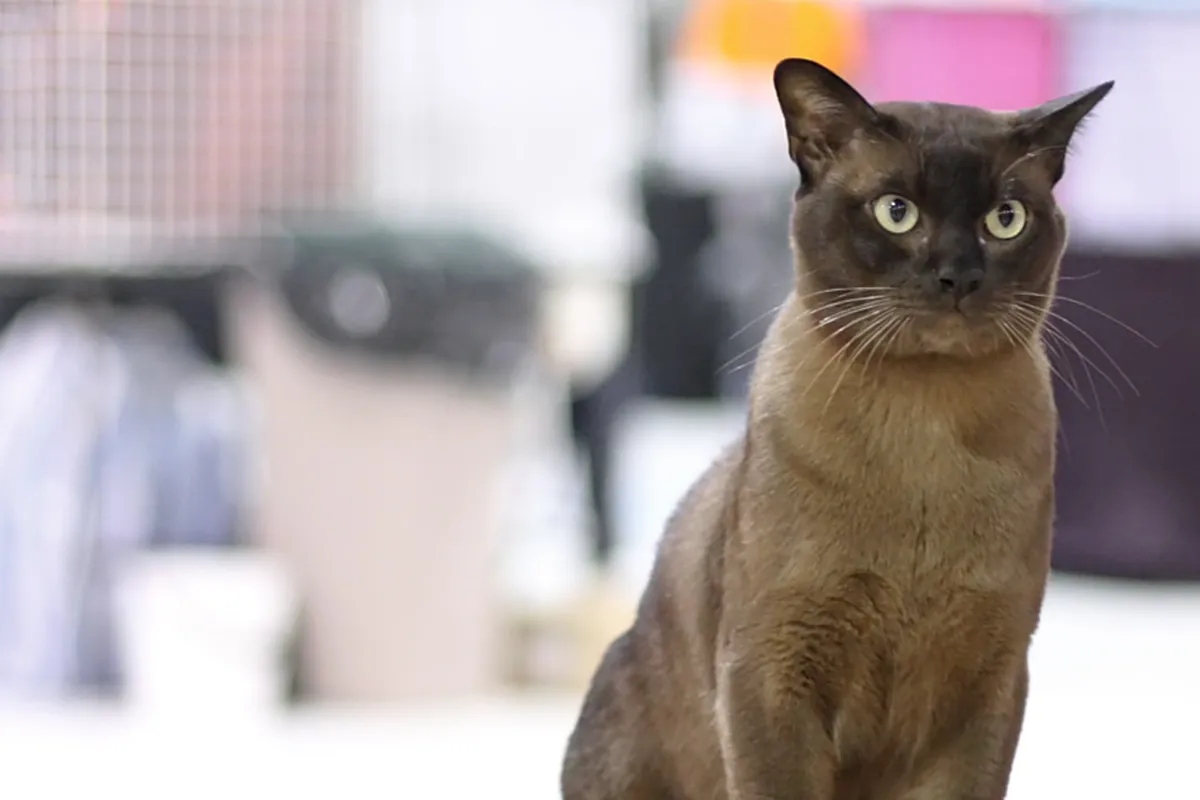
Burmese at a glance
| Trait | Detail |
|---|---|
| Origin | Southeast Asia; most of today’s American Burmese trace back to one cat, Wong Mau, brought to the United States in 1930 [1] |
| Breed group | FIFe Category 3 [2] |
| Build | Medium-sized, compact and muscular, with a surprising weight for its size; mature males may reach or exceed 12 lb (5.4 kg) [1] |
| Life expectancy | 14.42 years at birth, the longest of the 12 breed groups in the 2024 UK life tables (11.74 years for all cats) [3] |
| Coat | Very short, fine, glossy and close-lying; sable, champagne, blue or platinum in the CFA standard [1] |
Origin
Burmese occur naturally on the Malay Peninsula, but most of today’s American Burmese descend from Wong Mau, a small walnut-brown female brought to America in 1930 and bred to Siamese. Her solid dark-brown offspring bred true; the Cat Fanciers’ Association began registering Burmese in 1936 and granted championship status in 1959 [1]. The breed’s roots are described as cats of Thailand, once known as the Copper Cat of Siam [9].
Breeders later developed distinct lines. In the United States, a “Contemporary” Burmese with a very short muzzle became popular [9], and American Burmese are considered genetically distinct from Burmese in other parts of the world [5]. This matters for health, because the diabetes risk and the low-potassium gene have mainly been documented outside the United States [5, 6], and the head defect in the Contemporary line [9]. FIFe places the Burmese in Category 3 [2].
Common health problems
- Diabetes mellitus: in Swedish insurance data, Burmese had the highest diabetes incidence of all breeds, 48.8 cases per 10,000 cat-years, and 4.3 times the rate of all other cats; males and females were affected equally [4]. In English primary care, 2.27% of Burmese were diabetic compared with 0.58% of crossbred cats, with three times the odds after adjustment [5]. An increased risk has not been documented in American Burmese [5]. See diabetes in cats.
- Hypokalemic polymyopathy (low potassium): an inherited disorder in which serum potassium drops and causes muscle weakness, often in episodes; a bent-down head and neck is especially characteristic [7]. Signs usually appear between 2 and 6 months of age, sometimes later, and can be triggered by stress or exercise [6]. It is caused by a recessive variant of the WNK4 gene, probably through potassium loss in the urine [6, 7]. See potassium in cats.
- Burmese head defect: in the Contemporary line, kittens with two copies of an ALX1 gene variant are born with a severe malformation of the face and skull that is incompatible with life; cats with one copy have a shorter muzzle than non-carriers and were favored by breeders, which helped the variant spread [9].
- Slow fat clearance: in an Australian study, healthy Burmese had a median triglyceride level of 8.2 mmol/L six hours after a fatty meal, against 1.0 mmol/L in other cats; seven Burmese reached 6.6 to 19.0 mmol/L, yet none had high fasting values. The authors discussed links with fat in the eye (lipid aqueous), pancreatitis and diabetes [8].
- Feline orofacial pain syndrome: a painful, often one-sided mouth discomfort with tongue mutilation; 100 of the 113 cats in a case series were Burmese, and 12% were euthanized because of it. Most (63%) had a history of mouth lesions, and at least 16% first showed signs while their adult teeth erupted [10].
- Kidney and ureter stones: in UK referral data, Burmese had 1.92 times the odds of upper urinary tract stones compared with non-pedigree cats [11]. See kidney disease in cats.
- GM2 gangliosidosis: a fatal inherited storage disease of the nervous system first described in the Burmese; in a large DNA screening, 1 of 113 Burmese carried the variant [12].
The Bombay, created from Burmese and American Shorthair, also carries the head defect gene [9]: see the Bombay cat page.
Tests and screening in Burmese
- Glucose and fructosamine: with a three- to four-fold diabetes risk [4, 5], a high glucose in an older Burmese is worth discussing with your vet. See blood sugar in cats for how stress and diabetes are told apart.
- Potassium and creatine kinase (CK): affected cats were confirmed by signs together with a serum potassium below 3.0 mmol/L, usually with a raised CK [6]. Potassium can return to normal between episodes, so in the past repeated measurements were needed [7].
- DNA test for hypokalemia (WNK4): an inexpensive PCR test identifies affected cats and carriers [7]. In 268 cats of Burmese and related breeds, the variant made up 14.9% of the gene copies, while none of 16 US Burmese tested carried it [6]. A later screening of over 11,000 cats found lower frequencies than at the time of discovery, presumably thanks to testing and informed breeding [12].
- DNA test for the head defect (ALX1): offered to breeders; among more than 3,000 Burmese-type cats genotyped, the variant made up about 6% of gene copies, an estimate the authors considered biased [9].
- Triglycerides: because some Burmese have normal fasting values but very high values after a fatty meal [8], the time since the last meal matters when a lipemic (milky) sample or high triglycerides are reported. See cat blood work explained.
- Blood type: 98.8% of 161 Burmese-type cats in a large DNA study were type A and 1.2% type B [12].
Related articles
En français : Burmese.
Questions to ask your veterinarian
- Is my cat from European, Australian or American Burmese lines, and does that change its risks?
- Should my cat’s glucose or fructosamine be checked regularly as it gets older?
- Has my cat, or its parents, been DNA tested for hypokalemia (WNK4)?
- If my cat has episodes of weakness, should we measure potassium and CK during an episode?
- Were my cat’s triglycerides measured after a meal, and should the test be repeated fasting?
Get your Burmese’s blood work explained.
AI DiagAnimals reads glucose, fructosamine, potassium, creatine kinase, triglycerides and kidney values with your laboratory’s intervals, compares them with earlier results and prepares the questions for your vet. The service opens soon: leave your email to be told first.
Frequently asked questions
How long do Burmese cats live?
In the 2024 UK life tables, Burmese had a life expectancy at birth of 14.42 years, the longest of the 12 breed groups analyzed; the figure for all cats was 11.74 years [3].
Are Burmese cats prone to diabetes?
Yes, in Europe. Burmese had 4.3 times the diabetes rate of other cats in Sweden and three times the odds in England [4, 5]. An increased risk has not been documented in American Burmese [5].
What is Burmese hypokalemia?
An inherited disorder in which blood potassium falls and causes episodes of muscle weakness, usually in kittens of 2 to 6 months. It is caused by a WNK4 gene variant, and a DNA test identifies affected cats and carriers [6, 7].
What tests should a Burmese cat have?
The DNA tests for hypokalemia and, in Contemporary lines, for the head defect, plus glucose checks as the cat ages because of the diabetes risk [4, 6, 7, 9].
Why are my Burmese’s triglycerides high?
Some healthy Burmese clear fat from the blood slowly after a meal: in one study their triglycerides six hours after a fatty meal were far higher than in other cats, while fasting values were normal [8]. Your vet can tell you whether a repeat fasting test is useful.
Sources
- The Cat Fanciers’ Association. Burmese: breed profile. cfa.org/breed/burmese
- Fédération Internationale Féline. Breeds and standards. fifeweb.org/cats/breeds
- Teng KT et al. Life tables of annual life expectancy and risk factors for mortality in cats in the UK. J Feline Med Surg. 2024;26(5):1098612X241234556. doi.org/10.1177/1098612X241234556
- Öhlund M et al. Incidence of diabetes mellitus in insured Swedish cats in relation to age, breed and sex. J Vet Intern Med. 2015;29(5):1342-1347. doi.org/10.1111/jvim.13584
- O’Neill DG et al. Epidemiology of diabetes mellitus among 193,435 cats attending primary-care veterinary practices in England. J Vet Intern Med. 2016;30(4):964-972. doi.org/10.1111/jvim.14365
- Gandolfi B et al. First WNK4-hypokalemia animal model identified by genome-wide association in Burmese cats. PLoS One. 2012;7(12):e53173. doi.org/10.1371/journal.pone.0053173
- Malik R et al. Periodic hypokalaemic polymyopathy in Burmese and closely related cats: a review including the latest genetic data. J Feline Med Surg. 2015;17(5):417-426. doi.org/10.1177/1098612X15581135
- Kluger EK et al. Triglyceride response following an oral fat tolerance test in Burmese cats, other pedigree cats and domestic crossbred cats. J Feline Med Surg. 2009;11(2):82-90. doi.org/10.1016/j.jfms.2008.05.005
- Lyons LA et al. Aristaless-Like Homeobox protein 1 (ALX1) variant associated with craniofacial structure and frontonasal dysplasia in Burmese cats. Dev Biol. 2016;409(2):451-458. doi.org/10.1016/j.ydbio.2015.11.015
- Rusbridge C et al. Feline orofacial pain syndrome (FOPS): a retrospective study of 113 cases. J Feline Med Surg. 2010;12(6):498-508. doi.org/10.1016/j.jfms.2010.03.005
- Geddes RF et al. Risk factors for upper urinary tract uroliths and ureteral obstruction in cats under referral veterinary care in the United Kingdom. J Vet Intern Med. 2023;37(2):567-577. doi.org/10.1111/jvim.16659
- Anderson H et al. Genetic epidemiology of blood type, disease and trait variants, and genome-wide genetic diversity in over 11,000 domestic cats. PLoS Genet. 2022;18(6):e1009804. doi.org/10.1371/journal.pgen.1009804
Laboratory methods and reference intervals vary. This article explains; it does not diagnose. For a decision about your pet, use the original report and talk to your veterinarian. Our editorial policy.