
 Français
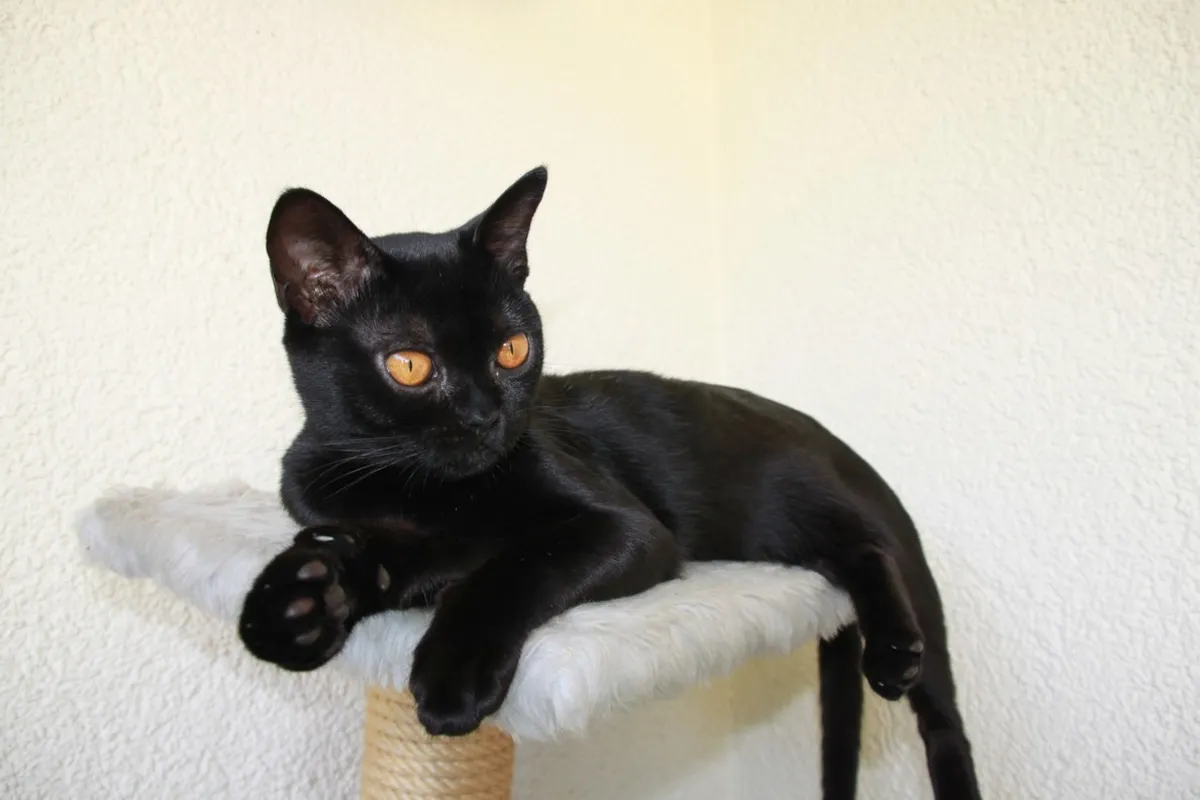
Bombay at a glance
| Trait | Detail |
|---|---|
| Origin | United States: created in 1966 in Kentucky by crossing a black American Shorthair with a Burmese [1] |
| Breed group | FIFe preliminary recognition in Category 3 (2023–2027) [2] |
| Build | Medium-sized, muscular and surprisingly heavy for its size, with a rounded head and a moderate nose stop [1] |
| Life expectancy | No breed figure in the 2024 UK life tables, which only covered breeds with 15 or more deaths; 11.74 years at birth for all cats [3] |
| Coat | Short, fine and close-lying with a patent-leather sheen, black to the roots; eyes gold to copper [1] |
Origin
The Bombay was created in 1966 by Kentucky breeder Nikki Horner, who bred a black American Shorthair male to a Burmese female to produce a “parlor panther”; the name refers to the black leopards of India. The Cat Fanciers’ Association accepted the breed for registration in 1970 and for championship in 1976, and it remains one of the association’s rarer breeds [1].
Its close link with the Burmese continues: Bombay and Burmese pedigrees overlap, and both breeds were studied together to find the head defect gene [4]. FIFe has given the Bombay preliminary recognition in Category 3 for 2023 to 2027 [2].
Common health problems
- Burmese head defect: a recessive malformation of the face and skull, incompatible with life, in kittens with two copies of an ALX1 gene variant. Affected Bombay kittens were part of the study that identified the gene, and 43 of 133 Bombays tested (32%) carried one copy, a much higher share than the 151 of 3,250 Burmese tested [4]. See the Burmese cat page.
- Hypertrophic cardiomyopathy (HCM): the breed club reports that HCM has been found in Bombays and that responsible breeders test before breeding [1]. No Bombay-specific prevalence figure has been published; across all cats, most HCM cases are non-pedigree, and prevalence data for pedigree breeds are lacking [9].
- Breathing and short noses: the CFA standard disqualifies an extreme nose break that interferes with normal breathing and tearing of the eyes [1]. In a French series of 37 short-nosed cats treated surgically for narrowed nostrils, 4 were Bombays [7].
- Eyes: the breed club notes overly teary eyes that may need regular wiping [1]. In a French referral study that counted the Bombay among short-nosed breeds, 36% of short-nosed cats had corneal ulcers against 15% of other cats, and corneal sequestra were also more frequent [8].
- Low potassium (hypokalemia): this inherited disorder of the Burmese is caused by a WNK4 variant; the variant was not found in 13 US Bombays tested [5], but a review lists the Bombay among breeds with Burmese lines in which testing can help remove it [6]. See potassium in cats.
Short-nosed breeds share some of these eye and breathing issues: see the Persian cat page.
Tests and screening in Bombays
- DNA test for the head defect (ALX1): a genetic test has been offered by university laboratories [4]. Because the condition is recessive, a kitten is affected only when it inherits the variant from both parents [4].
- Heart screening: heart ultrasound (echocardiography) is the reference test for HCM [9]. The NT-proBNP blood test can be used when ultrasound is not available but is not recommended to tell normal cats from mild to moderate HCM [9]. In cats aged 6 years or more with an abnormal heart sound, a T4 test is recommended to look for hyperthyroidism [9]. See hyperthyroidism in cats.
- Potassium and the WNK4 test: in Burmese, the disorder was confirmed by weakness together with a serum potassium below 3.0 mmol/L, usually with a raised creatine kinase (CK) [5]. An inexpensive PCR test identifies affected cats and carriers [6].
- What is not known: we found no published breed reference values or blood-type survey for the Bombay, so its results are read against general feline intervals. See cat blood work explained.
Related articles
En français : Bombay.
Questions to ask your veterinarian
- Have my cat’s parents been DNA tested for the ALX1 head defect variant?
- Have my cat’s parents been screened for heart disease by ultrasound, and should my cat be?
- Are my cat’s nostrils narrow, and does that affect its breathing?
- Are my cat’s tear stains a sign of an eye problem?
- If my cat has episodes of weakness, should we measure potassium and CK?
Get your Bombay’s blood work explained.
AI DiagAnimals reads the blood count, kidney values, potassium, T4 and NT-proBNP with your laboratory’s intervals, compares them with earlier results and prepares the questions for your vet. The service opens soon: leave your email to be told first.
Frequently asked questions
How long do Bombay cats live?
There is no published breed figure: the 2024 UK life tables only covered breeds with 15 or more deaths, and the Bombay was not among them. The life expectancy at birth of all cats was 11.74 years [3].
What health problems do Bombay cats have?
The Burmese head defect gene is common in the breed [4]. The breed club reports hypertrophic cardiomyopathy and teary eyes [1], and short-nosed Bombays can have narrow nostrils [7].
Do Bombay cats carry the Burmese head defect?
Yes. In one study, 43 of 133 Bombays tested carried the ALX1 variant; kittens with two copies have a lethal malformation of the face and skull, and a DNA test exists [4].
What tests should a Bombay cat have?
The ALX1 DNA test for breeding cats and heart ultrasound screening are the tests most often discussed [1, 4, 9].
Are Bombay cats healthy?
The breed club considers them quite healthy because of their mixed ancestry, while reporting heart disease and teary eyes [1]. Published studies on the breed are few, so many questions remain open.
Sources
- The Cat Fanciers’ Association. Bombay: breed profile. cfa.org/breed/bombay
- Fédération Internationale Féline. Breeds and standards. fifeweb.org/cats/breeds
- Teng KT et al. Life tables of annual life expectancy and risk factors for mortality in cats in the UK. J Feline Med Surg. 2024;26(5):1098612X241234556. doi.org/10.1177/1098612X241234556
- Lyons LA et al. Aristaless-Like Homeobox protein 1 (ALX1) variant associated with craniofacial structure and frontonasal dysplasia in Burmese cats. Dev Biol. 2016;409(2):451-458. doi.org/10.1016/j.ydbio.2015.11.015
- Gandolfi B et al. First WNK4-hypokalemia animal model identified by genome-wide association in Burmese cats. PLoS One. 2012;7(12):e53173. doi.org/10.1371/journal.pone.0053173
- Malik R et al. Periodic hypokalaemic polymyopathy in Burmese and closely related cats: a review including the latest genetic data. J Feline Med Surg. 2015;17(5):417-426. doi.org/10.1177/1098612X15581135
- Thouvenot Oudart E et al. Stenotic nares treatment in 37 brachycephalic cats by ala vestibuloplasty: 2017–2025. J Feline Med Surg. 2026;28(5):1098612X261440977. doi.org/10.1177/1098612X261440977
- Frejlich M et al. Prevalence and characteristics of feline ulcerative keratitis and corneal sequestra in a referral population and comparison between brachycephalic and nonbrachycephalic cats. Vet Ophthalmol. 2026;29(2):e70048. doi.org/10.1111/vop.70048
- Luis Fuentes V et al. ACVIM consensus statement guidelines for the classification, diagnosis, and management of cardiomyopathies in cats. J Vet Intern Med. 2020;34(3):1062-1077. doi.org/10.1111/jvim.15745
Laboratory methods and reference intervals vary. This article explains; it does not diagnose. For a decision about your pet, use the original report and talk to your veterinarian. Our editorial policy.