
 Français
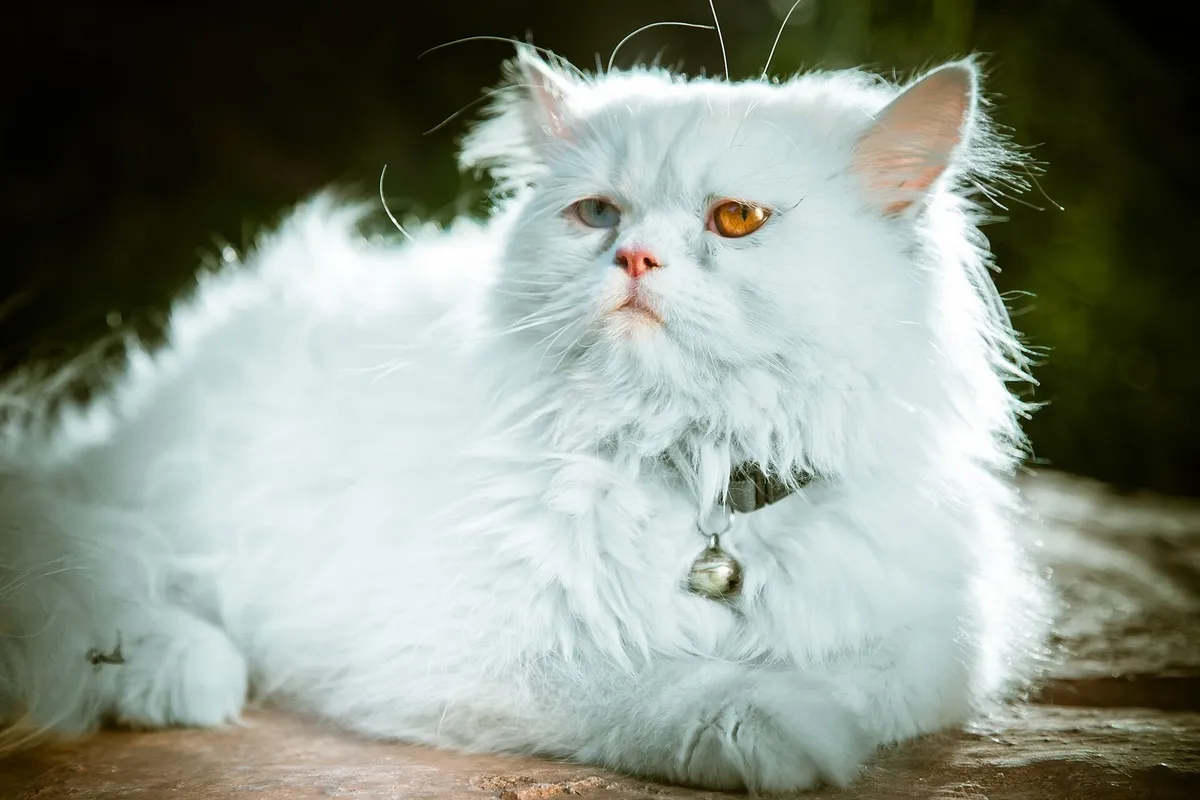
Persian cat at a glance
| Trait | Detail |
|---|---|
| Origin | Named after Persia, its presumed country of origin; developed in Europe, then the United States [1] |
| Breed group | FIFe Category 1 [2] |
| Build | Cobby and solidly built, with short, heavy-boned legs; mean adult weight 3.9 kg (8.6 lb) in UK primary care [1, 3] |
| Life expectancy | Median longevity 13.5 years (UK, 2013) [3]; life expectancy at birth 10.93 years (UK, 2019) [4] |
| Coat | Long, flowing and full, in many colors, including the pointed Himalayan pattern [1] |
Origin
In 1626, the Italian traveler Pietro della Valle brought a heavily coated longhaired cat back from Persia. Crosses with the Turkish Angora produced a sturdy, short-nosed cat with a silky coat, and these Persians dominated the first cat shows [1].
The first imports reached the United States in the late 1880s, and the Persian was one of the six foundation breeds of the Cat Fanciers’ Association in 1906 [1].
Common health problems
- Polycystic kidney disease (PKD): an inherited disease in which fluid-filled cysts form in the kidneys. It was estimated to affect about 38% of Persians worldwide; a single dominant PKD1 variant was found in all 41 affected Persians tested [5]. In France, 41.8% of Persians screened by ultrasound in 2000–2002 had cysts [6]. PKD often leads to kidney failure from mid to late life [7]. See kidney disease in cats.
- Kidney deaths: in 3,235 Persians under UK primary care, kidney disease was the most common cause of death (23.4%) [3].
- Coat, nails, eyes and teeth: the most common disorders were haircoat problems (12.7%), periodontal disease (11.3%), overgrown nails (7.2%) and ocular discharge (5.8%) [3].
- Breathing: the emphasis on very flat faces led to cats with narrow nostrils and breathing problems; breeders have reduced their number [1].
- Hypertrophic cardiomyopathy: in a French series, Persians with HCM were diagnosed at a median age of 11 years, later than Maine Coons or Sphynx, and 56% had an obstruction of the outflow of the left ventricle [8].
- Kidney and ureter stones: Persians were among the breeds at higher risk of upper urinary tract stones in UK referral practice [9].
- Ringworm (dermatophytosis): diagnosed in 21.2% of Persians seen at an Italian dermatology referral practice, against 2.1% of domestic shorthairs [10].
Tests and screening in Persians
- DNA test for PKD1: affected cats carry one copy of the variant; no cat with two copies has been found, which suggests that two copies are lethal before birth [5].
- Kidney ultrasound: done at 10 to 14 weeks of age in 70 Persian and Exotic kittens, it had a sensitivity of 96.2% and a specificity of 91% compared with genetic testing. Some cats with cysts were DNA-negative, so the authors advise using both tests [11].
- Kidney values: PKD often leads to kidney failure from mid to late life [7], which shows on the kidney values of the blood test. See creatinine and BUN in cats and SDMA in dogs and cats.
- Blood type: about 14% of Persians were type B in pooled breed data [12]. Type B cats carry strong natural antibodies against type A blood, so a transfusion or a mating between types needs care [12]. See anemia in cats.
- Routine blood panels: see cat blood work explained.
Related articles
En français : Persan.
Questions to ask your veterinarian
- Has my cat, or its parents, been tested for the PKD1 variant?
- Should my Persian have a kidney ultrasound, and at what age?
- Which kidney values and urine tests should we follow, and how often?
- Do my cat’s nostrils or eyes need attention?
- Do we know my cat’s blood type?
Get your Persian’s blood work explained.
AI DiagAnimals reads creatinine, SDMA, urea, phosphorus, urine specific gravity and the blood count with your laboratory’s intervals, compares them with earlier results and prepares the questions for your vet. The service opens soon: leave your email to be told first.
Frequently asked questions
How long do Persian cats live?
The median longevity was 13.5 years in a UK study of 3,235 Persians [3]; another UK study found a life expectancy at birth of 10.93 years [4].
What health problems do Persian cats have?
Coat, dental, nail and eye problems are the most common, and polycystic kidney disease is the main inherited disease [3, 5].
How is polycystic kidney disease tested in Persians?
With a DNA test for the PKD1 variant and a kidney ultrasound; in kittens of 10 to 14 weeks, ultrasound detected 96.2% of affected cats [5, 11].
What do Persian cats usually die of?
Kidney disease was the most common cause of death (23.4%), followed by cancer (8.5%) [3].
Are Persian cats blood type B?
Most are type A; about 14% were type B in pooled data [12].
Sources
- The Cat Fanciers’ Association. Persian: breed profile. cfa.org/breed/persian
- Fédération Internationale Féline. Breeds and standards. fifeweb.org/cats/breeds
- O’Neill DG et al. Persian cats under first opinion veterinary care in the UK: demography, mortality and disorders. Sci Rep. 2019;9(1):12952. doi.org/10.1038/s41598-019-49317-4
- Teng KT et al. Life tables of annual life expectancy and risk factors for mortality in cats in the UK. J Feline Med Surg. 2024;26(5):1098612X241234556. doi.org/10.1177/1098612X241234556
- Lyons LA et al. Feline polycystic kidney disease mutation identified in PKD1. J Am Soc Nephrol. 2004;15(10):2548-2555. doi.org/10.1097/01.ASN.0000141776.38527.BB
- Barthez PY et al. Prevalence of polycystic kidney disease in Persian and Persian related cats in France. J Feline Med Surg. 2003;5(6):345-347. doi.org/10.1016/S1098-612X(03)00052-4
- Domanjko-Petric A et al. Polycystic kidney disease: a review and occurrence in Slovenia with comparison between ultrasound and genetic testing. J Feline Med Surg. 2008;10(2):115-119. doi.org/10.1016/j.jfms.2007.07.004
- Trehiou-Sechi E et al. Comparative echocardiographic and clinical features of hypertrophic cardiomyopathy in 5 breeds of cats: a retrospective analysis of 344 cases (2001-2011). J Vet Intern Med. 2012;26(3):532-541. doi.org/10.1111/j.1939-1676.2012.00906.x
- Geddes RF et al. Risk factors for upper urinary tract uroliths and ureteral obstruction in cats under referral veterinary care in the United Kingdom. J Vet Intern Med. 2023;37(2):567-577. doi.org/10.1111/jvim.16659
- Colombo S et al. Epidemiological and clinical features of dermatophytosis in a referral practice in Italy: a retrospective study in different feline breeds. Vet Dermatol. 2026;37(3):399-404. doi.org/10.1111/vde.70050
- Bonazzi M et al. Comparison between ultrasound and genetic testing for the early diagnosis of polycystic kidney disease in Persian and Exotic Shorthair cats. J Feline Med Surg. 2009;11(6):430-434. doi.org/10.1016/j.jfms.2008.10.003
- Silvestre-Ferreira AC, Pastor J. Feline neonatal isoerythrolysis and the importance of feline blood types. Vet Med Int. 2010;2010:753726. doi.org/10.4061/2010/753726
Laboratory methods and reference intervals vary. This article explains; it does not diagnose. For a decision about your pet, use the original report and talk to your veterinarian. Our editorial policy.