
 Français
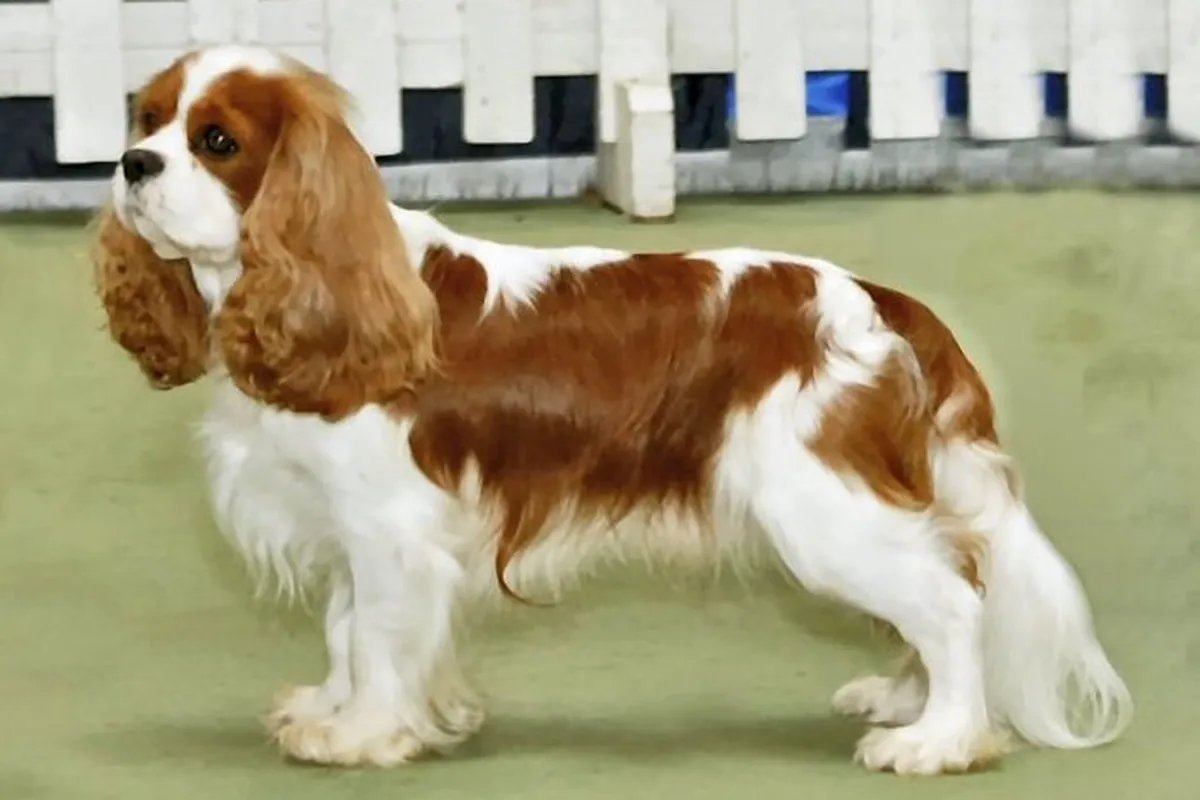
Cavalier King Charles Spaniel at a glance
| Trait | Detail |
|---|---|
| Origin | Great Britain [1] |
| Breed group | FCI group 9 (companion and toy dogs), section 7, English toy spaniels [1]; AKC Toy Group [2] |
| Weight | 12–18 lb (5.4–8 kg) [1] |
| Height | 12–13 in (30–33 cm) [2] |
| Life expectancy | 10.5 years at birth in a UK life table [4] |
| Coat | Long and silky, free from curl, never trimmed; black and tan, ruby, Blenheim or tricolour [1] |
Origin
Toy spaniels were common pets at the English court; under the Stuarts they took the name King Charles Spaniels, and King Charles II was rarely seen without several at his heels. Later breeding for show produced the flat-faced King Charles Spaniel [3].
Later, an American, Roswell Eldridge, offered prizes at Crufts for spaniels with the longer nose seen in old paintings. A breed club was founded and the name Cavalier King Charles Spaniel chosen in 1928, and the Kennel Club granted separate registration in 1945 [3].
Common health problems
- Mitral valve disease: in a study of 1,749 Cavaliers in UK practices, a heart murmur was the most common disorder (30.9%), and heart problems affected 31.7% [5]. Cavaliers had 47 times the odds of crossbred dogs of a diagnosis of degenerative mitral valve disease [6]. See heart failure in dogs.
- Age at onset: in 8,860 Cavaliers examined in the UK breed heart scheme, the median age at which a murmur was first heard was 7.8 years in males and 8.3 years in females [7].
- Older Cavaliers: of 126 Cavaliers aged 8 or more, 89% had a murmur and all had echocardiographic signs of mitral valve disease, yet 44% had no enlargement of the heart [8].
- Syringomyelia: fluid cavities in the spinal cord were found in 50.5% of 386 MRI-screened breeding Cavaliers with no signs, and the proportion rose with age [9].
- Other common problems: diarrhea (11.0%), dental disease (9.5%), ear infection (9.2%) and conjunctivitis (7.4%) [5].
Blood work and screening in Cavaliers
The Cavalier is one of the breeds where a normal-looking blood result can be misread. Inherited macrothrombocytopenia means fewer but larger platelets, with no bleeding tendency.
- Low platelet count without disease: in 105 healthy Cavaliers from 16 families, counted by hand, 46% of the parents had 100,000 platelets/µL or fewer. The trait is inherited as autosomal recessive [10].
- Analyzers miss large platelets: automated counters have difficulty counting large platelets, so the study counted them by hand [10]. A low platelet count from a machine is therefore not enough on its own to diagnose a platelet problem in a Cavalier [10, 11].
- Plateletcrit: the total platelet mass (plateletcrit) measured by some analyzers avoided overestimating low platelet mass in sick Cavaliers [11].
- DNA test: a variant in the β1-tubulin gene correlates with the macrothrombocytopenia, which helps tell the inherited form from acquired causes such as immune thrombocytopenia [12].
- Heart screening: breeding guidelines based on listening for a murmur were linked with later onset of murmurs only in some groups, and breeder compliance with the voluntary UK scheme was poor [7].
See also the CBC for dogs for how platelets are reported.
Related articles
En français : Cavalier King Charles.
Questions to ask your veterinarian
- Can you hear a heart murmur, and should my Cavalier have an echocardiogram?
- Is the low platelet count in my Cavalier’s results confirmed on a blood smear?
- Should we test for the β1-tubulin variant so the platelet count is read correctly in future?
- Which signs could point to syringomyelia, and is an MRI useful?
- How often should my Cavalier’s heart be checked as he or she gets older?
Get your Cavalier’s blood count explained.
AI DiagAnimals reads the platelet count, red and white cells and the chemistry with your laboratory’s intervals, and prepares the questions for your vet. The service opens soon: leave your email to be told first.
Frequently asked questions
How long do Cavalier King Charles Spaniels live?
A UK life table gave Cavaliers a life expectancy at birth of 10.5 years, a little below the 11.2 years of dogs overall [4].
Do all Cavaliers get heart disease?
Mitral valve disease is very common: in a group of 126 Cavaliers aged 8 or more, all had signs of it on echocardiography, but 44% had no enlargement of the heart [8].
Why is my Cavalier’s platelet count low?
Many healthy Cavaliers have an inherited macrothrombocytopenia: fewer, larger platelets that analyzers count poorly. In one study, 46% of healthy breeding Cavaliers had 100,000 platelets/µL or fewer [10].
Is there a DNA test for Cavalier platelets?
Yes. A variant in the β1-tubulin gene correlates with the inherited large platelets [12].
Sources
- Fédération Cynologique Internationale. FCI breed standard N° 136: Cavalier King Charles Spaniel. 2026. fci.be/Nomenclature/Standards/136g09-en.pdf
- American Kennel Club. Cavalier King Charles Spaniel: breed information. akc.org/dog-breeds/cavalier-king-charles-spaniel
- The Cavalier King Charles Spaniel Club (UK). History of the breed. thecavalierclub.co.uk/breed/history.html
- Teng KT et al. Life tables of annual life expectancy and mortality for companion dogs in the United Kingdom. Sci Rep. 2022;12(1):6415. doi.org/10.1038/s41598-022-10341-6
- Summers JF et al. Prevalence of disorders recorded in Cavalier King Charles Spaniels attending primary-care veterinary practices in England. Canine Genet Epidemiol. 2015;2:4. doi.org/10.1186/s40575-015-0016-7
- Mattin MJ et al. Prevalence of and risk factors for degenerative mitral valve disease in dogs attending primary-care veterinary practices in England. J Vet Intern Med. 2015;29(3):847-854. doi.org/10.1111/jvim.12591
- Swift S et al. Degenerative valvular disease in the Cavalier King Charles Spaniel: results of the UK breed scheme 1991-2010. J Vet Intern Med. 2017;31(1):9-14. doi.org/10.1111/jvim.14619
- Prieto Ramos J et al. Clinical and echocardiographic findings in an aged population of Cavalier King Charles Spaniels. Animals (Basel). 2021;11(4):949. doi.org/10.3390/ani11040949
- McLeay L, Child G. Syringomyelia in Australian Cavalier King Charles spaniels: prevalence and changes over 16 years of magnetic resonance imaging screening. Aust Vet J. 2026;104(1-2):50-56. doi.org/10.1111/avj.70013
- Pedersen HD et al. Idiopathic asymptomatic thrombocytopenia in Cavalier King Charles Spaniels is an autosomal recessive trait. J Vet Intern Med. 2002;16(2):169-173. pubmed.ncbi.nlm.nih.gov/11899033
- Kelley J et al. Platelet count and plateletcrit in Cavalier King Charles Spaniels and Greyhounds using the Advia 120 and 2120. Vet Clin Pathol. 2014;43(1):43-49. doi.org/10.1111/vcp.12116
- Davis B et al. Mutation in beta1-tubulin correlates with macrothrombocytopenia in Cavalier King Charles Spaniels. J Vet Intern Med. 2008;22(3):540-545. doi.org/10.1111/j.1939-1676.2008.0085.x
Laboratory methods and reference intervals vary. This article explains; it does not diagnose. For a decision about your pet, use the original report and talk to your veterinarian. Our editorial policy.