
 Français
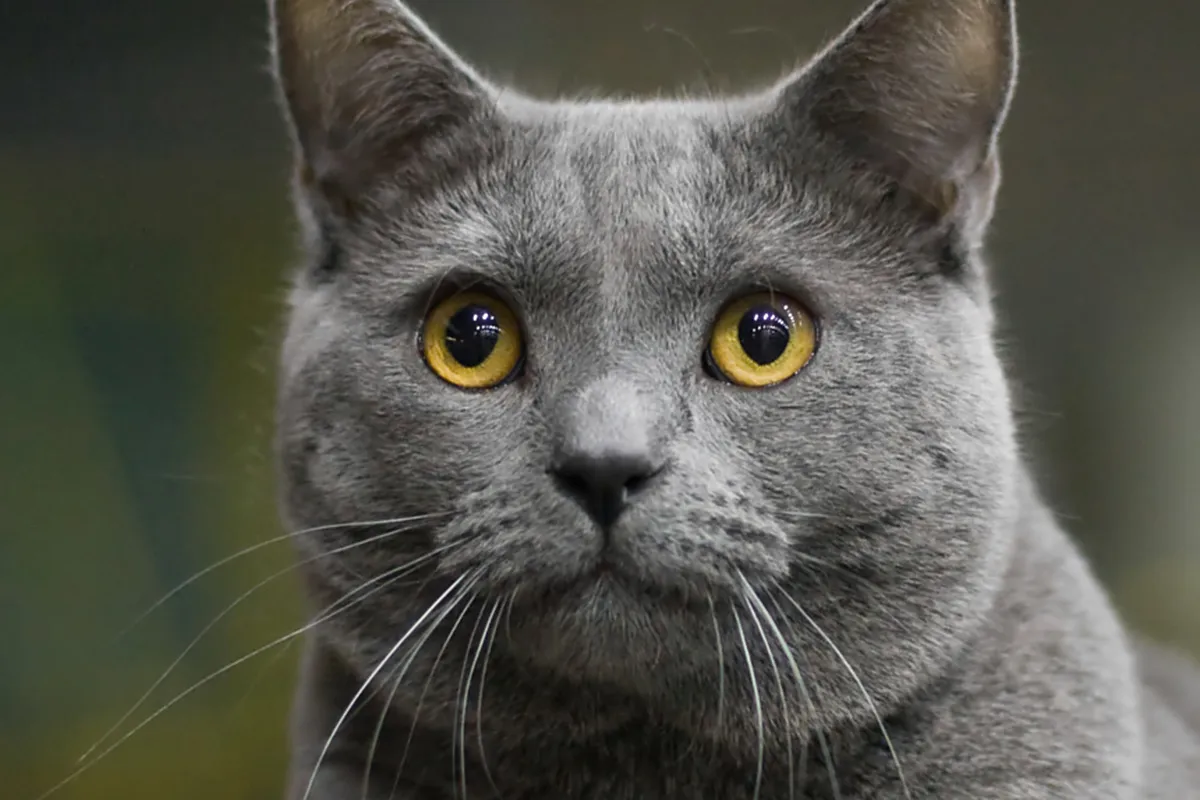
Chartreux at a glance
| Trait | Detail |
|---|---|
| Origin | France; selective breeding began in the 1920s from natural colonies of French blue cats [1] |
| Breed group | FIFe Category 3, recognized since 1949 [2] |
| Build | Broad-shouldered and powerful on fine-boned legs; matures in 3 to 5 years, when males may weigh up to 14 lb (6.4 kg) and females are significantly smaller [1] |
| Life expectancy | No breed figure in the 2024 UK life tables, which only covered breeds with 15 or more deaths; 11.74 years at birth for all cats [3] |
| Coat | Blue only, dense and woolly, somewhat water-resistant with an insulating undercoat; eyes gold to copper [1] |
Origin
Blue cats of France appear in literature from the 16th century. The name was long linked to the Carthusian monks, but it may instead come from a Spanish wool known to traders, reminiscent of the cat’s woolly coat. Breeders in France began selecting Chartreux in the 1920s from natural colonies of blue cats of consistent type [1].
The first Chartreux reached North America in 1970. Breeders there follow the French tradition of naming each year’s kittens with a given letter [1]. FIFe has recognized the breed since its foundation in 1949 [2].
Common health problems
- Weight gain: described as a problem for some mature Chartreux; the breed is naturally massive but should feel solid and muscular [1]. In the UK life-table study, cats with a non-ideal body weight had a shorter lifespan [3].
- Patellar luxation: a heritable displacement of the kneecap, seen in some Chartreux; a vet can screen kittens and cats, and mildly affected cats are unlikely to have mobility problems [1].
- Struvite bladder stones: in a case-control study of 7,334 cats with magnesium ammonium phosphate (struvite) stones at the Minnesota Urolith Center, the Chartreux was among the breeds at increased risk [5]. See urinalysis for dogs and cats and urinary tract infection.
- Hypertrophic cardiomyopathy (HCM): in a French series of 344 cats with HCM from five breeds, Chartreux were diagnosed at a median age of 8 years, much later than Maine Coons (2.5 years) and Sphynx (3.5 years); all cats that survived beyond 15 years were domestic shorthairs, Persians or Chartreux [4].
- Polycystic kidney disease (PKD): a single case was reported in a 12-year-old Chartreux, confirmed by a genetic test; the authors suggested including the breed in PKD screening [6]. See kidney disease in cats.
Tests and screening in Chartreux
- Breed-dependent reference intervals: in 536 healthy cats from four breeds, including 129 Chartreux, breed had a significant effect on 9 of 13 plasma chemistry values, and the differences could be clinically relevant for creatinine, glucose and total protein; the authors concluded that breed-specific intervals should be considered [7]. Ask your vet how your laboratory’s intervals apply to your cat. See creatinine and BUN in cats and blood sugar in cats.
- Urinalysis: the test that shows crystals, urine pH and concentration, relevant in a breed at higher risk of struvite stones [5]. See urinalysis for dogs and cats.
- Blood type: data are scarce. Five Chartreux typed in one European study were all type A [8]. In a German genotyping survey of 8 Chartreux, 2 had the b/b genotype of type B, 1 a combination of two different b variants predicted to give type B, and 3 carried one b copy [9]. Typing before a transfusion and before breeding is therefore worthwhile [9].
- Kneecap check: patellar luxation can be screened by a vet during a physical examination [1].
- Heart ultrasound: the test that diagnoses HCM [4].
- Routine blood panels: see cat blood work explained.
Related articles
En français : Chartreux.
Questions to ask your veterinarian
- Is my Chartreux at a healthy weight for a breed that matures late?
- Are my cat’s creatinine, glucose and total protein within what is expected for its breed?
- Should my cat have a urinalysis to look for crystals?
- Have my cat’s kneecaps been checked?
- Do we know my cat’s blood type?
Get your Chartreux’s blood work explained.
AI DiagAnimals reads creatinine, glucose, total protein and the urinalysis with your laboratory’s intervals, compares them with earlier results and prepares the questions for your vet. The service opens soon: leave your email to be told first.
Frequently asked questions
How long do Chartreux cats live?
There is no published breed-specific figure: the 2024 UK life tables only covered breeds with 15 or more deaths, and the Chartreux was not among them. The life expectancy at birth of all cats was 11.74 years [3].
Are Chartreux cats healthy?
The breed is described as generally healthy. Weight gain in mature cats and patellar luxation are the problems breeders mention, and a US study found a higher risk of struvite bladder stones [1, 5].
Do Chartreux have different blood test results?
A French study of 129 healthy Chartreux and cats of three other breeds found that some reference values, notably creatinine, glucose and total protein, depend on breed [7].
What tests should a Chartreux have?
Regular weight checks, a kneecap examination, urinalysis and blood typing are the checks most relevant to the breed [1, 5, 9].
Is the Chartreux the same as the British Shorthair?
No. Both are sturdy blue cats, but the Chartreux comes from France and is shown in blue only [1]. See our British Shorthair page.
Sources
- The Cat Fanciers’ Association. Chartreux: breed profile. cfa.org/breed/chartreux
- Fédération Internationale Féline. Breeds and standards. fifeweb.org/cats/breeds
- Teng KT et al. Life tables of annual life expectancy and risk factors for mortality in cats in the UK. J Feline Med Surg. 2024;26(5):1098612X241234556. doi.org/10.1177/1098612X241234556
- Trehiou-Sechi E et al. Comparative echocardiographic and clinical features of hypertrophic cardiomyopathy in 5 breeds of cats: a retrospective analysis of 344 cases (2001-2011). J Vet Intern Med. 2012;26(3):532-541. doi.org/10.1111/j.1939-1676.2012.00906.x
- Lekcharoensuk C et al. Association between patient-related factors and risk of calcium oxalate and magnesium ammonium phosphate urolithiasis in cats. J Am Vet Med Assoc. 2000;217(4):520-525. doi.org/10.2460/javma.2000.217.520
- Volta A et al. Polycystic kidney disease in a Chartreux cat. J Feline Med Surg. 2010;12(2):138-140. doi.org/10.1016/j.jfms.2009.06.001
- Reynolds BS et al. Breed dependency of reference intervals for plasma biochemical values in cats. J Vet Intern Med. 2010;24(4):809-818. doi.org/10.1111/j.1939-1676.2010.0541.x
- Gavazza A et al. Feline blood groups: a systematic review of phylogenetic and geographical origin. Animals (Basel). 2021;11(12):3339. doi.org/10.3390/ani11123339
- Kehl A et al. CMAH genotyping survey for blood types A, B and C (AB) in purpose-bred cats. Anim Genet. 2019;50(3):303-306. doi.org/10.1111/age.12778
Laboratory methods and reference intervals vary. This article explains; it does not diagnose. For a decision about your pet, use the original report and talk to your veterinarian. Our editorial policy.