
 Français
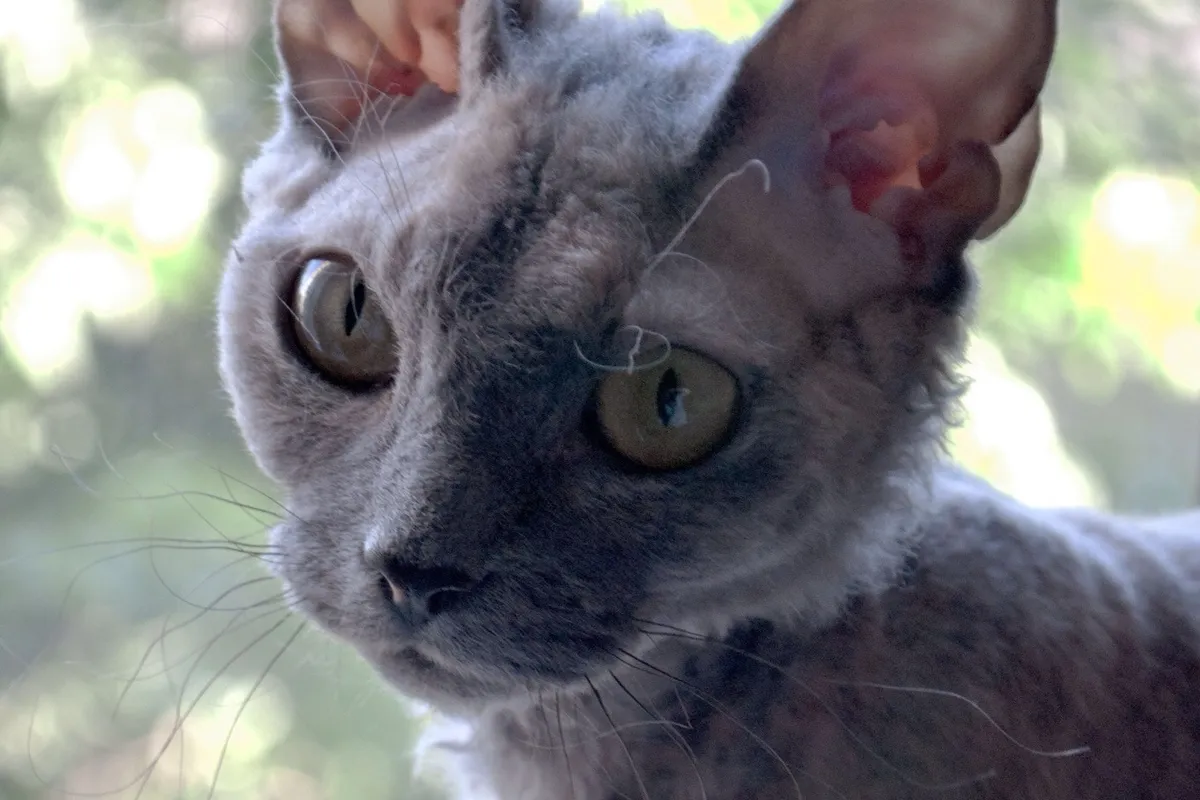
Devon Rex at a glance
| Trait | Detail |
|---|---|
| Origin | England (Devon), from a curly-coated male kitten born in 1959 [1] |
| Breed group | FIFe Category 4 [2] |
| Build | Small to medium-sized but muscular; adults typically weigh 6–9 lb (2.7–4.1 kg), males somewhat more [1] |
| Life expectancy | No breed figure in the 2024 UK life tables, which only covered breeds with 15 or more deaths; 11.74 years at birth for all cats [3] |
| Coat | Soft, wavy and of variable density, with sparse guard hairs and fragile curly whiskers [1]; the curl is linked to a variant of the KRT71 gene [4] |
Origin
In 1959, a single curly-haired male kitten was born in a garden litter in Devon, England. He was named Kirlee. Test matings showed that his coat was not the Cornish Rex mutation, and the breed was built from his offspring, later outcrossed with several other breeds, which explains the wide range of colors and patterns [1].
All Devon Rex cats tested in a genetic study carried two copies of the same KRT71 variant, the gene behind their curly coat; the Sphynx carries a different variant of the same gene [4]. FIFe places the Devon Rex in Category 4 [2].
Common health problems
- Blood type B and neonatal isoerythrolysis: 41% of Devon Rex cats were type B in pooled breed data [5]. When a type B queen nurses type A kittens, antibodies in her milk can destroy the kittens’ red cells; in breeds such as the Devon Rex, random matings carry a high risk [5]. See anemia in cats.
- Hereditary myopathy (congenital myasthenic syndrome): some Devon Rex and Sphynx cats develop weakness of the legs and trunk, a dilated esophagus (megaesophagus), swallowing weakness and fatigue with exercise. The disease is linked to a COLQ gene variant; carriers suggested an allele frequency of about 2% in the Devon Rex [7].
- Vitamin K-dependent coagulopathy: a deficiency of clotting factors II, VII, IX and X was found in three Devon Rex cats without rodenticide exposure, liver or intestinal disease [8]. In two littermates, the cause was a defective liver enzyme (gamma-glutamyl carboxylase) [9].
- Kneecap (patellar) luxation: Devon Rex cats are among the breeds overrepresented for patellar luxation, with the Siamese, British Shorthair and Abyssinian [10].
- Deafness in white cats: in 40 white Devon Rex cats tested with brainstem auditory evoked responses, 10% were deaf in one or both ears [11].
- Diabetes: in Swedish insurance data, the Devon Rex and Sphynx group ranked third for diabetes incidence once age was taken into account [12]. See diabetes in cats.
The Devon Rex shares the COLQ myopathy and a KRT71 coat gene with the Sphynx.
Tests and screening in Devon Rex cats
- Blood typing: the Cat Fanciers’ Association calls genetic testing essential for breeders because of the high rate of type B [1]. Type B cats carry strong natural antibodies against type A, so typing before any transfusion matters in every cat [5].
- DNA test for blood type: in a German genotyping survey of 18 Devon Rex cats, 3 had two copies of the b allele (type B) and 9 carried one copy [6]. Because type B is recessive, a type A cat can carry b; genotyping lets breeders predict kittens’ blood types and avoid incompatible matings [6].
- DNA test for the COLQ variant: confirms the diagnosis in a weak cat and identifies carriers [7].
- Clotting tests: in affected cats, clotting factor levels normalized with vitamin K1; when it was stopped in two cats, the prothrombin time (PT) and activated partial thromboplastin time (aPTT) became prolonged again, although the cats showed no bleeding [8].
- Hearing test: brainstem auditory evoked responses (BAER) detect deafness in white kittens [11].
- Routine blood panels: read like those of any adult cat. See cat blood work explained and blood sugar in cats.
Related articles
En français : Devon rex.
Questions to ask your veterinarian
- Do we know my cat’s blood type, and should it be confirmed by a DNA test?
- If my cat ever needs a transfusion, will donor blood be typed and crossmatched?
- Should my Devon Rex be tested for the COLQ myopathy variant?
- Would a clotting test before surgery be useful for my cat?
- Should my cat’s kneecaps be checked?
Get your Devon Rex’s blood work explained.
AI DiagAnimals reads the blood count, blood type, clotting times and chemistry panel with your laboratory’s intervals, compares them with earlier results and prepares the questions for your vet. The service opens soon: leave your email to be told first.
Frequently asked questions
How long do Devon Rex cats live?
There is no published breed-specific figure: the 2024 UK life tables only covered breeds with 15 or more deaths, and the Devon Rex was not among them. The life expectancy at birth of all cats was 11.74 years [3].
What health problems do Devon Rex cats have?
A high rate of blood type B, an inherited COLQ myopathy, a rare vitamin K-dependent clotting disorder and patellar luxation are the best documented [5, 7, 8, 10].
Why does blood type matter in the Devon Rex?
About 41% of Devon Rex cats are type B. A type B cat given type A blood, or type A kittens nursed by a type B queen, can suffer severe destruction of red cells [5].
Sources
- The Cat Fanciers’ Association. Devon Rex: breed profile. cfa.org/breed/devon-rex
- Fédération Internationale Féline. Breeds and standards. fifeweb.org/cats/breeds
- Teng KT et al. Life tables of annual life expectancy and risk factors for mortality in cats in the UK. J Feline Med Surg. 2024;26(5):1098612X241234556. doi.org/10.1177/1098612X241234556
- Gandolfi B et al. The naked truth: Sphynx and Devon Rex cat breed mutations in KRT71. Mamm Genome. 2010;21(9-10):509-515. doi.org/10.1007/s00335-010-9290-6
- Silvestre-Ferreira AC, Pastor J. Feline neonatal isoerythrolysis and the importance of feline blood types. Vet Med Int. 2010;2010:753726. doi.org/10.4061/2010/753726
- Kehl A et al. CMAH genotyping survey for blood types A, B and C (AB) in purpose-bred cats. Anim Genet. 2019;50(3):303-306. doi.org/10.1111/age.12778
- Gandolfi B et al. COLQ variant associated with Devon Rex and Sphynx feline hereditary myopathy. Anim Genet. 2015;46(6):711-715. doi.org/10.1111/age.12350
- Maddison JE et al. Vitamin K-dependent multifactor coagulopathy in Devon Rex cats. J Am Vet Med Assoc. 1990;197(11):1495-1497. pubmed.ncbi.nlm.nih.gov/2272883
- Soute BA et al. Congenital deficiency of all vitamin K-dependent blood coagulation factors due to a defective vitamin K-dependent carboxylase in Devon Rex cats. Thromb Haemost. 1992;68(5):521-525. pubmed.ncbi.nlm.nih.gov/1455398
- Černá P et al. The prevalence of feline hip dysplasia, patellar luxation and lumbosacral transitional vertebrae in pedigree cats in the Czech Republic. Animals (Basel). 2021;11(9):2482. doi.org/10.3390/ani11092482
- Kortas A et al. Sensorineural deafness in purebred white Devon Rex cats. J Vet Intern Med. 2024;38(2):1120-1126. doi.org/10.1111/jvim.17007
- Öhlund M et al. Incidence of diabetes mellitus in insured Swedish cats in relation to age, breed and sex. J Vet Intern Med. 2015;29(5):1342-1347. doi.org/10.1111/jvim.13584
Laboratory methods and reference intervals vary. This article explains; it does not diagnose. For a decision about your pet, use the original report and talk to your veterinarian. Our editorial policy.