
 Français
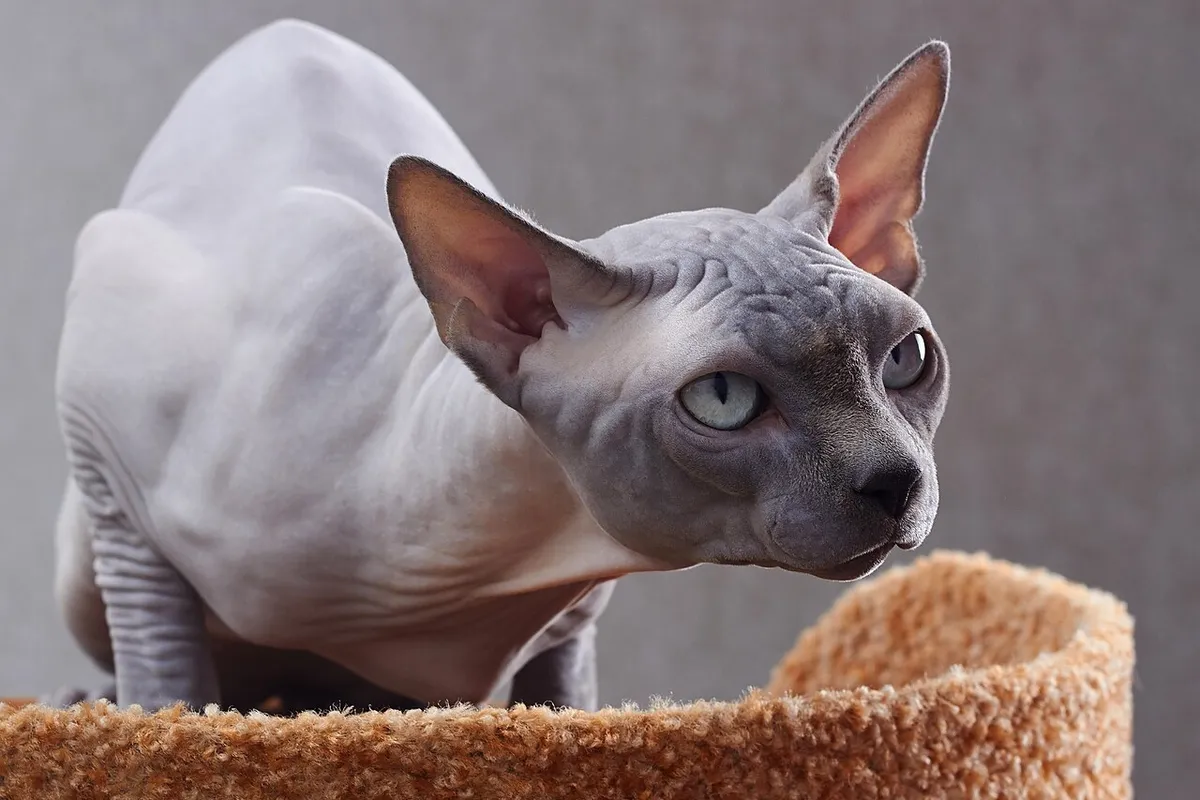
Sphynx cat at a glance
| Trait | Detail |
|---|---|
| Origin | Canada (Toronto), from a hairless kitten born in 1966 [1] |
| Breed group | FIFe Category 4 [2] |
| Build | Medium-sized but substantial, with sturdy bones, good muscle and a rounded belly; males usually larger than females [1] |
| Life expectancy | 6.68 years at birth in a 2019 UK study, the shortest of the 12 groups analyzed (based on 18 deaths) [3] |
| Coat | Hairless or nearly so, often with short hair on the nose, ears and tail; linked to a variant of the KRT71 gene [1, 4] |
Origin
Today’s Sphynx descends from a spontaneous mutation: a hairless kitten born to a domestic cat in Toronto, Canada, in 1966. The trait was recessive, and breeders built the breed over about 30 years by crossing to normal-coated cats and back to hairless cats. Two hairless cats born in Minnesota in 1975 were also added to the gene pool [1].
The Cat Fanciers’ Association accepted the Sphynx for registration in 1998 and granted it championship status in 2002 [1]. A splice-site variant of the KRT71 keratin gene was later identified as the likely cause of the hairless coat [4].
Common health problems
- Heart disease: among 114 Sphynx cats screened by heart ultrasound in France, 39 (34.2%) had heart disease: 23 had HCM and 16 had congenital heart disease, with mitral valve dysplasia in 15 of them. HCM became more common with age, and a large family suggested a dominant inheritance with incomplete penetrance [5].
- Young age at diagnosis: in a series of 344 cats with HCM, the median age at diagnosis was 3.5 years in Sphynx cats, against 8 years in domestic shorthairs, and sudden death was seen in Sphynx cats [6].
- Inherited myopathy: a muscle disease causing weakness, a dilated esophagus and tiring with exercise, linked to a COLQ gene variant [7].
- Eyes: of 110 Sphynx cats seen at an eye referral center, 42 had corneal sequestrum and 25 had entropion of the lower eyelid; both were more common and diagnosed younger than in other cats [8].
- Skin: Malassezia yeasts were found on the skin of 26 of 32 Sphynx cats (81%) but none of 10 domestic shorthairs, and 5 of the Sphynx had greasy seborrhea [9]. The breed’s oily skin needs regular bathing [1]. Of 13 cats with cutaneous mastocytosis (urticaria pigmentosa), 9 were Sphynx [10].
Tests and screening in Sphynx cats
- Heart ultrasound: the screening test for HCM and valve defects. Body weight must be taken into account when reading wall thickness in this breed [5].
- HCM gene tests: only two HCM gene variants are known in cats, both almost specific to Maine Coons and Ragdolls, and testing for them in other breeds is not recommended [11].
- NT-proBNP: not recommended to tell normal cats from cats with mild to moderate HCM; its main value is in spotting severe disease, or when heart ultrasound is not available [11].
- Thyroid and blood pressure: recommended in a cat with thickened heart walls, to look for hyperthyroidism or hypertension [11]. See hyperthyroidism in cats and, for blood pressure, kidney disease in cats.
- DNA test for COLQ myopathy: confirms the diagnosis in a weak cat and identifies carriers [7].
- Blood type: about 17% of Sphynx cats were type B in pooled breed data [12]. Type B cats carry strong natural antibodies against type A blood, so typing before a transfusion matters [12]. See anemia in cats.
- Skin samples: in the Sphynx cats sampled, Malassezia was found in the armpits, groin and claw folds but never in the ears, which matters when choosing where to take samples [9].
- Routine blood panels: see cat blood work explained.
Related articles
En français : Sphynx.
Questions to ask your veterinarian
- At what age, and how often, should my Sphynx have a heart ultrasound?
- Does my cat have a heart murmur or a gallop sound?
- Would an NT-proBNP test add anything for my cat?
- Should my cat be tested for the COLQ myopathy variant?
- Do we know my cat’s blood type?
Get your Sphynx’s blood work explained.
AI DiagAnimals reads NT-proBNP, T4, kidney values and the blood count with your laboratory’s intervals, compares them with earlier results and prepares the questions for your vet. The service opens soon: leave your email to be told first.
Frequently asked questions
How long do Sphynx cats live?
A UK study of cats that died in 2019 found a life expectancy at birth of 6.68 years for Sphynx cats, the shortest of the breeds analyzed, though based on only 18 deaths [3].
What health problems do Sphynx cats have?
Heart disease (hypertrophic cardiomyopathy and mitral valve defects), an inherited myopathy, eye problems such as corneal sequestrum and entropion, and skin yeast are documented [5, 7, 8, 9].
Do Sphynx cats get heart disease?
Often: 34.2% of 114 Sphynx cats screened in France had heart disease, and HCM became more common with age [5].
Sources
- The Cat Fanciers’ Association. Sphynx: breed profile. cfa.org/breed/sphynx
- Fédération Internationale Féline. Breeds and standards. fifeweb.org/cats/breeds
- Teng KT et al. Life tables of annual life expectancy and risk factors for mortality in cats in the UK. J Feline Med Surg. 2024;26(5):1098612X241234556. doi.org/10.1177/1098612X241234556
- Gandolfi B et al. The naked truth: Sphynx and Devon Rex cat breed mutations in KRT71. Mamm Genome. 2010;21(9-10):509-515. doi.org/10.1007/s00335-010-9290-6
- Chetboul V et al. Prospective echocardiographic and tissue Doppler screening of a large Sphynx cat population: reference ranges, heart disease prevalence and genetic aspects. J Vet Cardiol. 2012;14(4):497-509. doi.org/10.1016/j.jvc.2012.08.001
- Trehiou-Sechi E et al. Comparative echocardiographic and clinical features of hypertrophic cardiomyopathy in 5 breeds of cats: a retrospective analysis of 344 cases (2001-2011). J Vet Intern Med. 2012;26(3):532-541. doi.org/10.1111/j.1939-1676.2012.00906.x
- Gandolfi B et al. COLQ variant associated with Devon Rex and Sphynx feline hereditary myopathy. Anim Genet. 2015;46(6):711-715. doi.org/10.1111/age.12350
- Sarfaty H et al. Prevalence and characteristics of ocular diseases in Sphynx cats: a retrospective assessment (2012-2021) and comparison with non-Sphynx cats. Vet Ophthalmol. 2022;25(5):367-375. doi.org/10.1111/vop.12994
- Ahman SE, Bergström KE. Cutaneous carriage of Malassezia species in healthy and seborrhoeic Sphynx cats and a comparison to carriage in Devon Rex cats. J Feline Med Surg. 2009;11(12):970-976. doi.org/10.1016/j.jfms.2009.04.011
- Ngo J et al. Feline maculopapular cutaneous mastocytosis: a retrospective study of 13 cases and proposal for a new classification. J Feline Med Surg. 2019;21(4):394-404. doi.org/10.1177/1098612X18776141
- Luis Fuentes V et al. ACVIM consensus statement guidelines for the classification, diagnosis, and management of cardiomyopathies in cats. J Vet Intern Med. 2020;34(3):1062-1077. doi.org/10.1111/jvim.15745
- Silvestre-Ferreira AC, Pastor J. Feline neonatal isoerythrolysis and the importance of feline blood types. Vet Med Int. 2010;2010:753726. doi.org/10.4061/2010/753726
Laboratory methods and reference intervals vary. This article explains; it does not diagnose. For a decision about your pet, use the original report and talk to your veterinarian. Our editorial policy.