
 Français
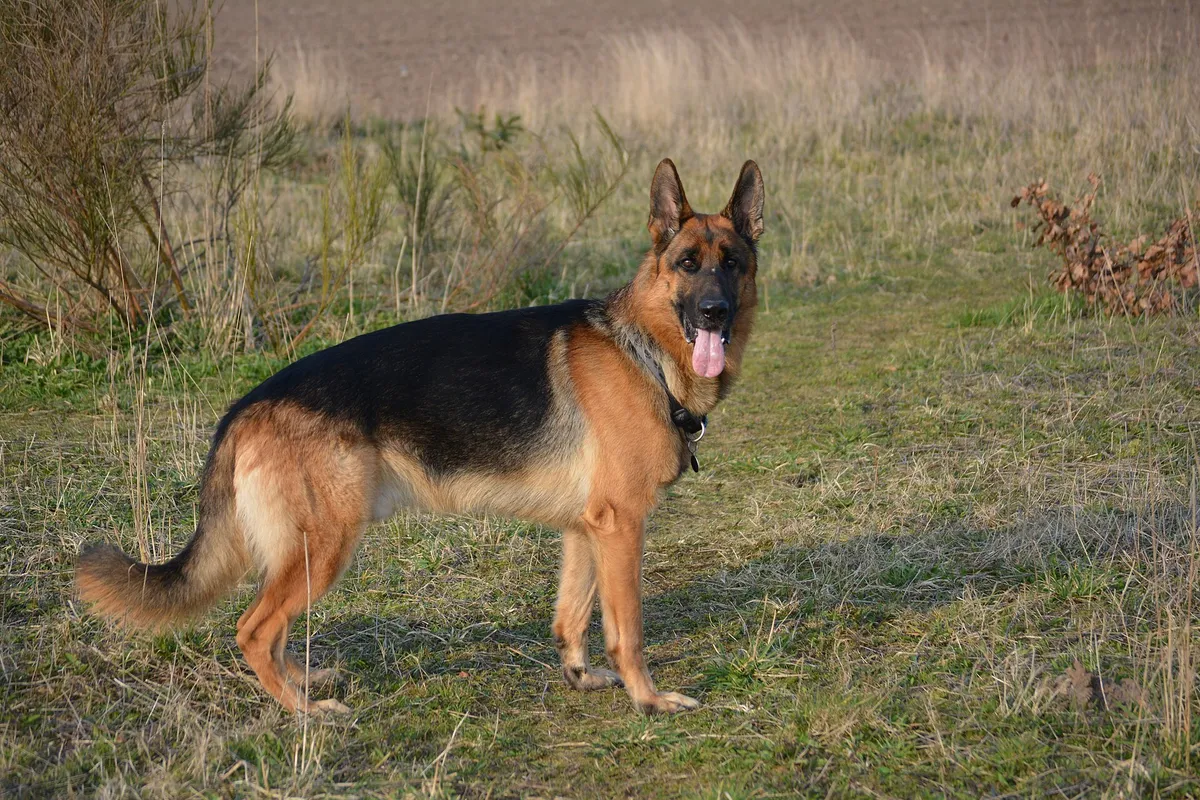
German Shepherd at a glance
| Trait | Detail |
|---|---|
| Origin | Germany [1] |
| Breed group | FCI Group 1 (Sheepdogs and Cattle Dogs), Section 1 Sheepdogs; AKC Herding Group [1, 2] |
| Weight | 30–40 kg (66–88 lb) for males, 22–32 kg (49–71 lb) for females [1] |
| Height | 60–65 cm (23.5–25.5 in) for males, 55–60 cm (21.5–23.5 in) for females [1] |
| Life expectancy | Median 10.3 years in a UK primary-care study [3]; 11.3 years in a 2024 UK study of over 580,000 dogs [4] |
| Coat | Double coat or long double coat, both with undercoat [1] |
Origin
Methodical breeding of the German Shepherd started in 1899, after the founding of the German Shepherd Dog Society (SV) on the suggestions of A. Meyer and Max von Stephanitz. It was bred from the herding dogs of central and southern Germany to create a high-performing working dog [1].
The FCI standard describes it today as a versatile working, herding and service dog [1].
Common health problems
In a UK study of German Shepherds seen by primary-care vets, the most common disorders were ear infections (7.89%), osteoarthritis (5.54%), diarrhea (5.24%) and overweight (5.18%). The leading causes of death were musculoskeletal disorders (16.3%), inability to stand (14.9%), cancer (14.5%) and spinal cord disorders (13.6%) [3].
- Hip and elbow dysplasia: at screening in Sweden, 25.6% of young German Shepherds had hip dysplasia (grades C–E) and 16.9% had elbow dysplasia [5].
- Exocrine pancreatic insufficiency (EPI): a condition that severely impairs the absorption of nutrients [11]. German Shepherds are over-represented among dogs with EPI [6]. In the breed, the underlying pancreatic acinar atrophy is not present at birth and is not inherited in a simple way [7]. See lipase and amylase.
- Degenerative myelopathy: a progressive, fatal disease of the spinal cord that typically starts at 8 years of age or older with poor coordination of the hind legs. The German Shepherd is one of the breeds in which it was linked to a SOD1 gene variant [8].
- Anal furunculosis (perianal fistulas): ulcers and draining tracts around the anus, a disease that particularly affects German Shepherds and is thought to be immune-mediated [9].
- Other reported predispositions: hemangiosarcoma and lumbosacral disease [3]. See hemangiosarcoma in dogs.
Tests and screening in German Shepherds
- TLI (trypsin-like immunoreactivity): the blood test used to diagnose EPI [6]. A result of 2.5 µg/L or less is considered diagnostic [10].
- Vitamin B12 (cobalamin): German Shepherds more often have a low B12 than other dogs, and those with very low values (below 150 ng/L) were more likely to have a TLI in the EPI range [10]. In 299 dogs with EPI, 67% had a low B12, and a low B12 at diagnosis went with shorter survival [11].
- DNA test for degenerative myelopathy (SOD1): dogs with two copies of the SOD1:c.118A variant are at much higher risk than dogs with one copy. The variant is common and found in many breeds, so a positive test shows a risk, not a diagnosis [8, 12].
- Hip and elbow scoring: X-rays graded on the FCI hip scale and the International Elbow Working Group elbow scale [5].
For chronic gut disease that lowers blood proteins, see protein-losing enteropathy in dogs. Routine results are explained in the CBC for dogs.
Related articles
En français : Berger allemand.
Questions to ask your veterinarian
- My dog eats a lot but loses weight: should we run a TLI and a vitamin B12 test?
- Should my German Shepherd have a DNA test for degenerative myelopathy?
- Should my dog’s hips and elbows be X-rayed or scored?
- Is this hind-leg weakness from the joints or from the spine?
- How often should we recheck B12 if it was low?
Get your German Shepherd’s blood work explained.
AI DiagAnimals reads the blood count, chemistry, TLI and vitamin B12 with your laboratory’s intervals, and prepares the questions for your vet. The service opens soon: leave your email to be told first.
Frequently asked questions
How long do German Shepherds live?
The median lifespan was 10.3 years in a UK primary-care study [3] and 11.3 years in a larger 2024 UK study [4].
What health problems do German Shepherds have?
Ear infections, osteoarthritis, diarrhea and overweight are the most common; hip and elbow dysplasia, EPI, degenerative myelopathy and anal furunculosis are well-known breed problems [3, 5, 6, 8, 9].
How is EPI diagnosed in German Shepherds?
With a blood test called TLI; a value of 2.5 µg/L or less is considered diagnostic [6, 10]. Vitamin B12 is often measured at the same time [11].
Is there a test for degenerative myelopathy?
Yes, a DNA test for the SOD1 variant. Dogs with two copies are at much higher risk than dogs with one copy [12].
How common is hip dysplasia in German Shepherds?
At screening in Sweden, 25.6% of young German Shepherds had hip dysplasia graded C to E [5].
Sources
- Fédération Cynologique Internationale. FCI Standard No. 166: German Shepherd Dog. fci.be/Nomenclature/Standards/166g01-en.pdf
- American Kennel Club. German Shepherd Dog: dog breed information. akc.org/dog-breeds/german-shepherd-dog
- O’Neill DG et al. Demography and disorders of German Shepherd Dogs under primary veterinary care in the UK. Canine Genet Epidemiol. 2017;4:7. doi.org/10.1186/s40575-017-0046-4
- McMillan KM et al. Longevity of companion dog breeds: those at risk from early death. Sci Rep. 2024;14:531. doi.org/10.1038/s41598-023-50458-w
- Engdahl K et al. Prevalence of hip and elbow dysplasia in young adult dogs in Sweden. Vet Rec. 2026;198(12):e560-e573. doi.org/10.1002/vetr.70224
- Batchelor DJ et al. Breed associations for canine exocrine pancreatic insufficiency. J Vet Intern Med. 2007;21(2):207-214. pubmed.ncbi.nlm.nih.gov/17427378
- Westermarck E et al. Heritability of exocrine pancreatic insufficiency in German Shepherd dogs. J Vet Intern Med. 2010;24(2):450-452. doi.org/10.1111/j.1939-1676.2009.0461.x
- Awano T et al. Genome-wide association analysis reveals a SOD1 mutation in canine degenerative myelopathy that resembles amyotrophic lateral sclerosis. Proc Natl Acad Sci U S A. 2009;106(8):2794-2799. doi.org/10.1073/pnas.0812297106
- Massey J et al. Genetics of canine anal furunculosis in the German shepherd dog. Immunogenetics. 2014;66(5):311-324. doi.org/10.1007/s00251-014-0766-5
- Grützner N et al. Evaluation of serum cobalamin concentrations in dogs of 164 dog breeds (2006-2010). J Vet Diagn Invest. 2012;24(6):1105-1114. doi.org/10.1177/1040638712461250
- Soetart N et al. Serum cobalamin and folate as prognostic factors in canine exocrine pancreatic insufficiency: an observational cohort study of 299 dogs. Vet J. 2019;243:15-20. doi.org/10.1016/j.tvjl.2018.11.003
- Zeng R et al. Breed distribution of SOD1 alleles previously associated with canine degenerative myelopathy. J Vet Intern Med. 2014;28(2):515-521. doi.org/10.1111/jvim.12317
Laboratory methods and reference intervals vary. This article explains; it does not diagnose. For a decision about your pet, use the original report and talk to your veterinarian. Our editorial policy.