
 Français
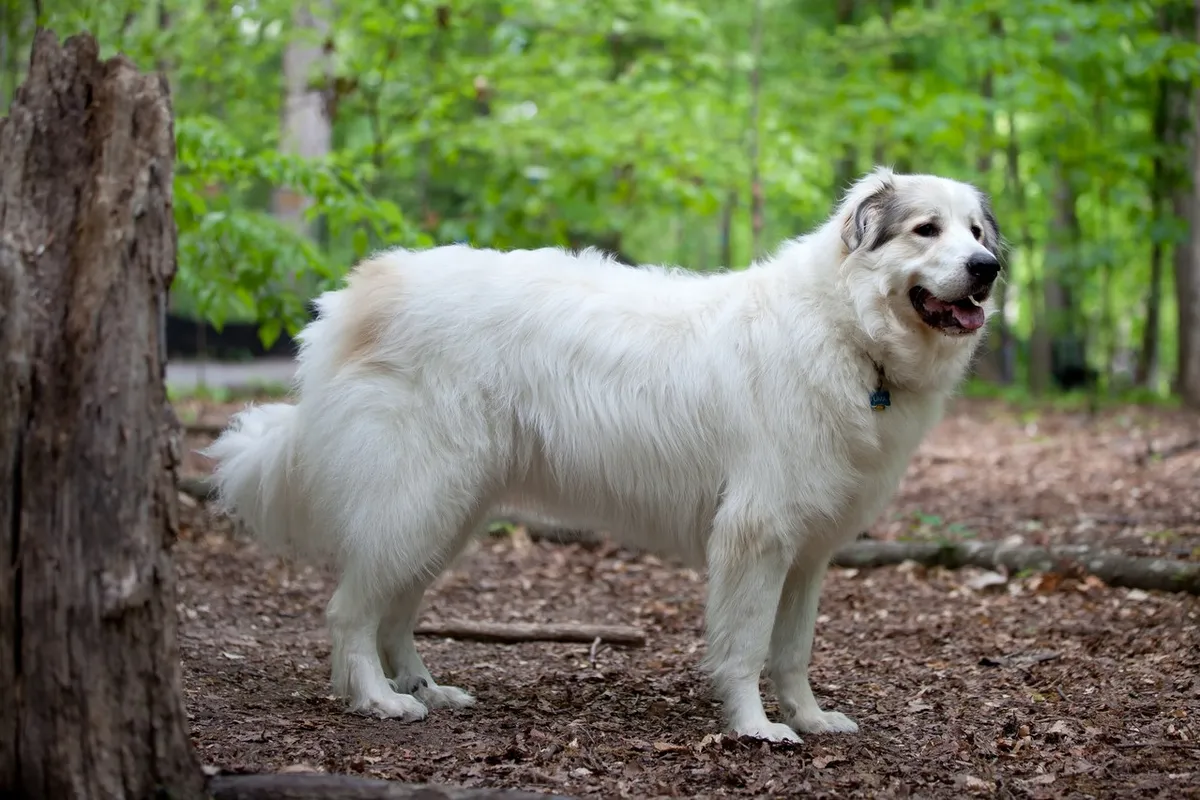
At a glance
| Trait | Detail |
|---|---|
| Origin | France [1] |
| Breed group | FCI group 2, section 2.2 (Molossoid, mountain type) [1]; AKC Working Group [2] |
| Weight | Males 100 lb (45 kg) and up, females 85 lb (39 kg) and up [2]; median adult weight 50.1 kg (110 lb) in UK practices [3] |
| Height | Males 70–80 cm (about 27.5–31.5 in), females 65–75 cm (about 25.5–29.5 in), with a tolerance of 2 cm above [1] |
| Life expectancy | Median age at death 11.0 years in UK veterinary records, based on only 11 dogs [3] |
| Coat | Long, flat and supple with a thick undercoat; white, or white with grey, pale yellow or orange patches [1] |
| Dewclaws | Double dewclaws on each hind leg, as required by the standard [1] |
Origin
The breed has been present in the Pyrenees since time immemorial. It guarded castles in the Middle Ages, is mentioned by Gaston Phoebus in the 14th century and was a companion dog at the court of Louis XIV. The first detailed description dates from 1897, and the official standard was registered with the French kennel club in 1923 [1].
Its traditional job is pastoral guardian in the mountains: working on its own, it protects flocks from predators [1].
Common health problems
- Addison’s disease (hypoadrenocorticism): at a Canadian veterinary teaching hospital from 2005 to 2014, 9.73% of Great Pyrenees were diagnosed with it, the highest rate of all breeds, against 0.38% of all dogs seen. Eleven Great Pyrenees were affected [4]. See Addison’s disease in dogs.
- Glanzmann thrombasthenia: an inherited defect of platelet function. The first affected Great Pyrenees had chronic nosebleeds and gum bleeding when its puppy teeth fell out, yet its platelets were normal in number and size [5]. The disease is autosomal recessive and linked to a mutation in the gene for the platelet fibrinogen receptor (αIIb) [6].
- Inherited eye and spinal cord variants: in Italian breeding dogs, 6% carried the BEST1 variant of multifocal retinopathy and 13% carried the SOD1 variant linked to degenerative myelopathy. None carried the hereditary cataract variant tested [7].
- SACS-associated neuronal degeneration: a disease recognized recently in the breed, with progressive loss of coordination, stiffness and nerve damage that can start as early as 4 months of age. It is autosomal recessive and caused by a deletion in the SACS gene [8].
- Chondrodysplasia (dwarfism): short-limbed, short-bodied puppies have been described, with an inheritance compatible with a recessive trait. Three of the 5 pups studied were deaf [9].
What is special in the Great Pyrenees’ blood work
We found no breed-specific reference intervals for the Great Pyrenees. The published work instead points to two situations where routine results need careful reading.
Signs of Addison’s disease. Compared with dogs of other breeds with the disease, affected Great Pyrenees more often had anemia, azotemia (raised kidney values) and eosinophilia, or were brought in with low blood pressure and weight loss [4]. Our guide to the ACTH stimulation test explains how the diagnosis is confirmed.
Bleeding with normal results. In thrombasthenic Great Pyrenees, coagulation screening tests, platelet count and von Willebrand factor were all within reference ranges, despite uncontrolled nosebleeds [6]. The defect showed only on specialized platelet tests: aggregation responses were markedly reduced and clot retraction impaired [5]. A normal blood count therefore does not rule it out.
DNA tests. The thrombasthenia mutation allowed carriers to be identified among relatives of an affected dog [6]. A genetic test is offered for SACS-associated neuronal degeneration [8], and dogs can be genotyped for the multifocal retinopathy and degenerative myelopathy variants [7].
Related articles
En français : Montagne des Pyrénées.
Questions to ask your veterinarian
- Could my dog’s vague signs, such as weight loss or tiredness, be Addison’s disease?
- Do my dog’s blood results show anemia, raised kidney values or a high eosinophil count?
- If my dog bleeds easily but the platelet count is normal, should platelet function be tested?
- Have the parents been DNA-tested for thrombasthenia, neuronal degeneration, retinopathy and degenerative myelopathy?
- Is my dog’s growth normal for a giant breed puppy?
Get your Great Pyrenees’ blood work explained.
AI DiagAnimals reads the blood count, electrolytes, kidney values and other results together with your laboratory’s intervals, and explains them in plain language. The service opens soon: leave your email to be told first.
Frequently asked questions
How long do Great Pyrenees live?
In UK veterinary records, the median age at death was 11.0 years, but only 11 dogs were included [3]. The AKC gives a life expectancy of 10 to 12 years [2].
What health problems do Great Pyrenees have?
Published studies point to Addison’s disease [4], an inherited platelet disorder called Glanzmann thrombasthenia [5, 6], a neuronal degeneration [8], dwarfism [9], and variants linked to retinopathy and degenerative myelopathy [7].
Are Great Pyrenees prone to Addison’s disease?
In a Canadian hospital study, 9.73% of Great Pyrenees had Addison’s disease, the highest rate of all breeds, against 0.38% of all dogs [4].
Sources
- FCI. Standard No. 137: Chien de Montagne des Pyrénées (Pyrenean Mountain Dog). 2005. fci.be/Nomenclature/Standards/137g02-en.pdf
- American Kennel Club. Great Pyrenees: dog breed information. akc.org/dog-breeds/great-pyrenees
- O’Neill DG et al. Giant dog breeds under primary veterinary care in the UK: demography, common disorders and mortality. Companion Anim Health Genet. 2026;13:4. doi.org/10.1186/s40575-026-00152-7
- Decôme M, Blais MC. Prevalence and clinical features of hypoadrenocorticism in Great Pyrenees dogs in a referred population: 11 cases. Can Vet J. 2017;58(10):1093-1099. pubmed.ncbi.nlm.nih.gov/28966360
- Boudreaux MK et al. Type I Glanzmann’s thrombasthenia in a Great Pyrenees dog. Vet Pathol. 1996;33(5):503-511. doi.org/10.1177/030098589603300504
- Lipscomb DL et al. Two genetic defects in alphaIIb are associated with type I Glanzmann’s thrombasthenia in a Great Pyrenees dog. Vet Pathol. 2000;37(6):581-588. doi.org/10.1354/vp.37-6-581
- Moretti R et al. Allele and genotype frequencies for primary hereditary cataract, multifocal retinopathy 1, and degenerative myelopathy in Pyrenean Mountain dog from Italy. Top Companion Anim Med. 2024;58:100844. doi.org/10.1016/j.tcam.2023.100844
- Ekenstedt KJ et al. A SACS deletion variant in Great Pyrenees dogs causes autosomal recessive neuronal degeneration. Hum Genet. 2023;142(11):1587-1601. doi.org/10.1007/s00439-023-02599-1
- Bingel SA, Sande RD. Chondrodysplasia in five Great Pyrenees. J Am Vet Med Assoc. 1994;205(6):845-848. pubmed.ncbi.nlm.nih.gov/7829378
Laboratory methods and reference intervals vary. This article explains; it does not diagnose. For a decision about your pet, use the original report and talk to your veterinarian. Our editorial policy.