
 Français
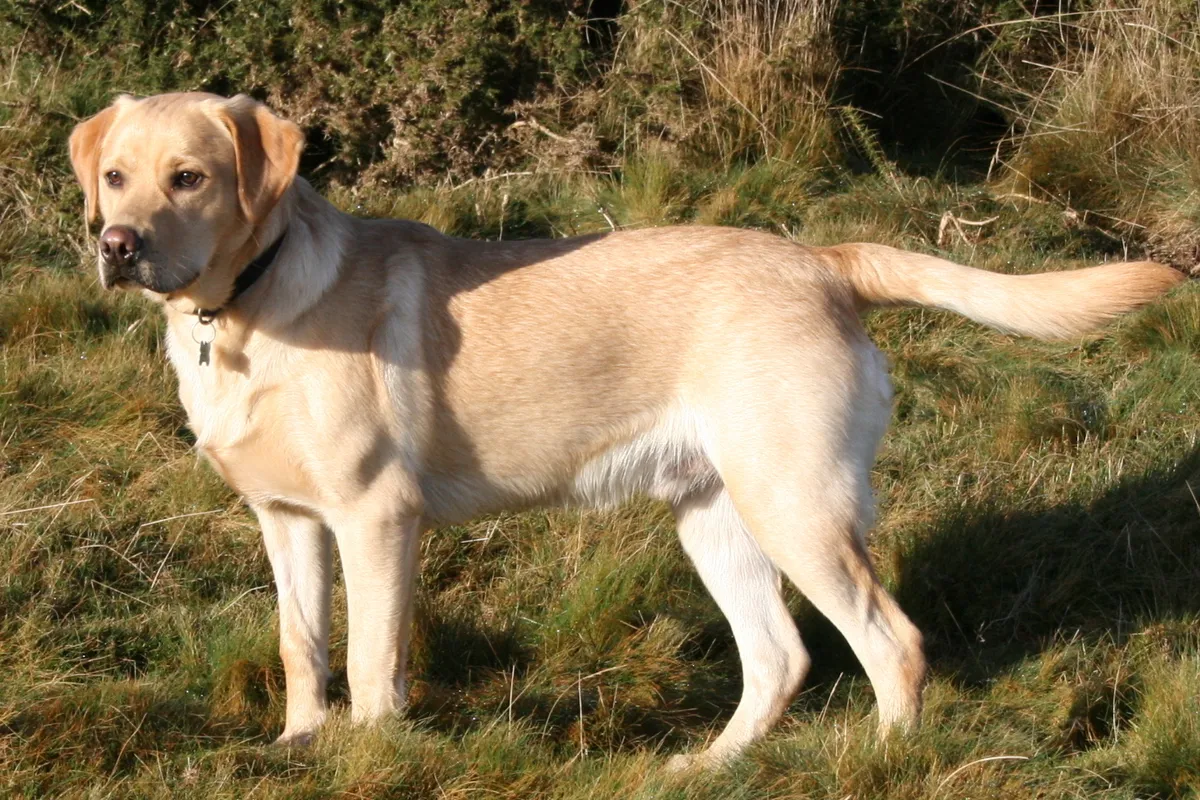
Labrador Retriever at a glance
| Trait | Detail |
|---|---|
| Origin | Great Britain, from dogs of the Newfoundland coast [1] |
| Breed group | FCI Group 8 (Retrievers, Flushing Dogs, Water Dogs), Section 1; AKC Sporting Group [1, 2] |
| Weight | Average adult 33 kg (73 lb): males 35.2 kg (78 lb), females 30.4 kg (67 lb) in a UK study [3] |
| Height | Ideal 56–57 cm (22–22.5 in) for males, 54–56 cm (21–22 in) for females [1] |
| Life expectancy | Median 12.0 years in a UK primary-care study [3]; 13.1 years in a 2024 UK study of over 580,000 dogs [4] |
| Coat | Short, dense, weather-resistant undercoat; black, yellow or liver/chocolate [1] |
Origin
The breed standard says the Labrador is popularly thought to come from the coast of Newfoundland, where fishermen used similar dogs to retrieve fish. Dogs were brought to Britain in the late 1800s, the breed club was formed in 1916 and the Labrador first became famous in field trials [1].
The FCI still classes it as a retriever with a working trial [1], and some Labradors are selected to become assistance dogs [5].
Common health problems
The best figures come from VetCompass, which reads the records of UK primary-care practices. In a random sample of 2,074 Labradors, 61.6% had at least one disorder recorded in a year [3].
- Ear infections (otitis externa): the most common problem, in 10.4% of Labradors. Chocolate dogs were more affected (23.4%) than yellow (17.0%) or black ones (12.8%) [3].
- Overweight and obesity: 8.8% [3]. A small deletion in the POMC gene, found at an allele frequency of 12%, is linked to higher body weight and stronger food motivation [5].
- Joint disease: degenerative joint disease in 5.5% and lameness in 4.4% [3]. At screening in Sweden, 16.2% of young Labradors had hip dysplasia (grades C–E) and 9.0% had elbow dysplasia [6].
- Lipomas (fatty lumps): 4.1% [3]. Any new lump is worth showing to your vet; see mast cell tumors for how lumps are sampled.
- Hypothyroidism: 0.30% of Labradors in a large UK study, with 1.4 times the odds of crossbreds [7]. See hypothyroidism in dogs.
- Copper-associated liver disease: an ATP7B gene variant was more common in Labradors with copper build-up in the liver (30%) than in controls (13%) [9]. See liver disease in dogs.
The most common causes of death were musculoskeletal disorders (24.5%) and cancer (21.1%) [3].
Tests and screening in Labradors
- Liver enzymes and copper: copper-associated hepatopathy is confirmed on a liver sample with copper measurement. The ATP7B DNA result alone is hard to use: 47% of affected dogs did not carry the variant and 25% of control dogs did [9]. See high ALT in dogs.
- Vitamin B12 (cobalamin): in 28,675 tests, Labradors had a higher share of results below the reference interval than other dogs [10].
- Thyroid tests: the breed has a modest predisposition to hypothyroidism [7], so a thyroid panel is part of the work-up when signs suggest it.
- DNA test for exercise-induced collapse (DNM1): depending on the line, 17.9–38.0% of Labradors carried the variant and 1.8–13.6% had two copies; 83.6% of dogs with two copies had collapsed by 4 years of age, but not all affected dogs collapse [8].
- Hip and elbow scoring: X-rays graded on the FCI hip scale and the International Elbow Working Group elbow scale are used in screening schemes [6].
Routine blood work in a Labrador is read like any other dog’s: see the CBC for dogs.
Related articles
En français : Labrador retriever.
Questions to ask your veterinarian
- Is my Labrador at a healthy weight, and what body condition score do you give?
- Should my dog’s hips and elbows be X-rayed or scored?
- Do the liver values suggest we should look for copper build-up?
- Are signs like weight gain or skin changes worth a thyroid test?
- Is a DNA test for exercise-induced collapse useful for my dog?
Get your Labrador’s blood work explained.
AI DiagAnimals reads the blood count, liver enzymes, thyroid values and the rest of the chemistry with your laboratory’s intervals, and prepares the questions for your vet. The service opens soon: leave your email to be told first.
Frequently asked questions
How long do Labradors live?
The median lifespan was 12.0 years in a UK primary-care study, and 10.7 years in chocolate Labradors [3]. A larger 2024 UK study found a median of 13.1 years [4].
What health problems are common in Labradors?
Ear infections (10.4%), overweight (8.8%) and degenerative joint disease (5.5%) were the most frequent in UK primary care [3].
Why are Labradors always hungry?
About 12% of the gene copies in the breed carry a POMC deletion that is linked to stronger food motivation and higher body weight [5].
What tests should a Labrador have?
Hip and elbow scoring [6], a DNA test for exercise-induced collapse [8], and thyroid or liver tests when signs or routine results point that way [7, 9].
Do chocolate Labradors have more health problems?
In one UK study they lived shorter lives (median 10.7 vs 12.1 years) and had more ear infections and skin hot spots than black or yellow Labradors [3].
Sources
- Fédération Cynologique Internationale. FCI Standard No. 122: Labrador Retriever. fci.be/Nomenclature/Standards/122g08-en.pdf
- American Kennel Club. Labrador Retriever: dog breed information. akc.org/dog-breeds/labrador-retriever
- McGreevy PD et al. Labrador retrievers under primary veterinary care in the UK: demography, mortality and disorders. Canine Genet Epidemiol. 2018;5:8. doi.org/10.1186/s40575-018-0064-x
- McMillan KM et al. Longevity of companion dog breeds: those at risk from early death. Sci Rep. 2024;14:531. doi.org/10.1038/s41598-023-50458-w
- Raffan E et al. A deletion in the canine POMC gene is associated with weight and appetite in obesity-prone Labrador retriever dogs. Cell Metab. 2016;23(5):893-900. doi.org/10.1016/j.cmet.2016.04.012
- Engdahl K et al. Prevalence of hip and elbow dysplasia in young adult dogs in Sweden. Vet Rec. 2026;198(12):e560-e573. doi.org/10.1002/vetr.70224
- O’Neill DG et al. Frequency, breed predispositions and other demographic risk factors for diagnosis of hypothyroidism in dogs under primary veterinary care in the UK. Canine Med Genet. 2022;9:11. doi.org/10.1186/s40575-022-00123-8
- Minor KM et al. Presence and impact of the exercise-induced collapse associated DNM1 mutation in Labrador retrievers and other breeds. Vet J. 2011;189(2):214-219. doi.org/10.1016/j.tvjl.2011.06.022
- Langlois DK et al. ATP7A, ATP7B, and RETN genotypes in Labrador Retrievers with and without copper-associated hepatopathy. J Am Vet Med Assoc. 2022;260(14):1-8. doi.org/10.2460/javma.21.12.0541
- Grützner N et al. Evaluation of serum cobalamin concentrations in dogs of 164 dog breeds (2006-2010). J Vet Diagn Invest. 2012;24(6):1105-1114. doi.org/10.1177/1040638712461250
Laboratory methods and reference intervals vary. This article explains; it does not diagnose. For a decision about your pet, use the original report and talk to your veterinarian. Our editorial policy.