
 Français
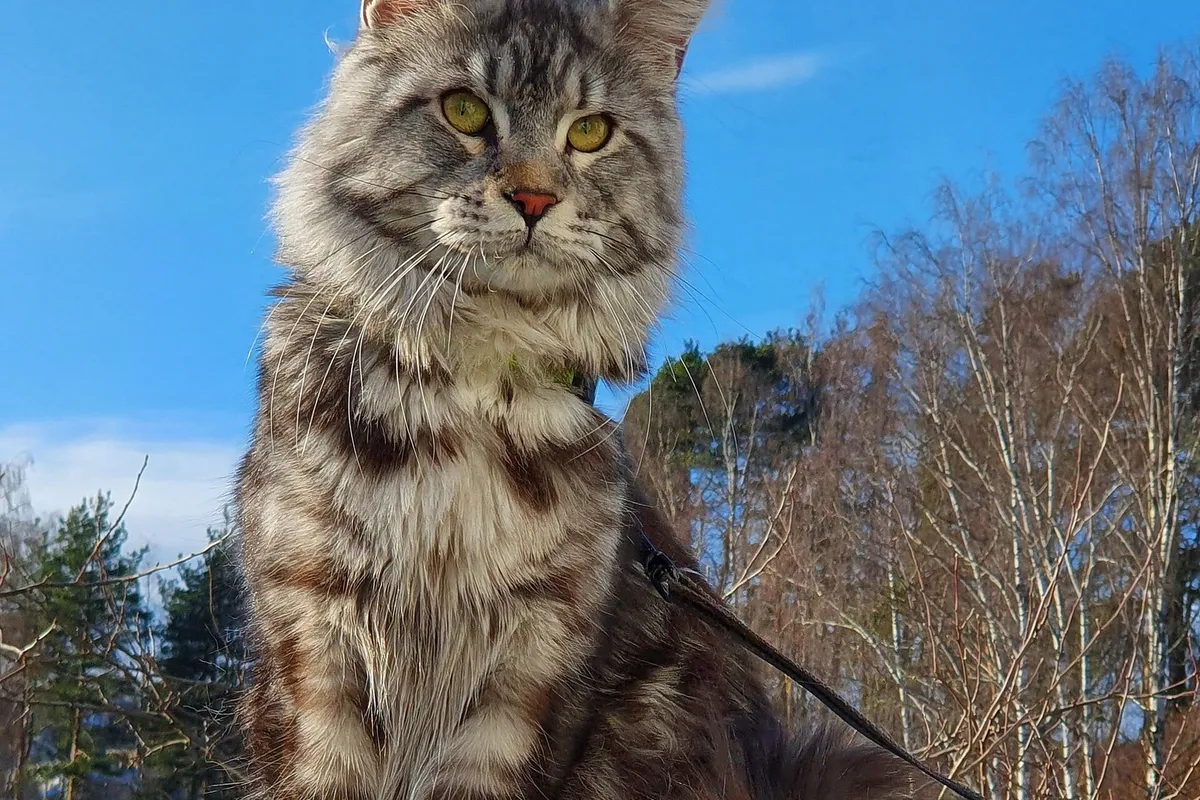
Maine Coon at a glance
| Trait | Detail |
|---|---|
| Origin | United States (New England) [1] |
| Breed group | FIFe Category 2 (semi-longhair breeds) [2] |
| Build | Large, rugged and slow to mature (up to 3 years); mature males often reach or exceed 20 lb (9 kg), females are smaller [1] |
| Life expectancy | 9.71 years at birth in a 2019 UK study of 7,936 cat deaths [3] |
| Coat | Heavy and shaggy, shorter on the shoulders and longer on the sides, belly and hind legs, with a long plumed tail [1] |
Origin
The Maine Coon’s roots lie in New England, where short-haired ship cats arrived with the early settlers; the story that the breed comes from crosses with raccoons is a genetic impossibility. A brown tabby Maine Coon was named Best Cat at the first US cat show in 1895 [1].
The breed faded from shows in the early 20th century, then breeders worked for its return, and the Cat Fanciers’ Association granted it championship status in 1976 [1].
Common health problems
- Hypertrophic cardiomyopathy (HCM): in 2005, a variant of the MYBPC3 gene (A31P) was identified in Maine Coons with familial HCM [4]. Among Maine Coons tested at a US laboratory, 34% carried it [5]. In a Danish cohort of 282 Maine Coons, 80% of cats with two copies developed HCM and 48% died of a cardiac cause during follow-up, a much higher risk than in cats with one copy or none [6].
- Why the gene test is not the whole story: the variant is far more common than the disease, and it is mainly cats with two copies that develop clinically relevant HCM; Maine Coons without the variant have also been diagnosed with HCM [7].
- Hip dysplasia: in the US Orthopedic Foundation for Animals registry, 24.9% of 2,548 Maine Coons had hip dysplasia, slightly more males (27.3%) than females (23.3%); 56% of cases affected both hips [8].
- Dental disease: 16.7% of Maine Coons had periodontal disease in one year of UK primary care, among the highest breed figures, against 15.2% of all cats [9].
- Inherited neuromuscular diseases: a DNA test for spinal muscular atrophy (LIX1) exists, and an X-linked myotubular myopathy linked to an MTM1 variant has been described in a 7-month-old Maine Coon [10].
Life expectancy: in the same UK study, purebred cats and cats with a non-ideal body weight had a shorter lifespan [3].
Tests and screening in Maine Coons
- DNA test for MYBPC3 A31P: recommended for Maine Coons intended for breeding, and it can be considered in pet cats to estimate their risk. A negative result does not rule out HCM, so regular heart ultrasound should be considered even in cats without the variant [7].
- Heart ultrasound (echocardiography): the test that shows the thickness of the heart walls and the size of the left atrium [7].
- NT-proBNP blood test: in 227 cats, a value above 46 pmol/L separated cats with hidden cardiomyopathy from normal cats with 85.8% sensitivity and 91.2% specificity [11]. Experts do not recommend it to tell normal cats from cats with mild to moderate HCM; it is most useful to pick out severe disease, or when echocardiography is not available [7].
- Thyroid and blood pressure: in a cat with thickened heart walls, a T4 test and a blood pressure measurement are recommended to look for hyperthyroidism or hypertension as the cause [7]. See hyperthyroidism in cats.
- Blood type: about 3% of Maine Coons were type B in pooled breed data, the rest type A [12]. Type B cats carry strong natural antibodies against type A, so typing before a transfusion matters in every cat [12]. See anemia in cats.
- Hip X-rays: scored by registries such as the Orthopedic Foundation for Animals [8].
- Routine blood panels: read like those of any adult cat. See cat blood work explained and creatinine and BUN in cats.
Related articles
En français : Maine coon.
Questions to ask your veterinarian
- Has my cat been tested for the MYBPC3 A31P variant, and does it carry one copy or two?
- At what age, and how often, should my Maine Coon have a heart ultrasound?
- Would an NT-proBNP test be useful for my cat, and how should it be read?
- Should my cat’s hips be X-rayed?
- Do we know my cat’s blood type?
Get your Maine Coon’s blood work explained.
AI DiagAnimals reads NT-proBNP, T4, kidney values and the blood count with your laboratory’s intervals, compares them with earlier results and prepares the questions for your vet. The service opens soon: leave your email to be told first.
Frequently asked questions
How long do Maine Coons live?
In a UK study of cats that died in 2019, Maine Coons had a life expectancy at birth of 9.71 years, against 11.74 years for all cats [3].
What health problems do Maine Coons have?
Hypertrophic cardiomyopathy and hip dysplasia are the best documented; periodontal disease is also common [5, 8, 9].
Does a positive MYBPC3 test mean my Maine Coon will get heart disease?
Not necessarily. The risk is highest with two copies of the variant: 80% of such cats developed HCM in a Danish cohort. Most cats with one copy do not develop clinically relevant disease, and cats without the variant can still be affected [6, 7].
Sources
- The Cat Fanciers’ Association. Maine Coon Cat: breed profile. cfa.org/breed/maine-coon
- Fédération Internationale Féline. Breeds and standards. fifeweb.org/cats/breeds
- Teng KT et al. Life tables of annual life expectancy and risk factors for mortality in cats in the UK. J Feline Med Surg. 2024;26(5):1098612X241234556. doi.org/10.1177/1098612X241234556
- Meurs KM et al. A cardiac myosin binding protein C mutation in the Maine Coon cat with familial hypertrophic cardiomyopathy. Hum Mol Genet. 2005;14(23):3587-3593. doi.org/10.1093/hmg/ddi386
- Fries R et al. Prevalence of the myosin-binding protein C mutation in Maine Coon cats. J Vet Intern Med. 2008;22(4):893-896. doi.org/10.1111/j.1939-1676.2008.0113.x
- Granström S et al. Genotype-phenotype correlation between the cardiac myosin binding protein C mutation A31P and hypertrophic cardiomyopathy in a cohort of Maine Coon cats: a longitudinal study. J Vet Cardiol. 2015;17 Suppl 1:S268-S281. doi.org/10.1016/j.jvc.2015.10.005
- Luis Fuentes V et al. ACVIM consensus statement guidelines for the classification, diagnosis, and management of cardiomyopathies in cats. J Vet Intern Med. 2020;34(3):1062-1077. doi.org/10.1111/jvim.15745
- Loder RT, Todhunter RJ. Demographics of hip dysplasia in the Maine Coon cat. J Feline Med Surg. 2018;20(4):302-307. doi.org/10.1177/1098612X17705554
- O’Neill DG et al. Periodontal disease in cats under primary veterinary care in the UK: frequency and risk factors. J Feline Med Surg. 2023;25(3):1098612X231158154. doi.org/10.1177/1098612X231158154
- Kopke MA et al. X-linked myotubular myopathy associated with an MTM1 variant in a Maine coon cat. J Vet Intern Med. 2022;36(5):1800-1805. doi.org/10.1111/jvim.16509
- Fox PR et al. Multicenter evaluation of plasma N-terminal probrain natriuretic peptide (NT-pro BNP) as a biochemical screening test for asymptomatic (occult) cardiomyopathy in cats. J Vet Intern Med. 2011;25(5):1010-1016. doi.org/10.1111/j.1939-1676.2011.00776.x
- Silvestre-Ferreira AC, Pastor J. Feline neonatal isoerythrolysis and the importance of feline blood types. Vet Med Int. 2010;2010:753726. doi.org/10.4061/2010/753726
Laboratory methods and reference intervals vary. This article explains; it does not diagnose. For a decision about your pet, use the original report and talk to your veterinarian. Our editorial policy.