
 Français
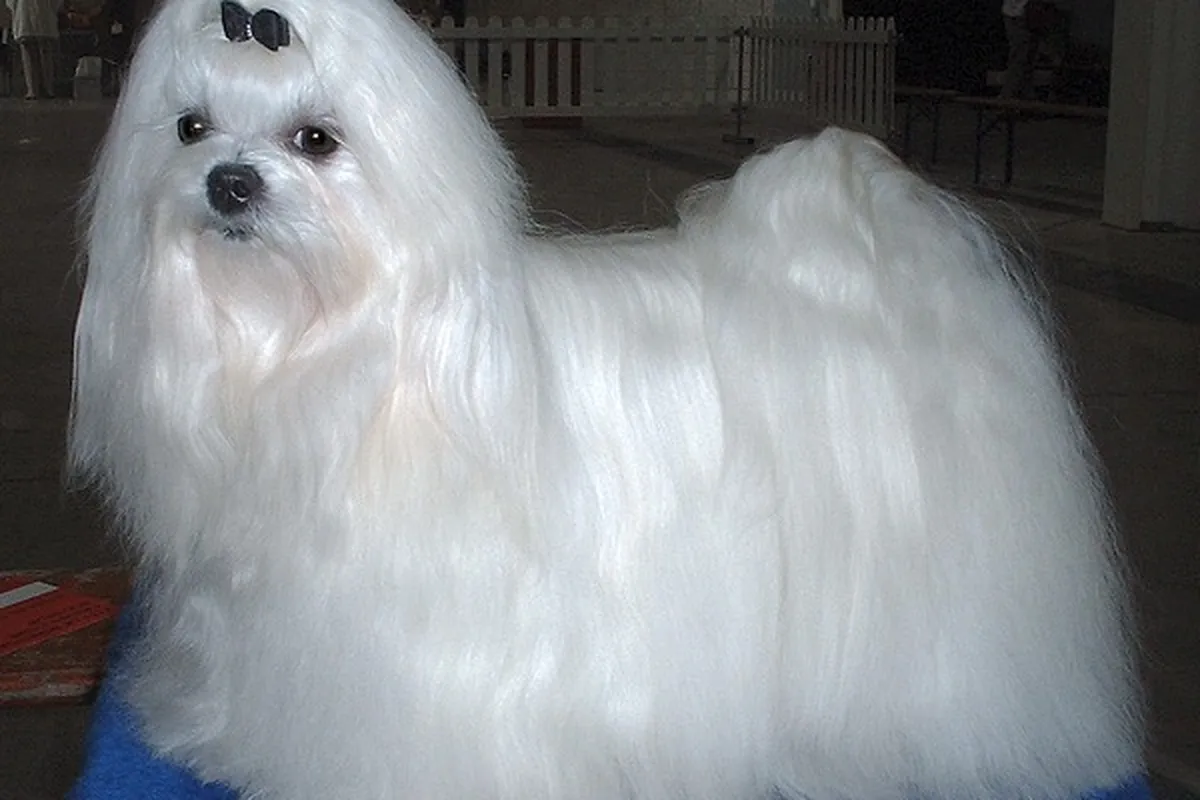
Maltese at a glance
| Trait | Detail |
|---|---|
| Origin | Central Mediterranean area; patronage Italy [1] |
| Breed group | FCI group 9 (companion and toy dogs), section 1, bichons and related breeds [1]; AKC Toy Group [2] |
| Weight | 6.6–8.8 lb (3–4 kg) [1] |
| Height | Males 8.3–9.8 in (21–25 cm), females 7.9–9.1 in (20–23 cm) [1] |
| Life expectancy | Median survival 13.1 years in UK veterinary records [3] |
| Coat | Very long, dense, straight and silky, with no undercoat; pure white, a pale ivory tinge allowed [1] |
Origin
According to the FCI standard, the name does not mean the breed comes from the island of Malta: it derives from a Semitic word meaning refuge or harbor. The ancestors of the Maltese lived in the ports of the central Mediterranean, where they hunted mice and rats [1].
A breed of little dogs called “canes melitenses” is mentioned at the time of Aristotle. The dog was a favorite companion in Ancient Rome, and Renaissance painters often showed it beside the ladies of the time [1].
Common health problems
- Liver shunt: congenital portosystemic shunts were diagnosed in 1.6% of Maltese in a US database of teaching hospitals, against 0.05% of mixed-breed dogs [4]. In 113 related Australian Maltese, 19 had a shunt outside the liver, with an estimated heritability of 0.61 [5]. See liver shunt in dogs.
- Heart valves: the Maltese is predisposed to myxomatous mitral valve disease [6]. See heart failure in dogs.
- Brain inflammation: at UK referral centers, Maltese had 20.5 times the odds of crossbred dogs of meningoencephalitis of unknown origin, the second highest of all breeds [7].
- Collapsing trachea: among 110 small dogs with tracheal collapse confirmed by fluoroscopy in Korea, the Maltese was the most common breed (30.9%). A higher body condition score was linked with a more severe grade of collapse [8].
- Bladder stones: Maltese had 3.7 times the odds of mixed-breed dogs of calcium oxalate stones at a California laboratory [9]. See bladder stones in dogs.
- Teeth: in US veterinary records, extra-small breeds (under 6.5 kg, or about 14 lb) were up to five times more likely to be diagnosed with periodontal disease than giant breeds [10].
Blood work and screening in Maltese
The Maltese is one of the few breeds with a known quirk on a routine liver function test, the bile acids test.
- High bile acids without a shunt: in 195 Australian Maltese without known liver disease, after-meal bile acids ranged from 1 to 362 µmol/L, with a median of 65 µmol/L; 79% were above the reference range of 0 to 31 µmol/L set in mixed-breed dogs. Ammonia tolerance tests were normal in 102 of 106 Maltese tested [11].
- Method matters: in the same study, bile acids measured by liquid chromatography were consistently lower than with the usual enzymatic method, and the gap was much larger in Maltese, suggesting another substance in Maltese serum that reacts in the test [11].
- Not every population: in a Korean hospital study, 30 Maltese without a shunt had a mean bile acid level of 8 µmol/L, within the reference interval. Maltese with a portocaval shunt had higher bile acids before surgery than other breeds, and levels fell after surgery in both groups [12].
- Inherited high bile acids: in Australian Maltese, high after-meal bile acids, likely reflecting portal vein hypoplasia, had an estimated heritability of 0.81 [5]. In the Australian study, bile acids alone could not show which Maltese had a hidden shunt [11].
- Heart size on X-rays: in 23 healthy Maltese, the mean vertebral heart size was 9.1 ± 0.4, and breed-specific echocardiographic values were published to help assess mitral valve disease [6].
Related articles
En français : Bichon maltais.
Questions to ask your veterinarian
- If my Maltese has high bile acids, what other tests are needed before thinking of a liver shunt?
- Which method did the laboratory use to measure bile acids?
- Is there a heart murmur, and should my dog have chest X-rays or an echocardiogram?
- Does the cough or honking sound suggest tracheal collapse, and does weight play a role?
- Do the teeth need cleaning?
Get your Maltese’s blood work explained.
AI DiagAnimals reads bile acids, liver values, urea and the rest of the chemistry panel with your laboratory’s intervals, and prepares the questions for your vet. The service opens soon: leave your email to be told first.
Frequently asked questions
How long do Maltese dogs live?
In a large UK study, the median survival of Maltese was 13.1 years, against 12.0 years for crossbred dogs [3].
What health problems do Maltese have?
Liver shunts [4, 5], mitral valve disease [6], meningoencephalitis of unknown origin [7] and calcium oxalate bladder stones [9] are described in the breed, and the Maltese is among the breeds most often seen with tracheal collapse [8].
Why are bile acids high in my Maltese?
A liver shunt is one cause [4]. But in an Australian study, 79% of Maltese without known liver disease had after-meal bile acids above the reference range, and the trait appears inherited [5, 11]. In that study, bile acids alone could not show which Maltese had a hidden shunt [11].
Are Maltese prone to liver shunts?
Yes. In a US study, 1.6% of Maltese had a congenital portosystemic shunt, against 0.05% of mixed-breed dogs [4], and shunts appear inherited in the breed [5].
Do Maltese get heart disease?
Yes. The Maltese is predisposed to myxomatous mitral valve disease, and reference echocardiographic values have been published for healthy Maltese [6].
Sources
- Fédération Cynologique Internationale. FCI breed standard N° 65: Maltese. 2015. fci.be/Nomenclature/Standards/065g09-en.pdf
- American Kennel Club. Maltese: breed information. akc.org/dog-breeds/maltese
- McMillan KM et al. Longevity of companion dog breeds: those at risk from early death. Sci Rep. 2024;14:531 (supplementary table S3). doi.org/10.1038/s41598-023-50458-w
- Tobias KM, Rohrbach BW. Association of breed with the diagnosis of congenital portosystemic shunts in dogs: 2,400 cases (1980-2002). J Am Vet Med Assoc. 2003;223(11):1636-1639. doi.org/10.2460/javma.2003.223.1636
- O’Leary CA et al. The inheritance of extra-hepatic portosystemic shunts and elevated bile acid concentrations in Maltese dogs. J Small Anim Pract. 2014;55(1):14-21. doi.org/10.1111/jsap.12156
- Tsai CH et al. Echocardiographic parameters and indices in 23 healthy Maltese dogs. J Vet Sci. 2021;22(5):e60. doi.org/10.4142/jvs.2021.22.e60
- Choi Y, O’Neill DG et al. Meningoencephalitis of unknown origin in dogs under veterinary referral care in England (2017-2021): a multicenter case control study. Front Vet Sci. 2025;12:1710593. doi.org/10.3389/fvets.2025.1710593
- Kim MR et al. A retrospective study of tracheal collapse in small-breed dogs: 110 cases (2022-2024). Front Vet Sci. 2024;11:1448249. doi.org/10.3389/fvets.2024.1448249
- Kopecny L et al. Urolithiasis in dogs: evaluation of trends in urolith composition and risk factors (2006-2018). J Vet Intern Med. 2021;35(3):1406-1415. doi.org/10.1111/jvim.16114
- Wallis C et al. Association of periodontal disease with breed size, breed, weight, and age in pure-bred client-owned dogs in the United States. Vet J. 2021;275:105717. doi.org/10.1016/j.tvjl.2021.105717
- Tisdall PL et al. Post-prandial serum bile acid concentrations and ammonia tolerance in Maltese dogs with and without hepatic vascular anomalies. Aust Vet J. 1995;72(4):121-126. doi.org/10.1111/j.1751-0813.1995.tb15029.x
- Kim D et al. Comparison of serum bile acid concentrations between Maltese and other breeds of dogs with portosystemic shunt. In Vivo. 2023;37(2):709-713. doi.org/10.21873/invivo.13132
Laboratory methods and reference intervals vary. This article explains; it does not diagnose. For a decision about your pet, use the original report and talk to your veterinarian. Our editorial policy.