
 Français
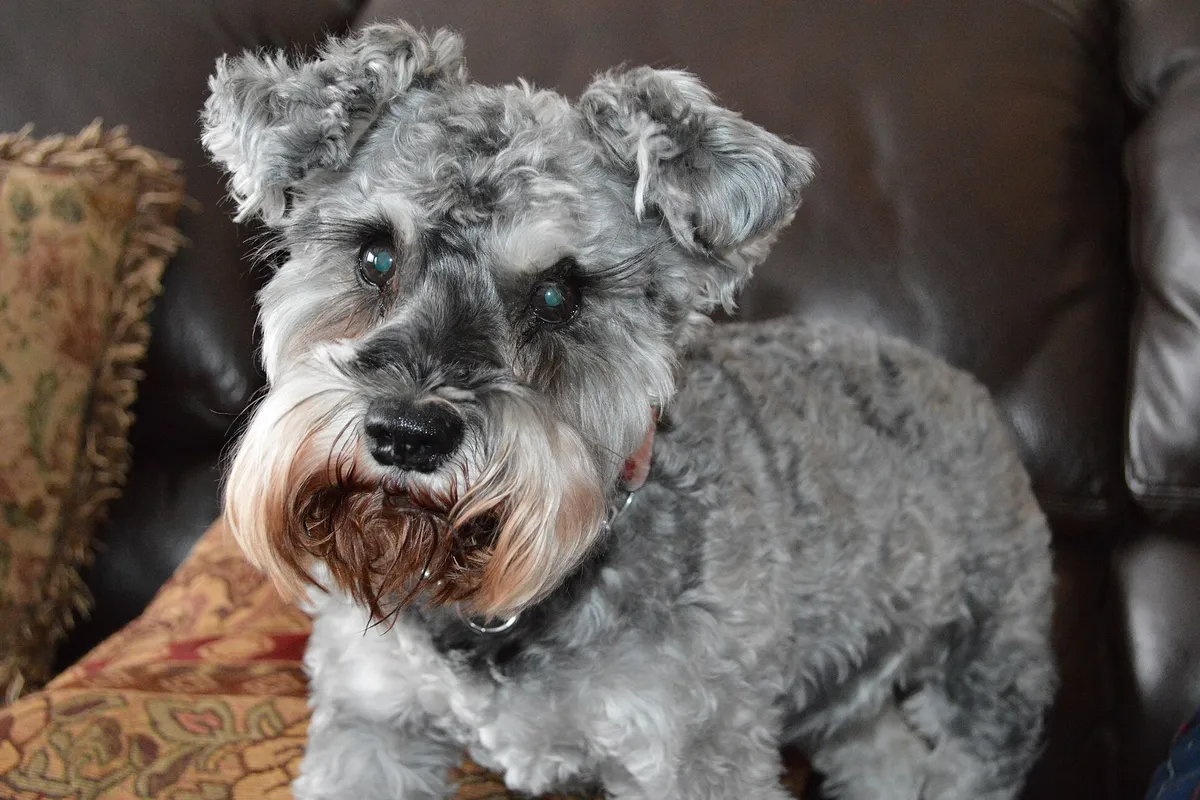
At a glance
| Trait | Detail |
|---|---|
| Origin | Germany (Frankfurt am Main area) [1] |
| Breed group | FCI group 2, section 1 (Pinscher and Schnauzer type) [1] |
| Weight | About 9–18 lb (4–8 kg) in the standard [1]; mean adult weight in UK practices 21.8 lb (9.9 kg) [2] |
| Height | 12–14 in (30–35 cm) at the withers [1] |
| Life expectancy | Median 13.3 years in a large UK study [3]; median age at death 11.6 years in UK veterinary records [2] |
| Coat | Wiry, harsh and dense with an undercoat; pure black, pepper and salt, black and silver, or pure white [1] |
Origin
The breed standard traces the Miniature Schnauzer to the Frankfurt am Main area around the turn of the 20th century, where it was first described as a rough-haired Miniature Pinscher. Breeders worked to produce a small dog with the look and qualities of the larger Schnauzer, “a reduced image of the Schnauzer” without a dwarfed appearance [1].
Common health problems
- Dental disease: periodontal disease was the most common diagnosis in 3,857 UK Miniature Schnauzers (17.4% in one year), followed by overweight (8.3%), anal sac impaction (5.8%), vomiting (5.1%) and ear infection (5.0%) [2].
- High triglycerides (primary hypertriglyceridemia): 32.8% of 192 healthy Miniature Schnauzers had triglycerides above the reference interval, against 5.3% of dogs of other breeds; both frequency and severity increased with age [4]. See cholesterol and triglycerides in dogs.
- Pancreatitis: Schnauzers with a history of pancreatitis were 5 times more likely to have high triglycerides after recovery than Schnauzers without (71% vs 33%) [5]. See pancreatitis in dogs.
- Bladder stones: in more than 10,000 stones analysed in California, Miniature Schnauzers had 2.5 times the odds of calcium oxalate stones compared with mixed breeds [7]. In a German series, 54.8% of the breed’s stones were calcium oxalate [8]. See bladder stones in dogs.
- Cushing’s syndrome: in UK primary care, the Miniature Schnauzer had 3.05 times the odds of crossbreeds, among the three highest-risk breeds [9]. See Cushing’s disease in dogs.
- Gallbladder mucocele: in a Japanese case-control study, Miniature Schnauzers had 5.23 times the odds of a gallbladder mucocele, and high triglycerides were associated with the disease [10].
- Other reported predispositions include diabetes mellitus, primary hypothyroidism and portosystemic shunt [2].
What is special in the Schnauzer’s blood work
Triglycerides first. High triglycerides are so frequent in this breed that they are often found by chance on a routine panel. In healthy Schnauzers, the median triglyceride level was 73.5 mg/dL, higher than in other breeds (55 mg/dL), and rose with age [4].
Liver enzymes. Healthy Schnauzers with moderate to severe hypertriglyceridemia were far more likely to have a high ALP (odds ratio 192.6) and also more likely to have high ALT, AST and GGT than Schnauzers with normal triglycerides [6]. A raised ALP in a Schnauzer is therefore read together with the triglycerides.
Pancreatic lipase. Schnauzers with triglycerides of 862 mg/dL or more were 4.5 times more likely to have a pancreatic lipase (cPLI) result in the pancreatitis range than Schnauzers with normal triglycerides [11]. See lipase and amylase.
Urine. Because calcium oxalate stones are common in the breed [7], a urinalysis, sometimes with imaging, is part of the work-up of urinary signs.
DNA tests. A variant of the SPINK1 gene was once proposed as a pancreatitis marker, but a later study found it in most Miniature Schnauzers (allele frequency 0.77) and no link with pancreatitis [12]. There is no validated DNA test for the breed’s high triglycerides.
Related articles
En français : Schnauzer nain.
Questions to ask your veterinarian
- Are my dog’s triglycerides high, and was the sample taken after a fast?
- Could high triglycerides explain the raised ALP or ALT on this panel?
- Should we check pancreatic lipase if my dog has vomiting or belly pain?
- Does the urinalysis show crystals, and is an X-ray worth doing for stones?
- How often should we repeat blood and urine tests as my Schnauzer gets older?
Get your Schnauzer’s blood work explained.
AI DiagAnimals reads the triglycerides, cholesterol, liver enzymes, pancreatic values and urinalysis together with your laboratory’s intervals, and prepares the questions for your vet. The service opens soon: leave your email to be told first.
Frequently asked questions
How long do Miniature Schnauzers live?
A large UK study found a median lifespan of 13.3 years [3]. In UK veterinary records, the median age at death was 11.6 years, with some dogs reaching 17 [2].
Why do Miniature Schnauzers have high triglycerides?
Many have a primary, inherited form of hypertriglyceridemia. About one healthy Schnauzer in three is above the reference interval, more often with age [4].
Are Miniature Schnauzers prone to pancreatitis?
Schnauzers with a history of pancreatitis are 5 times more likely to have high triglycerides, and very high triglycerides go with pancreatic lipase values in the pancreatitis range [5, 11].
Sources
- FCI. Standard No. 183: Miniature Schnauzer (Zwergschnauzer). 2007. fci.be/Nomenclature/Standards/183g02-en.pdf
- O’Neill DG et al. Miniature Schnauzers under primary veterinary care in the UK in 2013: demography, mortality and disorders. Canine Genet Epidemiol. 2019;6:1. doi.org/10.1186/s40575-019-0069-0
- McMillan KM et al. Longevity of companion dog breeds: those at risk from early death. Sci Rep. 2024;14:531 (supplementary table S3). doi.org/10.1038/s41598-023-50458-w
- Xenoulis PG et al. Investigation of hypertriglyceridemia in healthy Miniature Schnauzers. J Vet Intern Med. 2007;21(6):1224-1230. doi.org/10.1892/07-051.1
- Xenoulis PG et al. Serum triglyceride concentrations in Miniature Schnauzers with and without a history of probable pancreatitis. J Vet Intern Med. 2011;25(1):20-25. doi.org/10.1111/j.1939-1676.2010.0644.x
- Xenoulis PG et al. Serum liver enzyme activities in healthy Miniature Schnauzers with and without hypertriglyceridemia. J Am Vet Med Assoc. 2008;232(1):63-67. doi.org/10.2460/javma.232.1.63
- Kopecny L et al. Urolithiasis in dogs: evaluation of trends in urolith composition and risk factors (2006-2018). J Vet Intern Med. 2021;35(3):1406-1415. doi.org/10.1111/jvim.16114
- Breu D et al. Occurrence of uroliths: age-, breed- and gender-specific differences in dogs from Germany (in German). Tierarztl Prax Ausg K Kleintiere Heimtiere. 2021;49(1):6-12. doi.org/10.1055/a-1334-0733
- Schofield I et al. Frequency and risk factors for naturally occurring Cushing’s syndrome in dogs attending UK primary-care practices. J Small Anim Pract. 2022;63(4):265-274. doi.org/10.1111/jsap.13450
- Kutsunai M et al. The association between gall bladder mucoceles and hyperlipidaemia in dogs: a retrospective case control study. Vet J. 2014;199(1):76-79. doi.org/10.1016/j.tvjl.2013.10.019
- Xenoulis PG et al. Association between serum triglyceride and canine pancreatic lipase immunoreactivity concentrations in miniature schnauzers. J Am Anim Hosp Assoc. 2010;46(4):229-234. doi.org/10.5326/0460229
- Furrow E et al. High prevalence of the c.74A>C SPINK1 variant in miniature and standard Schnauzers. J Vet Intern Med. 2012;26(6):1295-1299. doi.org/10.1111/j.1939-1676.2012.01013.x
Laboratory methods and reference intervals vary. This article explains; it does not diagnose. For a decision about your pet, use the original report and talk to your veterinarian. Our editorial policy.