
 Français
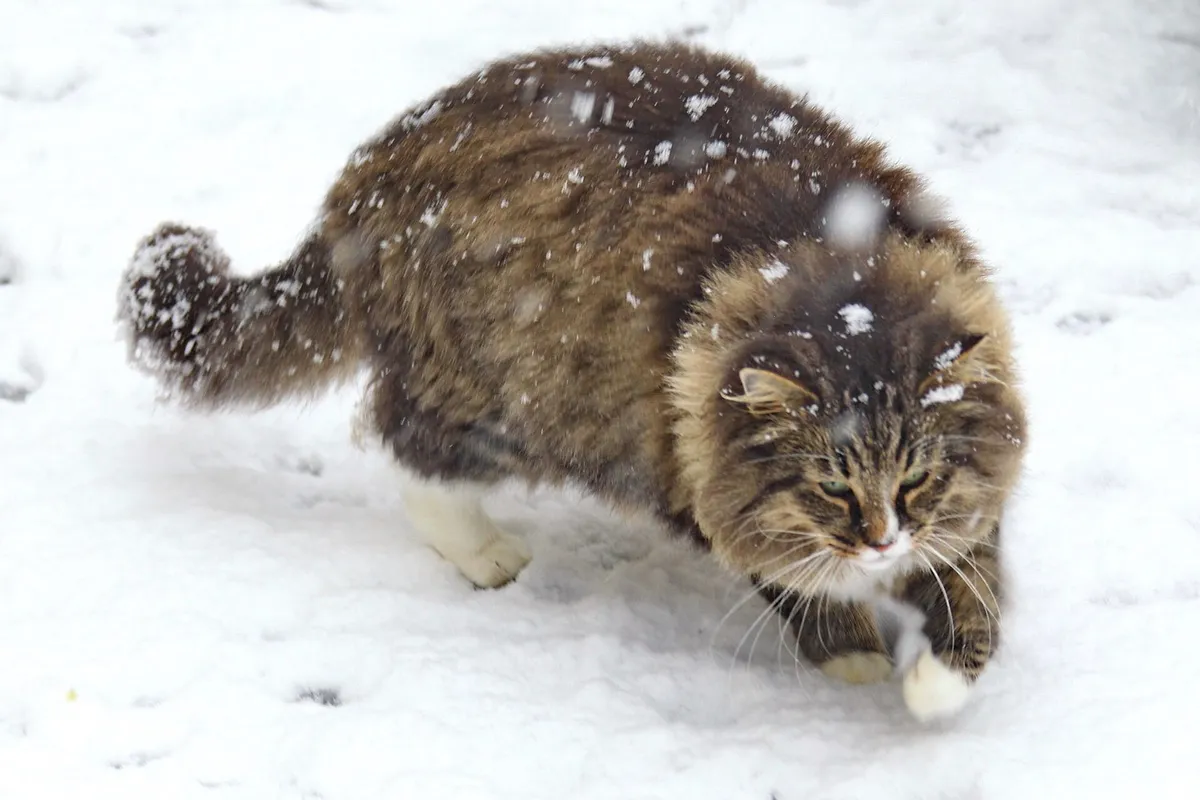
Norwegian Forest Cat at a glance
| Trait | Detail |
|---|---|
| Origin | Norway [1] |
| Breed group | FIFe Category 2 (semi-longhair breeds) [2] |
| Build | Large and sturdy, slow to mature (up to 5 years); adult males 12–16 lb (5.4–7.3 kg), females 9–12 lb (4.1–5.4 kg) [1, 3] |
| Life expectancy | 9.95 years at birth in a 2019 UK study, but based on only 15 deaths (95% confidence interval 7.55–12.35 years) [4] |
| Coat | Semi-long: a woolly undercoat under long, coarse, glossy and water-repellent guard hairs, with a full ruff [3] |
Origin
The exact origins of the breed are unclear; it is thought to have lived for a very long time as a working farm cat and rodent catcher, and King Olaf named it the official cat of Norway in the 1970s. It almost disappeared as a distinct breed through crosses with shorthaired cats. The first breed club was formed in Norway in the mid-1970s, from carefully selected non-pedigree cats [1].
FIFe recognized the breed in 1977 [3]. The first breeding pair reached the United States in 1979, and the Cat Fanciers’ Association granted championship status in 1993 [1].
Common health problems
- Glycogen storage disease type IV (GSD IV): an inherited lack of the glycogen branching enzyme, first described in a family of Norwegian Forest Cats [5]. Most affected kittens die at or soon after birth, presumably from low blood sugar; those that survive look normal until progressive muscle and nerve degeneration starts at about 5 months [6]. Skeletal muscle, heart and nervous system are affected, but the liver failure seen in humans was absent [5]. Screening of 402 privately owned cats found 58 carriers and 4 affected cats [6].
- Familial cardiomyopathy: in a study of related cats, 13 of 53 screened cats (25%) had mild thickening of the left ventricle wall, without murmurs. In cats that died, the heart showed both hypertrophic and restrictive features, and pedigree data supported a familial disease [7].
- Pyruvate kinase deficiency: this inherited cause of anemia was found in several breeds, and PK testing is recommended for Norwegian Forest Cats; 3 of 13 cats of the breed sampled carried one copy of the variant [8]. See anemia in cats.
- Insurance data: in Sweden, Norwegian Forest Cats had a lower rate of veterinary care claims than Siamese, Burmese and Abyssinians [9].
Tests and breed-specific blood values
- Different normal values: in healthy Norwegian Forest Cats, ALP, calcium and phosphate were higher than published reference intervals, and β2- and γ-globulins were lower; the authors recommend breed-specific intervals for these values [10]. A mildly high ALP, calcium or phosphate is therefore read in this light. See high liver enzymes in cats and high calcium in dogs and cats.
- DNA test for GSD IV: a PCR-based test detects the GBE1 gene rearrangement responsible for the disease [6]. Because affected newborns are thought to die of low blood sugar [6], see also blood sugar in cats.
- Heart: breeders routinely test for hypertrophic cardiomyopathy [1]. In a Swedish study, healthy Norwegian Forest Cats had lower cardiac troponin I than healthy Birmans, and cats with HCM had higher levels than healthy cats [11].
- Blood type: no type B cats were found among Norwegian Forest Cats in a US survey of 1,100 purebred cats [12].
- PK deficiency: a DNA test is available, and testing is recommended for the breed [8].
Related articles
En français : Chat des forêts norvégiennes.
Questions to ask your veterinarian
- Has my cat, or its parents, been DNA tested for glycogen storage disease type IV?
- Should my cat have a heart ultrasound, and at what age?
- Is my cat’s ALP, calcium or phosphate result within what is expected for this breed?
- Has my cat been tested for pyruvate kinase deficiency?
- Do you know my cat’s blood type?
Get your Norwegian Forest Cat’s blood work explained.
AI DiagAnimals reads the ALP, calcium, phosphate, the blood count and the rest of the chemistry with your laboratory’s cat intervals, and prepares the questions for your vet. The service opens soon: leave your email to be told first.
Frequently asked questions
How long do Norwegian Forest Cats live?
A UK study of cats that died in 2019 gave 9.95 years at birth, but it was based on only 15 deaths, so the true figure is uncertain (7.55–12.35 years) [4].
What health problems do Norwegian Forest Cats have?
The best documented are glycogen storage disease type IV [5, 6] and a familial cardiomyopathy [7]; PK deficiency testing is also recommended [8].
What is GSD IV in Norwegian Forest Cats?
A recessive lack of the glycogen branching enzyme. Most affected kittens die around birth; survivors develop progressive muscle and nerve degeneration from about 5 months [6].
Is a high ALP normal in Norwegian Forest Cats?
Healthy Norwegian Forest Cats had higher ALP, calcium and phosphate than published intervals, so a mild increase may be normal for the breed. Your vet interprets it with the rest of the results [10].
Sources
- The Cat Fanciers’ Association. Norwegian Forest Cat: breed profile. cfa.org/breed/norwegian-forest-cat
- Fédération Internationale Féline. Breeds and standards. fifeweb.org/cats/breeds
- Fédération Internationale Féline. Breed standard: Norwegian Forest Cat (NFO). fifeweb.org/wp-content/uploads/2023/10/NFO.pdf
- Teng KT et al. Life tables of annual life expectancy and risk factors for mortality in cats in the UK. J Feline Med Surg. 2024;26(5):1098612X241234556. doi.org/10.1177/1098612X241234556
- Fyfe JC et al. Glycogen storage disease type IV: inherited deficiency of branching enzyme activity in cats. Pediatr Res. 1992;32(6):719-725. doi.org/10.1203/00006450-199212000-00020
- Fyfe JC et al. A complex rearrangement in GBE1 causes both perinatal hypoglycemic collapse and late-juvenile-onset neuromuscular degeneration in glycogen storage disease type IV of Norwegian forest cats. Mol Genet Metab. 2007;90(4):383-392. doi.org/10.1016/j.ymgme.2006.12.003
- März I et al. Familial cardiomyopathy in Norwegian Forest cats. J Feline Med Surg. 2015;17(8):681-691. doi.org/10.1177/1098612X14553686
- Grahn RA et al. Erythrocyte pyruvate kinase deficiency mutation identified in multiple breeds of domestic cats. BMC Vet Res. 2012;8:207. doi.org/10.1186/1746-6148-8-207
- Egenvall A et al. Morbidity of insured Swedish cats during 1999-2006 by age, breed, sex, and diagnosis. J Feline Med Surg. 2010;12(12):948-959. doi.org/10.1016/j.jfms.2010.08.008
- Paltrinieri S et al. Haematological and biochemical reference intervals of four feline breeds. J Feline Med Surg. 2014;16(2):125-136. doi.org/10.1177/1098612X13499337
- Hanås S et al. Cardiac troponin I in healthy Norwegian Forest Cat, Birman and domestic shorthair cats, and in cats with hypertrophic cardiomyopathy. J Feline Med Surg. 2022;24(10):e370-e379. doi.org/10.1177/1098612X221117115
- Giger U et al. Frequency and inheritance of A and B blood types in feline breeds of the United States. J Hered. 1991;82(1):15-20. doi.org/10.1093/jhered/82.1.15
Laboratory methods and reference intervals vary. This article explains; it does not diagnose. For a decision about your pet, use the original report and talk to your veterinarian. Our editorial policy.