
 Français
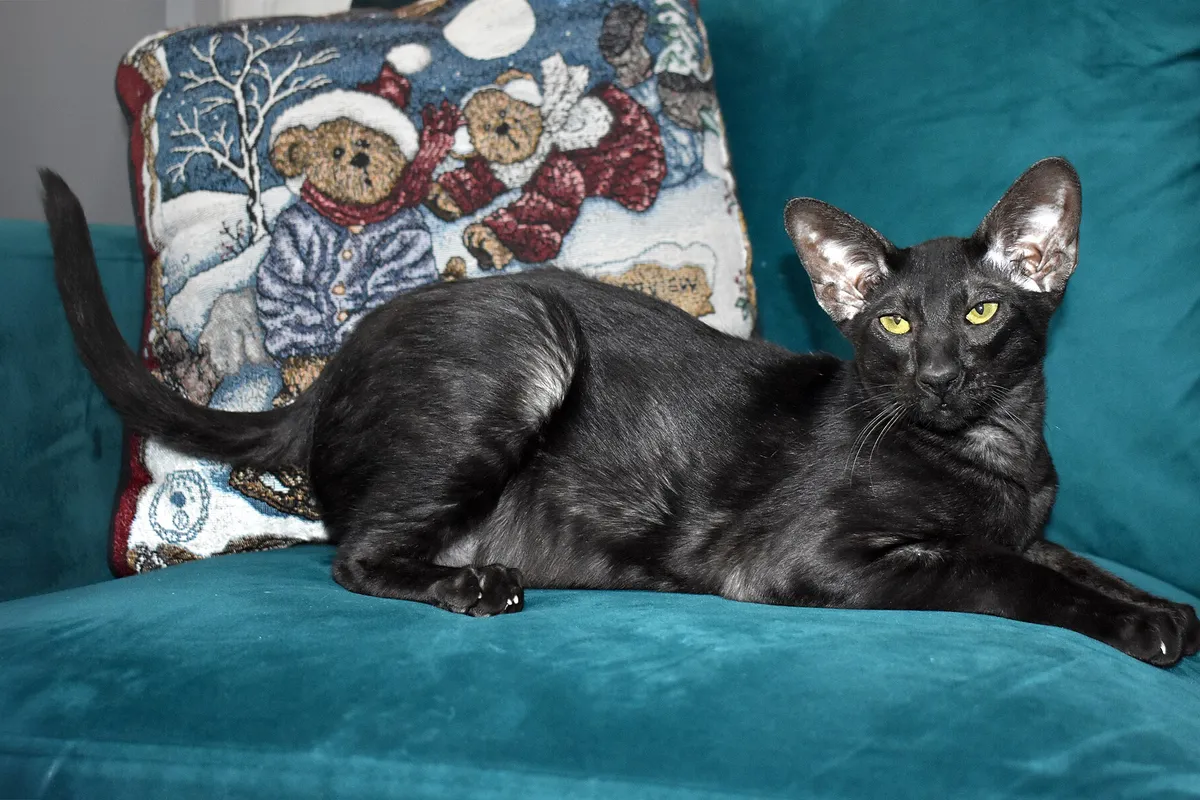
Oriental Shorthair at a glance
| Trait | Detail |
|---|---|
| Origin | Developed in Europe from the 1950s from Siamese lines, then in the United States in the 1960s and 1970s [1] |
| Breed group | FIFe Category 4, with the Oriental Longhair as a separate breed [2] |
| Build | Svelte, long and tubular, fine-boned but firmly muscled, with a long wedge-shaped head and very large ears [1] |
| Life expectancy | No breed figure in the 2024 UK life tables, which only covered breeds with 15 or more deaths; 11.69 years at birth for the Siamese and 11.74 years for all cats [3] |
| Coat | Short, sleek and close-lying (a longhaired variety exists); over 600 color, pattern and coat-length combinations in the CFA [1] |
Origin
The Oriental was developed in Europe in the 1950s as a Siamese-style cat without the point markings; England’s Governing Council of the Cat Fancy first recognized chestnut, lavender and white solids. Breeders in the United States added many more colors in the 1960s and 1970s. The Cat Fanciers’ Association accepted the Oriental Shorthair for registration in 1974 and for championship in 1977, then added the longhaired variety in 1988 [1].
Genetically, the Oriental Shorthair could not be told apart from the Siamese, Colorpoint Shorthair, Balinese and Javanese in a breed-relationship study, which is why researchers group them as the “Siamese breed group” [8]. FIFe places the Oriental Shorthair and the Oriental Longhair in Category 4 [2].
Common health problems
- Familial amyloidosis: a lethal condition in which amyloid A protein builds up throughout the body, mainly in the liver and thyroid gland. Signs usually appear between 1 and 7 years of age; at the end stage the liver is enlarged, pale and fragile and can rupture and bleed into the abdomen. In 17 affected Oriental Shorthairs, pedigrees showed a familial trait with a heritability of 0.56 [5]. In a Dutch series of 194 Siamese and Oriental cats examined after death, 12 (6.2%) had amyloidosis [4]. See high liver enzymes in cats.
- Liver rupture can be misread: in cats with bleeding from an amyloid-laden liver, the signs were at first taken for trauma, immune-mediated destruction of red cells or a clotting disorder [7]. See anemia in cats.
- Progressive retinal atrophy (rdAc): a recessive variant of the CEP290 gene that causes retinal degeneration and blindness. In the Siamese breed group, including Oriental Shorthairs, the variant made up 27% to 36% of gene copies, and two Oriental Shorthairs with two copies showed the disease [8]. In a later DNA screening, 41 of 178 Oriental Shorthairs (23%) and 17 of 51 Oriental Longhairs carried it [9].
- Mediastinal lymphoma in young cats: in Sydney, 22 of 118 cats with lymphoma were Siamese or Oriental (including crosses), more than expected, and a subgroup of cats under 2 years had lymphoma in the front of the chest [11]. A 21-year Californian survey also found a high incidence of mediastinal lymphoma in young Siamese or Oriental cats [10]. See lymphoma in cats.
- Diabetes: not a known weak point. In Swedish insurance data, the Oriental group (Siamese, Oriental Shorthair and related breeds) had 8.0 diabetes cases per 10,000 cat-years, against 11.6 for all insured cats [12]. See diabetes in cats.
The Siamese shares most of these risks: see the Siamese cat page.
Tests and screening in Oriental Shorthairs
- Amyloidosis: there is no DNA test yet; the condition seems to involve a major gene plus several minor ones [5]. A genome study of 20 affected Siamese and Oriental cats found eight associated markers, near genes that include SAA1, the precursor of amyloid A [6]. The breed club advises asking whether amyloidosis has occurred in a kitten’s lines [1].
- Liver values and imaging: in cats with liver rupture from amyloid, the diagnosis before death relied on liver ultrasound and fine-needle aspirate cytology [7]. Liver enzymes are read as in any cat: see cat blood work explained.
- DNA test for rdAc: commercial testing exists for the CEP290 variant [8]; carriers can be removed from breeding or bred only to non-carriers [1]. A 10-year-old Oriental Longhair with two copies had retinal changes on examination although its owner had noticed no loss of vision [9].
- Blood type: all 230 Oriental-type cats in a large DNA study were type A [9].
Related articles
En français : Oriental.
Questions to ask your veterinarian
- Has amyloidosis occurred in my cat’s family line?
- Has my cat, or its parents, been DNA tested for the rdAc (CEP290) variant?
- Are my cat’s liver values normal, and would an ultrasound be useful if they change?
- Should my cat have an eye examination as it gets older?
- If my young cat has breathing problems, could the chest be checked for a mass?
Get your Oriental’s blood work explained.
AI DiagAnimals reads the blood count, liver enzymes, bilirubin and kidney values with your laboratory’s intervals, compares them with earlier results and prepares the questions for your vet. The service opens soon: leave your email to be told first.
Frequently asked questions
How long do Oriental Shorthairs live?
There is no published breed figure: the 2024 UK life tables only covered breeds with 15 or more deaths. The closely related Siamese had a life expectancy at birth of 11.69 years, and all cats 11.74 years [3].
What health problems do Oriental cats have?
Familial amyloidosis of the liver and thyroid [4, 5], the rdAc retinal degeneration [8, 9] and mediastinal lymphoma in young cats [10, 11] are the best documented.
Is there a test for amyloidosis in Oriental cats?
Not yet. The inheritance is complex and research has found associated genetic markers, but no DNA test [5, 6]. Breeders can be asked about cases in a kitten’s lines [1].
Sources
- The Cat Fanciers’ Association. Oriental: breed profile. cfa.org/breed/oriental
- Fédération Internationale Féline. Breeds and standards. fifeweb.org/cats/breeds
- Teng KT et al. Life tables of annual life expectancy and risk factors for mortality in cats in the UK. J Feline Med Surg. 2024;26(5):1098612X241234556. doi.org/10.1177/1098612X241234556
- van der Linde-Sipman JS et al. Generalized AA-amyloidosis in Siamese and Oriental cats. Vet Immunol Immunopathol. 1997;56(1-2):1-10. doi.org/10.1016/s0165-2427(96)05717-0
- Struck AK et al. Complex segregation analysis of familial amyloidosis in Oriental shorthair cats. Vet J. 2020;265:105552. doi.org/10.1016/j.tvjl.2020.105552
- Esders SL et al. Single nucleotide polymorphisms associated with AA-amyloidosis in Siamese and Oriental Shorthair cats. Genes (Basel). 2023;14(12):2126. doi.org/10.3390/genes14122126
- Beatty JA et al. Spontaneous hepatic rupture in six cats with systemic amyloidosis. J Small Anim Pract. 2002;43(8):355-363. doi.org/10.1111/j.1748-5827.2002.tb00086.x
- Menotti-Raymond M et al. Widespread retinal degenerative disease mutation (rdAc) discovered among a large number of popular cat breeds. Vet J. 2010;186(1):32-38. doi.org/10.1016/j.tvjl.2009.08.010
- Anderson H et al. Genetic epidemiology of blood type, disease and trait variants, and genome-wide genetic diversity in over 11,000 domestic cats. PLoS Genet. 2022;18(6):e1009804. doi.org/10.1371/journal.pgen.1009804
- Louwerens M et al. Feline lymphoma in the post-feline leukemia virus era. J Vet Intern Med. 2005;19(3):329-335. pubmed.ncbi.nlm.nih.gov/15954547
- Gabor LJ et al. Clinical and anatomical features of lymphosarcoma in 118 cats. Aust Vet J. 1998;76(11):725-732. doi.org/10.1111/j.1751-0813.1998.tb12300.x
- Öhlund M et al. Incidence of diabetes mellitus in insured Swedish cats in relation to age, breed and sex. J Vet Intern Med. 2015;29(5):1342-1347. doi.org/10.1111/jvim.13584
Laboratory methods and reference intervals vary. This article explains; it does not diagnose. For a decision about your pet, use the original report and talk to your veterinarian. Our editorial policy.