
 Français
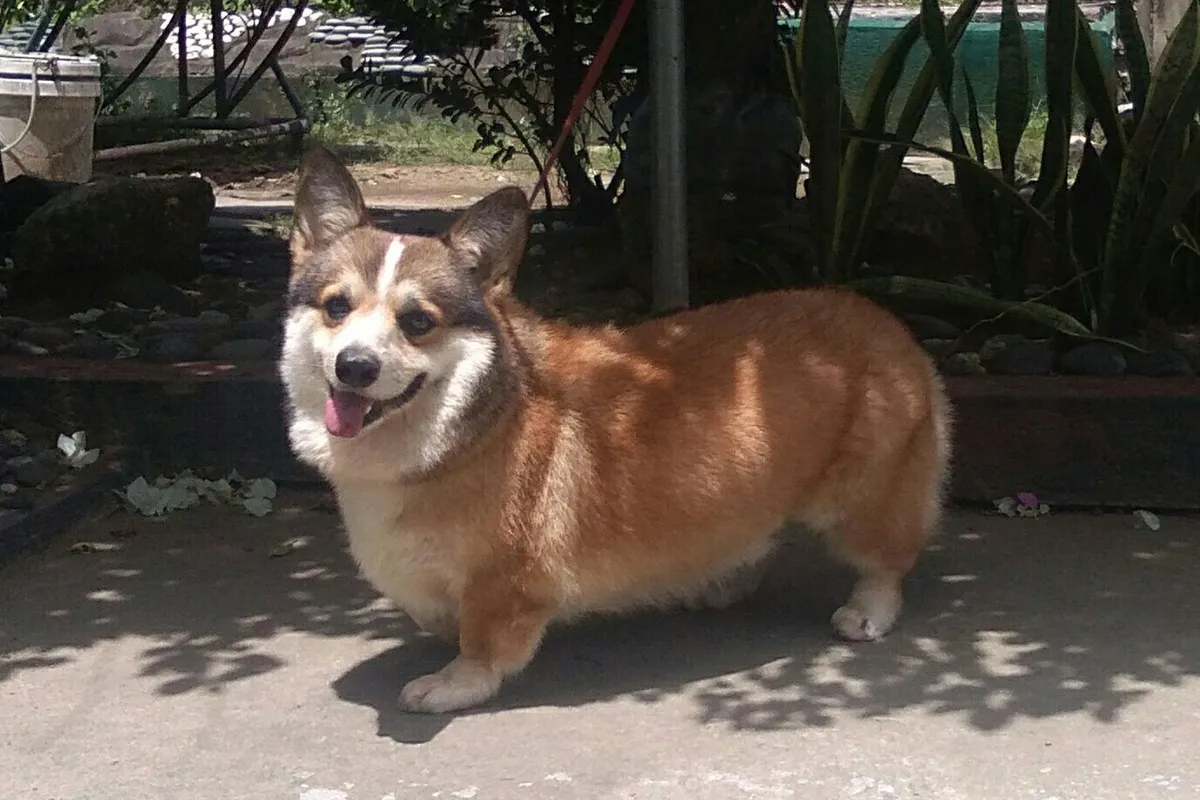
At a glance
| Trait | Detail |
|---|---|
| Origin | Great Britain (Wales) [1, 4] |
| Breed group | FCI Group 1 (Sheepdogs and cattle dogs), section 2, cattle dogs; AKC Herding Group [1, 2] |
| Weight | Males 22–26 lb (10–12 kg), females 20–24 lb (9–11 kg) [1] |
| Height | About 10–12 in (25–30 cm) [1] |
| Life expectancy | Median 13.2 years in a 2024 UK study, based on 221 deaths [3] |
| Coat | Medium length and straight, with a dense undercoat; red, sable, fawn, or black and tan, with or without white markings [1] |
Origin
The Pembroke is a traditional droving dog of Wales, used to move cattle. It is slightly smaller than its cousin the Cardigan Welsh Corgi, with a shorter body, smaller ears and straighter front legs [4, 1].
It has long been the more popular of the two Corgi breeds, perhaps helped by royal patronage from the reign of King George VI through that of Queen Elizabeth II [4].
Common health problems
- Degenerative myelopathy: a progressive, fatal disease of the spinal cord. Signs usually start at 8 years of age or older, with weakness and loss of coordination in the hind legs that later spread to the front legs [5]. In 21 Corgis followed until euthanasia, signs lasted a median of 19 months and the median age at euthanasia was 13 years; all dogs could no longer walk by then [6].
- The SOD1 risk variant: the mutation was found by studying 38 affected Pembroke Welsh Corgis, and dogs with two copies (A/A) were at risk in five breeds [5]. Among 3,209 Corgis tested in one laboratory, 2,091 (65%) were A/A; A/A dogs are at much higher risk than carriers with one copy [7].
- Intervertebral disc disease: in veterinary hospital studies, the Pembroke Welsh Corgi is among the breeds with a significantly higher risk. The breed carries an FGF4 retrogene linked to its short legs [9].
- Hips: in 399 Corgis assessed by PennHIP, all had hip laxity above 0.30 (mean distraction index 0.66), 18% had subluxation and 6.8% had osteoarthritis [10].
- Cystine stones: the Pembroke Welsh Corgi is among the breeds reported to carry inherited (type I or II) cystinuria variants, which can lead to cystine bladder stones [11]. See bladder stones in dogs.
- Heart: a heart defect, patent ductus arteriosus, has been reported in five related Corgi puppies and their sire [12]. See heart failure in dogs.
What is special in the Corgi’s tests
We found no published breed-specific reference intervals or known lab quirks for routine blood values in Pembroke Welsh Corgis. A complete blood count and chemistry panel are read with ordinary dog intervals.
DM is not a blood-test diagnosis. In the study that characterized the disease in Corgis, affected dogs had a neurological examination, blood tests, cerebrospinal fluid analysis, electrodiagnostic tests and spinal imaging; imaging showed no spinal cord compression [6]. In life, the diagnosis remains presumptive: most of 189 neurologists surveyed required the SOD1 DNA test, and 82 also required an MRI of the spine [8].
Reading the DNA test. A/A dogs are at much higher risk of DM than A/G carriers, but not all of them become ill. In dogs of several breeds followed beyond 10 years of age, 18 of 30 A/A dogs developed signs of DM, against 2 of 55 A/G dogs [7].
Urine. The breed’s inherited cystinuria variants [11] make cystine one of the stone types to keep in mind in a Corgi. See urinalysis for dogs and cats.
Related articles
En français : Corgi.
Questions to ask your veterinarian
- Has my Corgi been tested for the SOD1 variant, and what does an A/A result mean for my dog?
- Could my older Corgi’s hind-leg weakness be degenerative myelopathy or a disc problem?
- Would an MRI change the plan for my dog?
- Should my Corgi’s urine be checked for cystine crystals?
- Should we assess the hips, given the breed’s hip laxity?
Get your Corgi’s blood work explained.
AI DiagAnimals reads the blood count, chemistry panel and urinalysis together with your laboratory’s intervals, and explains them in the light of the Corgi’s known health issues. The service opens soon: leave your email to be told first.
Frequently asked questions
How long do Pembroke Welsh Corgis live?
A large 2024 UK study found a median lifespan of 13.2 years, based on 221 deaths [3].
What is degenerative myelopathy in Corgis?
A progressive disease of the spinal cord that causes weakness and loss of coordination in the hind legs, usually from 8 years of age or older [5]. In Corgis it progressed slowly, over a median of 19 months [6].
Should I DNA-test my Corgi for degenerative myelopathy?
The SOD1 test is the test most neurologists require when they suspect DM [8]. Two copies of the variant mean a much higher risk, but not certain disease [7].
Are Corgis prone to back problems?
Yes. The Pembroke Welsh Corgi is among the breeds at higher risk of intervertebral disc disease in hospital studies [9].
Sources
- FCI. Standard No. 39: Welsh Corgi Pembroke. 2026. fci.be/Nomenclature/Standards/039g01-en.pdf
- American Kennel Club. Pembroke Welsh Corgi: dog breed information. akc.org/dog-breeds/pembroke-welsh-corgi
- McMillan KM et al. Longevity of companion dog breeds: those at risk from early death. Sci Rep. 2024;14:531 (supplementary Table S3). doi.org/10.1038/s41598-023-50458-w
- The Royal Kennel Club. Welsh Corgi (Pembroke): breed information. royalkennelclub.com/search/breeds-a-to-z/breeds/pastoral/welsh-corgi-pembroke
- Awano T et al. Genome-wide association analysis reveals a SOD1 mutation in canine degenerative myelopathy that resembles amyotrophic lateral sclerosis. Proc Natl Acad Sci U S A. 2009;106(8):2794-2799. doi.org/10.1073/pnas.0812297106
- Coates JR et al. Clinical characterization of a familial degenerative myelopathy in Pembroke Welsh Corgi dogs. J Vet Intern Med. 2007;21(6):1323-1331. doi.org/10.1892/07-059.1
- Zeng R et al. Breed distribution of SOD1 alleles previously associated with canine degenerative myelopathy. J Vet Intern Med. 2014;28(2):515-521. doi.org/10.1111/jvim.12317
- Bouché TV et al. Diagnosis and management of dogs with degenerative myelopathy: a survey of neurologists and rehabilitation professionals. J Vet Intern Med. 2023;37(5):1815-1820. doi.org/10.1111/jvim.16829
- Brown EA et al. FGF4 retrogene on CFA12 is responsible for chondrodystrophy and intervertebral disc disease in dogs. Proc Natl Acad Sci U S A. 2017;114(43):11476-11481. doi.org/10.1073/pnas.1709082114
- Karbe GT et al. Radiographic hip joint phenotype of the Pembroke Welsh Corgi. Vet Surg. 2012;41(1):34-41. doi.org/10.1111/j.1532-950X.2011.00938.x
- Lulich JP et al. Epidemiological evaluation of neuter status, sex, and breed in dogs with cystine uroliths. J Vet Intern Med. 2025;39(3):e70110. doi.org/10.1111/jvim.70110
- Oswald GP, Orton EC. Patent ductus arteriosus and pulmonary hypertension in related Pembroke Welsh corgis. J Am Vet Med Assoc. 1993;202(5):761-764. pubmed.ncbi.nlm.nih.gov/8454510
Laboratory methods and reference intervals vary. This article explains; it does not diagnose. For a decision about your pet, use the original report and talk to your veterinarian. Our editorial policy.