
 Français
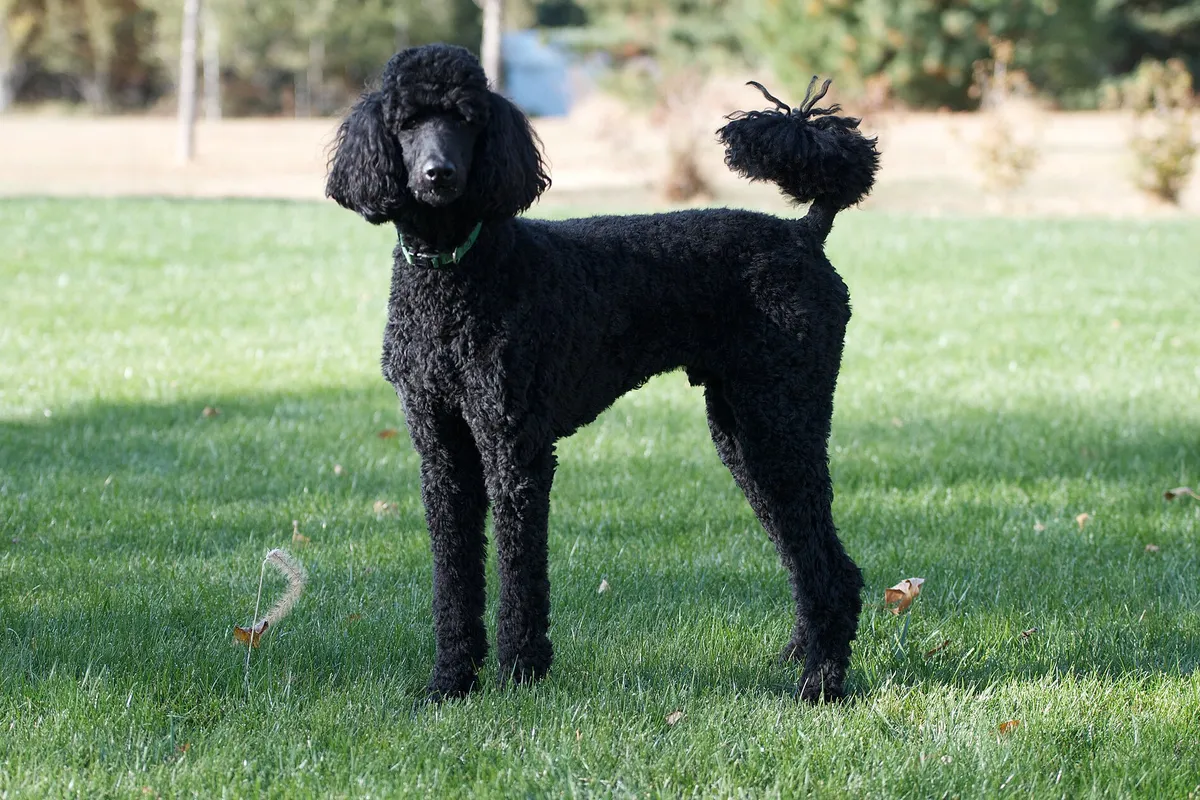
At a glance
| Trait | Detail |
|---|---|
| Origin | France [1] |
| Breed group | FCI group 9, section 2 (Poodle) [1] |
| Weight | Not set by the FCI standard, which defines four sizes by height [1] |
| Height | Toy 9.5–11 in (24–28 cm), Miniature 11–14 in (28–35 cm), Medium 14–18 in (35–45 cm), Standard 18–24 in (45–60 cm, +2 cm tolerance) [1] |
| Life expectancy | Median 14.0 years in a large UK study [2] |
| Coat | Curly or corded, woolly texture; solid black, white, brown, grey or fawn, or parti-coloured [1] |
Origin
The Poodle descends from the Barbet, a water dog used for wildfowling. In 1743 it was called the “caniche”, from the French word for a female duck, and the Barbet and the Poodle were then gradually separated [1].
It became a popular companion dog, helped by its four sizes and many colours [1].
Common health problems
- Addison’s disease (hypoadrenocorticism): in UK primary care, the Standard Poodle had 51.38 times the odds of a laboratory-confirmed diagnosis compared with crossbreeds [4]. In a US study of 778 Standard Poodles, 8.6% were Addisonian, with an estimated heritability of 0.75 [3]. See Addison’s disease in dogs.
- Sebaceous adenitis: an inflammatory disease of the skin’s oil glands. Along with Addison’s disease, it rose rapidly in Standard Poodles after the mid-20th century, and both diseases were concentrated among the most inbred dogs [5].
- Bladder stones: in more than 10,000 stones analysed in California, the Standard Poodle had the highest risk of calcium oxalate stones of all breeds (odds ratio 6.8 compared with mixed breeds) [6]. See bladder stones in dogs.
- Diabetes: Miniature and Toy Poodles were among the breeds at high risk of diabetes mellitus in a US hospital population [7]. See diabetes in dogs.
- Progressive retinal atrophy (prcd): an inherited, late-onset retinal disease. In Japan, the mutant prcd allele frequency in Toy Poodles was about 0.09 [8].
What is special in the Poodle’s blood work
Electrolytes in Standard Poodles. Addison’s disease often shows first on a chemistry panel. In UK dogs with a confirmed diagnosis, high potassium was reported in 88.7% and low sodium in 86.8%, with a median sodium-to-potassium ratio of 19.0 [4]. See potassium in dogs and cats.
The confirming test. The diagnosis is confirmed with an ACTH stimulation test, the test used to classify Standard Poodles in the heritability study [3]. See the ACTH stimulation test.
Glucose and urine. Because Miniature and Toy Poodles are at higher risk of diabetes [7], blood glucose and urine sugar are worth reading carefully, and a urinalysis also helps in the work-up of urinary signs given the Standard Poodle’s risk of calcium oxalate stones [6].
DNA tests. A genotyping test exists for the prcd variant behind one form of progressive retinal atrophy [8]. No genetic marker has been consistently linked with Addison’s disease or sebaceous adenitis in Standard Poodles beyond the degree of inbreeding [5].
Related articles
En français : Caniche.
Questions to ask your veterinarian
- Are my dog’s sodium and potassium normal, and what is the Na:K ratio?
- Given that my dog is a Standard Poodle, should we consider an ACTH stimulation test?
- Is the blood glucose normal, and should we check the urine for sugar?
- Does the urinalysis show crystals or signs of stones?
- Has my dog, or its parents, been tested for the prcd eye variant?
Get your Poodle’s blood work explained.
AI DiagAnimals reads the sodium, potassium, glucose, kidney values and urinalysis together with your laboratory’s intervals, and prepares the questions for your vet. The service opens soon: leave your email to be told first.
Frequently asked questions
How long do Poodles live?
A large UK study found a median lifespan of 14.0 years for Poodles, with a lower risk of early death than crossbreeds [2].
Are Standard Poodles prone to Addison’s disease?
Yes. In UK primary care they had about 51 times the odds of crossbreeds [4], and in a US study 8.6% of 778 Standard Poodles were affected [3].
What health problems do Poodles have?
Standard Poodles are prone to Addison’s disease, sebaceous adenitis and calcium oxalate stones [4, 5, 6]. Miniature and Toy Poodles are at higher risk of diabetes [7], and Toy Poodles can carry the prcd eye variant [8].
Sources
- FCI. Standard No. 172: Poodle (Caniche). 2024. fci.be/Nomenclature/Standards/172g09-en.pdf
- McMillan KM et al. Longevity of companion dog breeds: those at risk from early death. Sci Rep. 2024;14:531 (supplementary table S3). doi.org/10.1038/s41598-023-50458-w
- Famula TR et al. Heritability and complex segregation analysis of hypoadrenocorticism in the standard poodle. J Small Anim Pract. 2003;44(1):8-12. doi.org/10.1111/j.1748-5827.2003.tb00096.x
- Schofield I et al. Hypoadrenocorticism in dogs under UK primary veterinary care: frequency, clinical approaches and risk factors. J Small Anim Pract. 2021;62(5):343-350. doi.org/10.1111/jsap.13285
- Pedersen NC et al. The effect of genetic bottlenecks and inbreeding on the incidence of two major autoimmune diseases in standard poodles, sebaceous adenitis and Addison’s disease. Canine Genet Epidemiol. 2015;2:14. doi.org/10.1186/s40575-015-0026-5
- Kopecny L et al. Urolithiasis in dogs: evaluation of trends in urolith composition and risk factors (2006-2018). J Vet Intern Med. 2021;35(3):1406-1415. doi.org/10.1111/jvim.16114
- Hess RS et al. Breed distribution of dogs with diabetes mellitus admitted to a tertiary care facility. J Am Vet Med Assoc. 2000;216(9):1414-1417. doi.org/10.2460/javma.2000.216.1414
- Kohyama M et al. Real-time PCR genotyping assay for canine progressive rod-cone degeneration and mutant allele frequency in Toy Poodles, Chihuahuas and Miniature Dachshunds in Japan. J Vet Med Sci. 2016;78(3):481-484. doi.org/10.1292/jvms.15-0279
Laboratory methods and reference intervals vary. This article explains; it does not diagnose. For a decision about your pet, use the original report and talk to your veterinarian. Our editorial policy.