
 Français
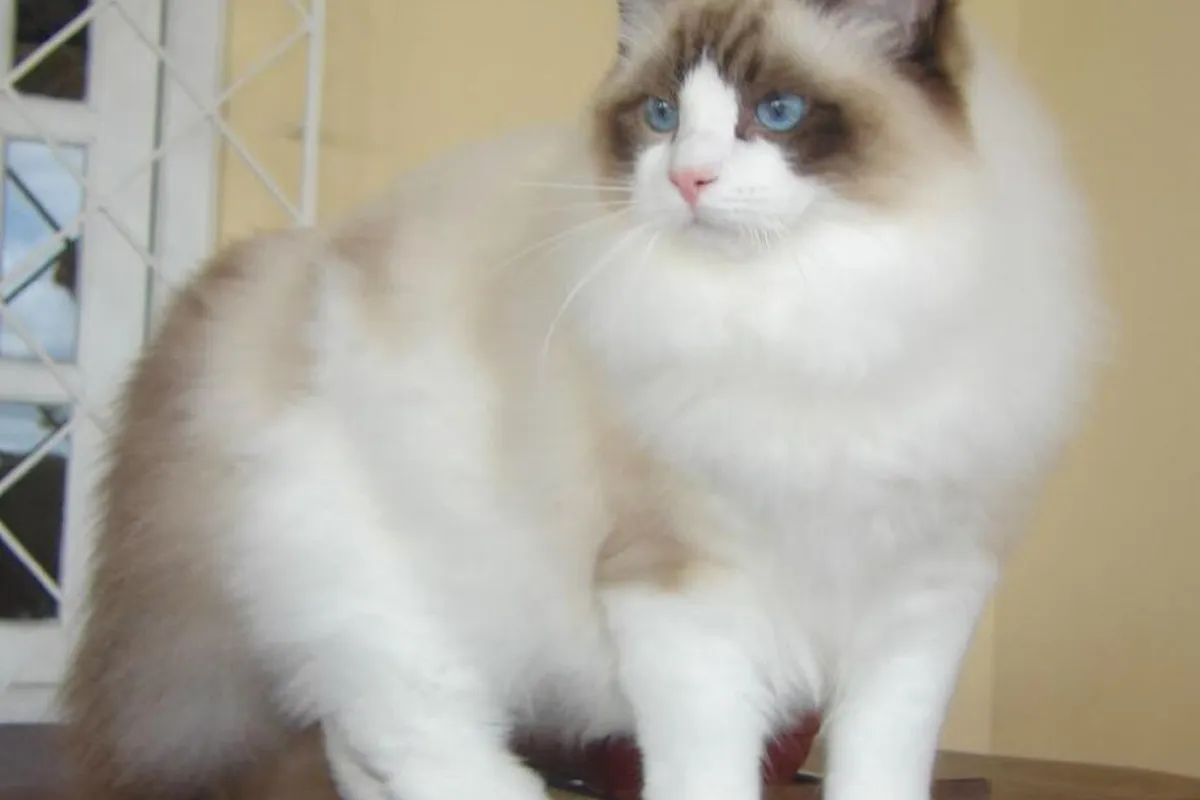
Ragdoll at a glance
| Trait | Detail |
|---|---|
| Origin | United States (Riverside, California), 1960s [1] |
| Breed group | FIFe Category 1 [2] |
| Build | Large, long and muscular; full size at about 4 years. Median adult weight 4.46 kg (9.8 lb) in UK primary care; mature males can reach or exceed 20 lb (9 kg) [1, 3] |
| Life expectancy | Median age at death 12.85 years (UK, 2019) [3]; life expectancy at birth 10.31 years [4] |
| Coat | Semi-long and silky, with little undercoat; always colorpointed, with blue eyes [1] |
Origin
Ann Baker, a breeder in Riverside, California, developed the Ragdoll in the 1960s from a group of domestic longhairs. The foundation cat, Josephine, was a white longhair carrying the colorpoint gene. Baker said Josephine went limp when held, which gave the breed its name, although this is not typical of today’s Ragdolls [1].
The Cat Fanciers’ Association accepted the breed for registration in 1993 and granted it championship status in 2000 [1]. Its share of UK cats born each year rose from 0.70% in 2005 to 3.72% in 2019 [3].
Common health problems
- Hypertrophic cardiomyopathy (HCM): in 2007, a variant of the MYBPC3 gene (R820W) was identified in Ragdolls with HCM, different from the one found in Maine Coons [5]. Among 2,018 Ragdolls tested in the British Isles, 27% carried it: 25.6% with one copy and 1.4% with two [6]. In a survey of 236 genotyped Ragdolls, cats with two copies had a median survival of 5.65 years and were more likely to die of heart disease; the median survival exceeded 16.7 years with one copy and 15.2 years without the variant [7].
- Everyday problems: in 2,025 Ragdolls under UK primary care, the most common disorders were periodontal disease (8.84%), diarrhea (7.11%) and obesity (6.91%) [3].
- Kidney disease: the most common cause of death (21.18% of deaths with a known cause) [3]. See kidney disease in cats.
- Kidney and ureter stones: Ragdolls were among the breeds at higher risk of upper urinary tract stones in UK referral practice [8].
- Diabetes: less common than in crossbred cats (odds ratio 0.11) in a UK study of over a million cats [9]. See diabetes in cats.
Tests and screening in Ragdolls
- DNA test for MYBPC3 R820W: recommended for Ragdolls intended for breeding, and it can be considered in pet cats to estimate their risk. Ragdolls without the variant have also been diagnosed with HCM, so regular heart ultrasound should be considered even in negative cats [10].
- NT-proBNP: in 227 cats, a value above 46 pmol/L separated hidden cardiomyopathy from normal hearts with 85.8% sensitivity and 91.2% specificity [11]. It is not recommended to tell normal cats from mild to moderate HCM; heart ultrasound is needed for that [10].
- Thyroid and blood pressure: recommended in a cat with thickened heart walls, to look for hyperthyroidism or hypertension [10]. See hyperthyroidism in cats.
- Kidney values: kidney disease is the leading cause of death in the breed [3], and creatinine and BUN (urea) are the kidney values of a routine panel. See creatinine and BUN in cats.
- Blood type: the DNA blood-type test has not been fully validated in Ragdolls, because DNA and serological results did not always agree. Blood typing cards or gel tests, and a crossmatch, check the blood itself [12].
Related articles
En français : Ragdoll.
Questions to ask your veterinarian
- Has my cat been tested for the MYBPC3 R820W variant, and does it carry one copy or two?
- Should my Ragdoll have a heart ultrasound, and how often?
- Are my cat’s kidney values stable compared with earlier tests?
- Is my cat’s weight ideal, and how should I adjust its food?
- Do we know my cat’s blood type, and how was it tested?
Get your Ragdoll’s blood work explained.
AI DiagAnimals reads kidney values, NT-proBNP, T4 and the blood count with your laboratory’s intervals, compares them with earlier results and prepares the questions for your vet. The service opens soon: leave your email to be told first.
Frequently asked questions
How long do Ragdolls live?
In UK primary care in 2019, the median age at death of Ragdolls was 12.85 years [3]; another UK study found a life expectancy at birth of 10.31 years [4].
What health problems do Ragdolls have?
Dental disease, diarrhea and obesity are the most common day-to-day problems; hypertrophic cardiomyopathy is the main inherited disease, and kidney disease the leading cause of death [3, 6].
Does a positive HCM gene test mean my Ragdoll will get heart disease?
The risk is mainly in cats with two copies of R820W, whose median survival was 5.65 years. In a survey of 236 Ragdolls, cats with one copy had a median survival of more than 16.7 years, similar to cats without the variant [7].
What tests should a Ragdoll have?
The MYBPC3 R820W DNA test and heart ultrasound screening are recommended, especially for breeding cats [10].
What do Ragdolls usually die of?
Kidney disorders were the most common cause of death (21.18%), followed by poor quality of life (12.94%) [3].
Sources
- The Cat Fanciers’ Association. Ragdoll: breed profile. cfa.org/breed/ragdoll
- Fédération Internationale Féline. Breeds and standards. fifeweb.org/cats/breeds
- O’Neill DG et al. Demography, common disorders, cause-specific mortality and life expectancy of Ragdoll cats under primary veterinary care during 2019 in the UK. Companion Anim Health Genet. 2025;12(1):8. doi.org/10.1186/s40575-025-00148-9
- Teng KT et al. Life tables of annual life expectancy and risk factors for mortality in cats in the UK. J Feline Med Surg. 2024;26(5):1098612X241234556. doi.org/10.1177/1098612X241234556
- Meurs KM et al. A substitution mutation in the myosin binding protein C gene in ragdoll hypertrophic cardiomyopathy. Genomics. 2007;90(2):261-264. doi.org/10.1016/j.ygeno.2007.04.007
- Casamian-Sorrosal D et al. Prevalence and demographics of the MYBPC3-mutations in ragdolls and Maine coons in the British Isles. J Small Anim Pract. 2014;55(5):269-273. doi.org/10.1111/jsap.12201
- Borgeat K et al. Association of the myosin binding protein C3 mutation (MYBPC3 R820W) with cardiac death in a survey of 236 Ragdoll cats. J Vet Cardiol. 2014;16(2):73-80. doi.org/10.1016/j.jvc.2014.03.005
- Geddes RF et al. Risk factors for upper urinary tract uroliths and ureteral obstruction in cats under referral veterinary care in the United Kingdom. J Vet Intern Med. 2023;37(2):567-577. doi.org/10.1111/jvim.16659
- Waite O et al. Frequency, risk factors, and mortality for diabetes mellitus in 1 225 130 cats under primary veterinary care in the United Kingdom in 2019. J Vet Intern Med. 2025;39(4):e70161. doi.org/10.1111/jvim.70161
- Luis Fuentes V et al. ACVIM consensus statement guidelines for the classification, diagnosis, and management of cardiomyopathies in cats. J Vet Intern Med. 2020;34(3):1062-1077. doi.org/10.1111/jvim.15745
- Fox PR et al. Multicenter evaluation of plasma N-terminal probrain natriuretic peptide (NT-pro BNP) as a biochemical screening test for asymptomatic (occult) cardiomyopathy in cats. J Vet Intern Med. 2011;25(5):1010-1016. doi.org/10.1111/j.1939-1676.2011.00776.x
- Silvestre-Ferreira AC, Pastor J. Feline neonatal isoerythrolysis and the importance of feline blood types. Vet Med Int. 2010;2010:753726. doi.org/10.4061/2010/753726
Laboratory methods and reference intervals vary. This article explains; it does not diagnose. For a decision about your pet, use the original report and talk to your veterinarian. Our editorial policy.