
 Français
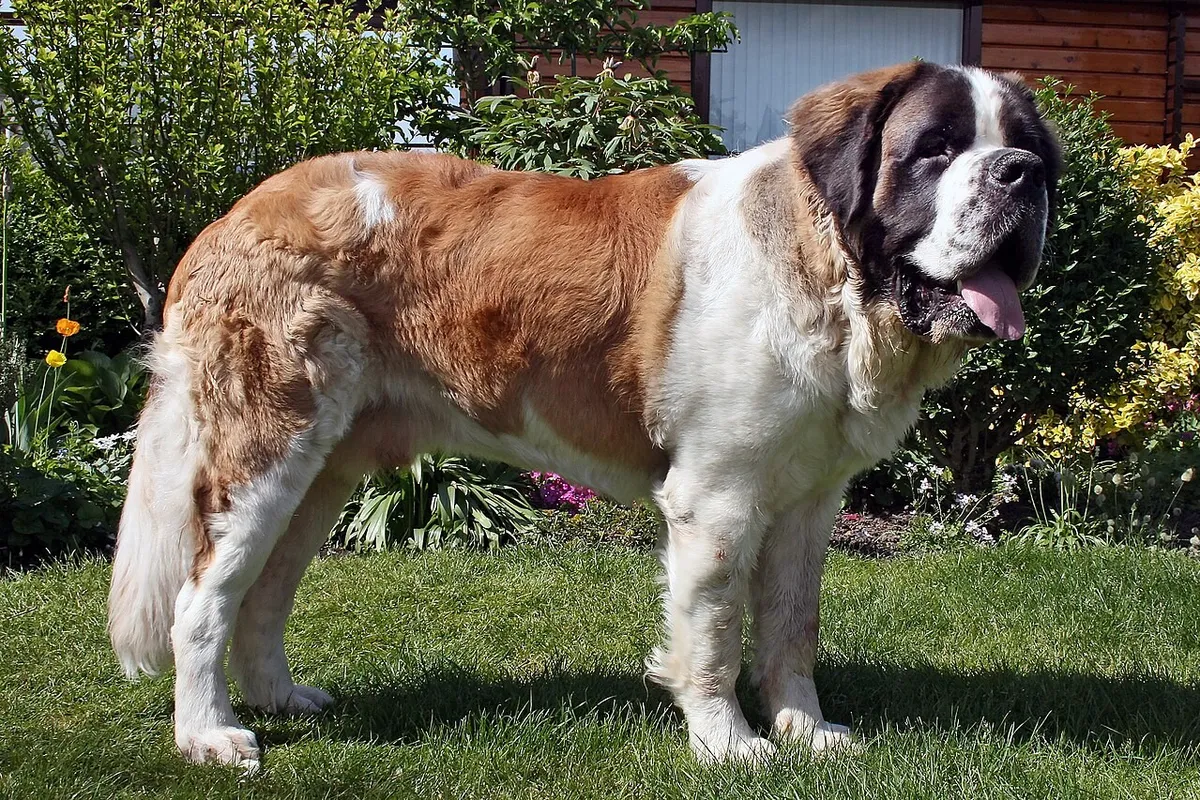
At a glance
| Trait | Detail |
|---|---|
| Origin | Switzerland [1] |
| Breed group | FCI group 2, section 2.2 (Molossoid, mountain type) [1]; AKC Working Group [2] |
| Weight | Males 140–180 lb (64–82 kg), females 120–140 lb (54–64 kg) [2]; median adult weight 65.1 kg (144 lb) in UK practices, the heaviest giant breed [4] |
| Height | Males 70–90 cm (about 27.5–35.5 in), females 65–80 cm (about 25.5–31.5 in) [1] |
| Life expectancy | Median 9.3 years in a large UK study [3]; median age at death 6.76 years in UK veterinary records (64 dogs) [4] |
| Coat | Short-haired or long-haired variety, both with plenty of undercoat; white with red patches up to a full red mantle [1] |
Origin
Monks founded a hospice at the Great St Bernard Pass, 2,469 m (8,100 ft) above sea level, in the 11th century. Large mountain dogs have been kept there since the middle of the 17th century for guarding, then as rescue dogs for travelers lost in snow and fog; the legendary “Barry” became the model of the rescue dog [1].
The first entry in the Swiss stud book, opened in 1884, was a Saint Bernard. The breed was recognized as Swiss in 1887 and is regarded as the Swiss national dog [1].
Common health problems
- Short life: in insured Swedish dogs, 52% of Saint Bernards had died by 8 years of age and 74% by 10 years [5].
- Bone tumors: in insured Swedish dogs under 10 years, Saint Bernards had 78 cases per 10,000 dog-years, the second highest rate after the Irish Wolfhound [6].
- Hip and elbow dysplasia: in Swedish screening from 2007 to 2016, 51.7% of long-haired Saint Bernards had hip dysplasia (grades C to E) and 27.7% had elbow dysplasia [7].
- Dilated cardiomyopathy: Saint Bernards were over-represented among 189 dogs with heart failure caused by this heart muscle disease [9]. See heart failure in dogs.
- Bloat (gastric dilatation-volvulus): the breed was one of 11 large and giant breeds followed in a US study, where giant breeds had 26 cases per 1,000 dog-years and 28.6% of affected dogs died [10].
- Ectropion: the lower eyelid rolls outwards. Its annual prevalence was 1.72% in Saint Bernards in UK practices, the second highest of all breeds [8].
- Nerve disease: Saint Bernards were 3.5 to 5 times more likely than the reference breeds to die of neurological causes in Swedish insured dogs [5]. A severe juvenile-onset polyneuropathy is linked to a deletion in the ARHGEF10 gene [11].
What is special in the Saint Bernard’s blood work
We found no breed-specific reference intervals for the Saint Bernard. A few points are still useful when reading its results.
Addison’s disease. At a Canadian teaching hospital, Saint Bernards had a higher rate of Addison’s disease (1.72%) than the hospital’s dogs overall (0.38%) [12]. See Addison’s disease in dogs and the ACTH stimulation test.
Heart disease and routine chemistry. In dogs of all breeds with heart failure from dilated cardiomyopathy, mild hyperglycemia was found in 38% and mild to moderate hypercholesterolemia in 33% [9].
DNA test. Homozygosity for the ARHGEF10 deletion was strongly associated with severe juvenile-onset polyneuropathy in Saint Bernards, and genotyping is offered by university laboratories [11].
Screening schemes. Hip and elbow X-ray scoring [7] and an eye examination for eyelid problems [8] address some of the breed’s best-documented problems.
Related articles
En français : Saint-bernard.
Questions to ask your veterinarian
- Have my dog’s hips and elbows been X-rayed and scored?
- Should my dog’s heart be checked with an echocardiogram?
- What signs of bloat should make me come in at once?
- Has my dog been DNA-tested for ARHGEF10 polyneuropathy?
- Is a lameness in my older dog worth an X-ray to rule out a bone tumor?
Get your Saint Bernard’s blood work explained.
AI DiagAnimals reads the blood count, glucose, cholesterol, electrolytes and other results together with your laboratory’s intervals, and explains them in plain language. The service opens soon: leave your email to be told first.
Frequently asked questions
How long do Saint Bernards live?
A large UK study found a median of 9.3 years [3]. In UK veterinary records of giant breeds, Saint Bernards died at a median age of 6.76 years [4].
What do Saint Bernards usually die of?
In insured Swedish dogs, Saint Bernards had one of the highest rates of bone tumors [6] and were 3.5 to 5 times more likely to die of neurological causes [5].
Do Saint Bernards have hip problems?
Yes. In Swedish screening, 51.7% of long-haired Saint Bernards had hip dysplasia and 27.7% had elbow dysplasia [7].
Are Saint Bernards prone to heart disease?
Saint Bernards were over-represented among dogs with dilated cardiomyopathy in a study of 189 cases [9].
Sources
- FCI. Standard No. 61: St. Bernhardshund, Bernhardiner (St. Bernard). 2016. fci.be/Nomenclature/Standards/061g02-en.pdf
- American Kennel Club. Saint Bernard: dog breed information. akc.org/dog-breeds/saint-bernard
- McMillan KM et al. Longevity of companion dog breeds: those at risk from early death. Sci Rep. 2024;14:531 (supplementary table S3). doi.org/10.1038/s41598-023-50458-w
- O’Neill DG et al. Giant dog breeds under primary veterinary care in the UK: demography, common disorders and mortality. Companion Anim Health Genet. 2026;13:4. doi.org/10.1186/s40575-026-00152-7
- Egenvall A et al. Mortality in over 350,000 insured Swedish dogs from 1995-2000: II. Breed-specific age and survival patterns and relative risk for causes of death. Acta Vet Scand. 2005;46(3):121-136. doi.org/10.1186/1751-0147-46-121
- Egenvall A et al. Bone tumors in a population of 400 000 insured Swedish dogs up to 10 y of age: incidence and survival. Can J Vet Res. 2007;71(4):292-299. pubmed.ncbi.nlm.nih.gov/17955904
- Engdahl K et al. Prevalence of hip and elbow dysplasia in young adult dogs in Sweden. Vet Rec. 2026;198(12):e560. doi.org/10.1002/vetr.70224
- O’Neill DG et al. Conformational eyelid disorders in dogs under primary veterinary care in the UK: epidemiology and clinical management. PLoS One. 2025;20(6):e0326526. doi.org/10.1371/journal.pone.0326526
- Tidholm A, Jönsson L. A retrospective study of canine dilated cardiomyopathy (189 cases). J Am Anim Hosp Assoc. 1997;33(6):544-550. doi.org/10.5326/15473317-33-6-544
- Glickman LT et al. Incidence of and breed-related risk factors for gastric dilatation-volvulus in dogs. J Am Vet Med Assoc. 2000;216(1):40-45. doi.org/10.2460/javma.2000.216.40
- Ekenstedt KJ et al. An ARHGEF10 deletion is highly associated with a juvenile-onset inherited polyneuropathy in Leonberger and Saint Bernard dogs. PLoS Genet. 2014;10(10):e1004635. doi.org/10.1371/journal.pgen.1004635
- Decôme M, Blais MC. Prevalence and clinical features of hypoadrenocorticism in Great Pyrenees dogs in a referred population: 11 cases. Can Vet J. 2017;58(10):1093-1099. pubmed.ncbi.nlm.nih.gov/28966360
Laboratory methods and reference intervals vary. This article explains; it does not diagnose. For a decision about your pet, use the original report and talk to your veterinarian. Our editorial policy.