
 Français
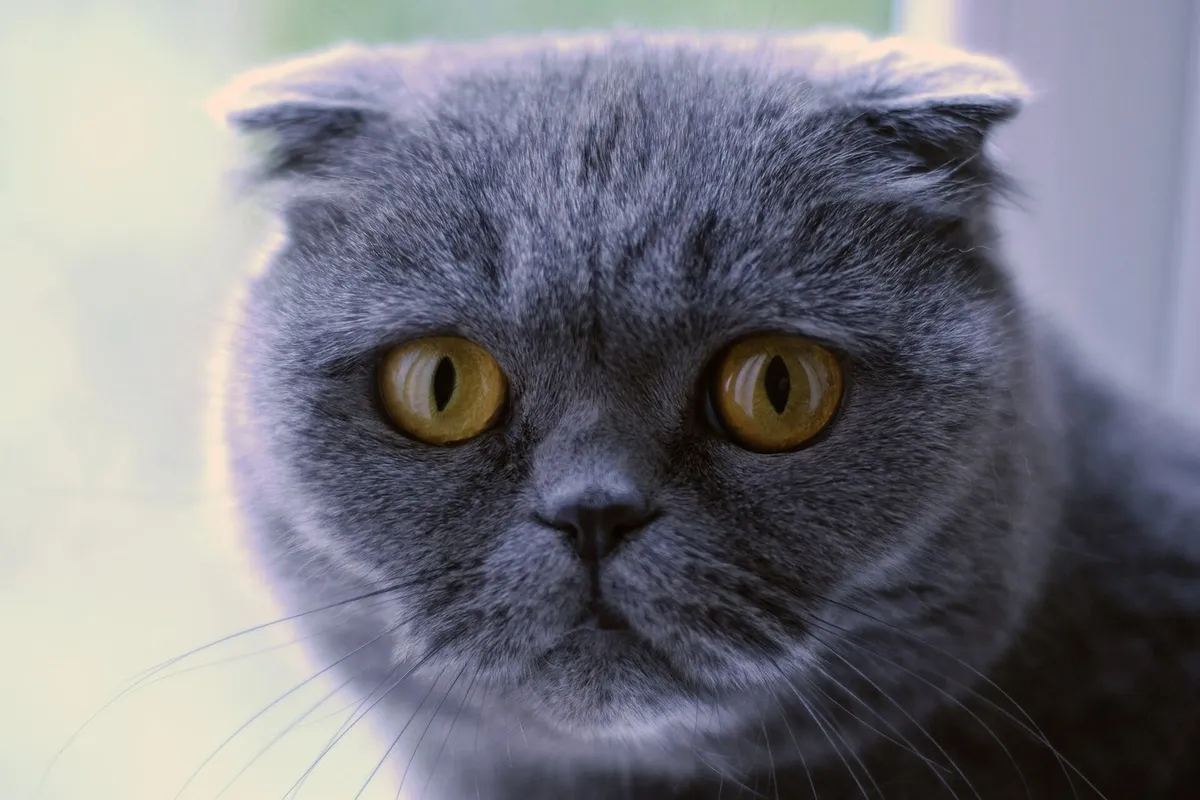
Scottish Fold at a glance
| Trait | Detail |
|---|---|
| Origin | Scotland (Tayside region), from a folded-ear farm cat found in 1961 [1] |
| Breed group | Recognized by the CFA in four divisions (folded or straight ears, short or long hair) [1]; not among the breeds recognized by FIFe [2] |
| Build | Medium size, round head, short neck, well-padded body with strong legs; the tail should be flexible [1] |
| Life expectancy | No breed figure in the 2019 UK life tables, which reported breeds with at least 15 recorded deaths [3] |
| Coat | Short or long; the folded ears appear at 3 to 4 weeks of age [1] |
Origin
In 1961, a shepherd named William Ross noticed a white female cat with folded ears, Susie, on a farm in the Tayside region of Scotland. Her daughter Snooks became the foundation queen, bred to a domestic male and then to a British Shorthair. The folded ears come from a dominant gene considered a spontaneous mutation [1].
The CFA granted championship status to shorthaired Folds in 1978 and to longhaired Folds in 1992, and accepted straight-eared cats in 2022 [1].
Common health problems
- Osteochondrodysplasia: the folded ears and the bone and joint disease of the breed are associated with one dominant variant of the TRPV4 gene (c.1024G>T). It malforms the distal fore and hind limbs and the tail and causes progressive joint destruction; the variant was not found in 648 unaffected cats [4]. Reported signs include lameness, reluctance to jump, a stiff stilted gait, short misshapen distal limbs, swelling at the back of the hind feet and a short, thick, inflexible tail [5].
- How many Folds are affected: an early Australian study concluded that all Scottish Folds had osteochondrodysplasia to some degree [5], and cats with two copies of the variant develop severe X-ray changes [6]. In a blinded X-ray study of genotyped cats, heterozygous Folds scored worse than straight-eared cats but had much milder signs than previously published [6]. In Australian clinic records, osteochondrodysplasia was diagnosed in 12 of 1,131 Scottish Folds and suspected in 64 more, usually before 30 months of age [7]. In an Italian group, all 12 Folds carried one copy and 1 showed clinical signs [8].
- The welfare debate: the authors of the Australian study advised against breeding fold-eared cats and recommended using straight-eared Scottish cats instead [5]. Others describe a complicated debate about whether cats with the TRPV4 variant should be bred for folded ears [6]. CFA breeders mate fold-eared cats only with straight-eared cats to limit bone and joint problems [1].
- Polycystic kidney disease (PKD): in 1,281 cats tested in Japan, the odds of carrying the PKD1 variant were significantly higher in Persians, Scottish Folds and Exotic Shorthairs, although numbers per breed were small [9]. See kidney disease in cats.
- Blood type: in a US survey, 15% of 27 Scottish Folds had blood type B [11]. See anemia in cats.
Tests and screening in Scottish Folds
- No blood test for the joint disease: osteochondrodysplasia is diagnosed from characteristic X-ray findings in the feet, joints and tail [5]. Regular, gentle checks of tail flexibility are advised, as stiffness can be an early sign [1].
- DNA test for TRPV4: genotyping shows whether a cat carries one or two copies of the variant [6, 8], and breeders use DNA testing to check that each pairing is appropriate [1].
- PKD1 DNA test and kidney values: among cats sent for PKD1 testing in Japan (not a random sample), 54% of Scottish Folds carried the variant. In carriers, a creatinine of 1.6 mg/dL (about 140 µmol/L) or more was more frequent from 3 years of age [10]. See creatinine and BUN in cats.
- Blood typing: type B occurs in the breed [11], so the blood type is worth knowing for breeding. See cat blood work explained.
Related articles
En français : Scottish fold.
Questions to ask your veterinarian
- Does my cat show any sign of osteochondrodysplasia, and should its feet, joints or tail be X-rayed?
- Is my cat’s tail flexible and its gait normal for its age?
- Has my cat been tested for the PKD1 variant, and should its kidneys be checked by ultrasound?
- Are my cat’s kidney values normal, and how have they changed over time?
- How can we keep my cat comfortable if it develops joint pain?
Get your Scottish Fold’s blood work explained.
AI DiagAnimals reads the kidney values, the urine results, the blood count and the rest of the chemistry with your laboratory’s cat intervals, and prepares the questions for your vet. The service opens soon: leave your email to be told first.
Frequently asked questions
Why are Scottish Folds’ ears folded?
Because of a dominant variant of the TRPV4 gene that affects cartilage. The same variant causes osteochondrodysplasia, a bone and joint disease [4].
Do all Scottish Folds have joint problems?
Studies differ. An early study found osteochondrodysplasia to some degree in all Folds [5]; more recent work found milder X-ray signs in cats with one copy and fewer clinical cases, while cats with two copies are severely affected [6, 7, 8].
What are the signs of osteochondrodysplasia?
Lameness, reluctance to jump, a stiff gait, short misshapen lower limbs and a short, thick, inflexible tail [5].
Sources
- The Cat Fanciers’ Association. Scottish Fold: breed profile. cfa.org/breed/scottish-fold
- Fédération Internationale Féline. Breeds and standards. fifeweb.org/cats/breeds
- Teng KT et al. Life tables of annual life expectancy and risk factors for mortality in cats in the UK. J Feline Med Surg. 2024;26(5):1098612X241234556. doi.org/10.1177/1098612X241234556
- Gandolfi B et al. A dominant TRPV4 variant underlies osteochondrodysplasia in Scottish fold cats. Osteoarthritis Cartilage. 2016;24(8):1441-1450. doi.org/10.1016/j.joca.2016.03.019
- Malik R et al. Osteochondrodysplasia in Scottish Fold cats. Aust Vet J. 1999;77(2):85-92. doi.org/10.1111/j.1751-0813.1999.tb11672.x
- Rorden C et al. Radiographical survey of osteochondrodysplasia in Scottish Fold cats caused by the TRPV4 gene variant. Hum Genet. 2021;140(11):1525-1534. doi.org/10.1007/s00439-021-02337-5
- Velie BD et al. An estimation of osteochondrodysplasia prevalence in Australian Scottish Fold cats: a retrospective study using VetCompass data. BMC Vet Res. 2023;19(1):252. doi.org/10.1186/s12917-023-03811-0
- Sartore S et al. Osteochondrodysplasia and the c.1024G>T variant of TRPV4 gene in Scottish Fold cats: genetic and radiographic evaluation. J Feline Med Surg. 2023;25(12):1098612X231211763. doi.org/10.1177/1098612X231211763
- Shitamori F et al. Large-scale epidemiological study on feline autosomal dominant polycystic kidney disease and identification of novel PKD1 gene variants. J Feline Med Surg. 2023;25(7):1098612X231185393. doi.org/10.1177/1098612X231185393
- Sato R et al. Epidemiological evaluation of cats associated with feline polycystic kidney disease caused by the feline PKD1 genetic mutation in Japan. J Vet Med Sci. 2019;81(7):1006-1011. doi.org/10.1292/jvms.18-0309
- Gavazza A et al. Feline blood groups: a systematic review of phylogenetic and geographical origin. Animals (Basel). 2021;11(12):3339. doi.org/10.3390/ani11123339
Laboratory methods and reference intervals vary. This article explains; it does not diagnose. For a decision about your pet, use the original report and talk to your veterinarian. Our editorial policy.