
 Français
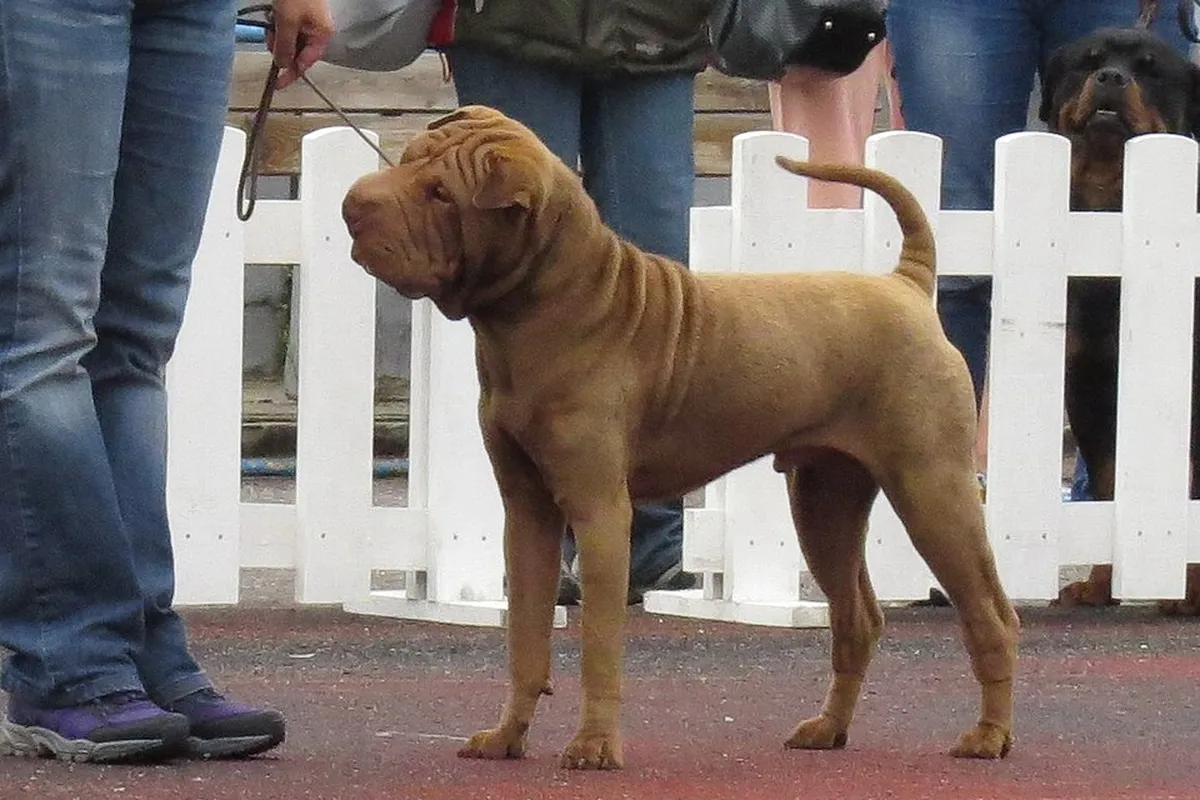
At a glance
| Trait | Detail |
|---|---|
| Origin | China [1] |
| Breed group | FCI group 2, section 2.1 (Molossian, mastiff type) [1]; AKC Non-Sporting Group [2] |
| Weight | Median adult weight in UK practices 49 lb (22.3 kg): males 52 lb (23.5 kg), females 46 lb (20.8 kg) [3] |
| Height | 17.5–20 in (44–51 cm) [1] |
| Life expectancy | Median 10.6 years in a large UK study [4]; median age at death 7.3 years in UK veterinary records [3] |
| Coat | Short, harsh and bristly, 0.4–1 in (1–2.5 cm), no undercoat; any solid color except white [1] |
Origin
The Shar Pei has existed for hundreds of years in the Chinese provinces bordering the South China Sea, probably originating around the town of Dialak; it was used as a hunting and guard dog [1]. Its name translates as “sand paper skin” [3].
The breed was reinvented as a companion dog in the USA in the late 1970s, where a more wrinkled, heavier “meat mouth” type replaced the traditional “bone mouth” type popular in China [3]. Western breeders strongly selected for thick, heavily folded skin [5].
Common health problems
- Eyes, ears and skin: among 1,913 Shar Peis in UK practices, the most common diagnoses in one year were entropion (in-turned eyelids, 17.88%), otitis externa (16.36%), other ear disorders (6.69%), aggression (5.23%) and pyoderma (4.29%) [3].
- Shar Pei fever: this inherited autoinflammatory disease causes recurrent episodes of fever without infection. It was diagnosed in 3.03% of Shar Peis in UK practices in one year [3], but in a UK survey 52 of 106 Shar Peis (49%) had had at least one episode, with a median temperature of 104.2 °F (40.1 °C); owners reported a median of four episodes a year, twice as many as appeared in the vet records [7].
- Kidney amyloidosis: in 91 dogs with renal amyloidosis, Shar Peis were much younger than other breeds (median 4.8 against 9.0 years), had amyloid in the inner kidney (medulla) in every case, and more often had amyloid outside the kidneys. Median survival after diagnosis was only 5 days for all dogs [8]. Renal disorders caused 13.24% of the deaths with a known cause in UK Shar Peis [3]. See kidney disease in dogs.
- Hypothyroidism: in UK primary care, Shar Peis had 2.8 times the odds of a hypothyroidism diagnosis compared with crossbred dogs [11]. See hypothyroidism in dogs.
- Elbows: of Shar Peis whose elbow X-rays were scored by the Orthopedic Foundation for Animals (OFA) between 1970 and 2015, 24.0% had elbow dysplasia, the fourth-highest rate of 60 breeds [12].
- Cancer: neoplasia was the most common cause of death with a known cause (15.44%) [3].
What is special in the Shar Pei’s tests
- Protein in the urine and kidney values. In dogs with renal amyloidosis, a raised urine protein to creatinine ratio (UPC) was the most constant finding (96% of all dogs). At diagnosis, creatinine was three times higher in Shar Peis than in other dogs, while low albumin was less frequent (64.7% against 100%) and none had nephrotic syndrome. The higher the creatinine, the shorter the survival [8]. See protein in urine and creatinine in dogs.
- Vitamin B12 (cobalamin). Of 139 Shar Pei samples sent to a US gastrointestinal laboratory, 64.0% had cobalamin below the reference interval and 38.1% had none detectable. Even healthy Shar Peis had higher methylmalonic acid, a marker of B12 shortage in the cells, than other dogs [9]. See chronic diarrhea in dogs.
- Potassium. A case report describes a Shar Pei whose potassium was a little high (6.3 mmol/L) without any signs, because its red cells were rich in potassium, as in Akitas and Shibas. It also had a low MCHC and a high RDW. Pseudohyperkalemia should be considered when a Shar Pei’s potassium is high for no clear reason [10]. See potassium in dogs and cats.
- DNA test for Shar Pei fever. The fever is linked to copy-number variants upstream of the HAS2 gene, which drives hyaluronan production in the skin [5]. Dogs carrying one form of the variant (CNV_16.1 allele 5) had four times the odds of Shar Pei autoinflammatory disease, and a digital PCR test could help breeders reduce the number of high-risk dogs [6].
For routine results, our guide to the blood count explains what each value means.
Related articles
En français : Shar pei.
Questions to ask your veterinarian
- Should my dog’s urine protein to creatinine ratio be checked regularly, given the breed’s risk of amyloidosis?
- Was my dog’s fever checked for infection, or could it be a Shar Pei fever episode?
- Has my dog’s vitamin B12 been measured?
- Is this high potassium real, or could it come from the red cells?
- Are my dog’s eyelids and ears causing problems that need treatment?
Get your Shar Pei’s blood work explained.
AI DiagAnimals reads creatinine, albumin, the urine protein to creatinine ratio, vitamin B12, potassium and thyroid results together with your laboratory’s intervals, and explains them in plain language. The service opens soon: leave your email to be told first.
Frequently asked questions
How long do Shar Peis live?
A large UK study found a median lifespan of 10.6 years [4]. In UK veterinary records, the median age at death was 7.3 years [3].
What health problems do Shar Peis have?
Entropion, ear infections and skin infections are the most common problems [3]. The breed is also prone to Shar Pei fever [7], kidney amyloidosis [8] and hypothyroidism [11].
What is Shar Pei fever?
An inherited autoinflammatory disease with recurrent bouts of high fever. It is linked to a duplication near the HAS2 gene that also causes the breed’s thick, folded skin [5].
Why should a Shar Pei’s urine be tested?
Kidney amyloidosis is a serious disease in the breed, and a raised urine protein to creatinine ratio was found in 96% of dogs with it [8].
Why is my Shar Pei’s vitamin B12 low?
Low cobalamin is very common in Shar Peis: 64% of samples tested at a US laboratory were below the reference interval. It is lower still in Shar Peis with intestinal disease, and even healthy Shar Peis may have a hidden shortage [9].
Sources
- FCI. Standard No. 309: Shar Pei. 1999. fci.be/Nomenclature/Standards/309g02-en.pdf
- American Kennel Club. Chinese Shar-Pei: dog breed information. akc.org/dog-breeds/chinese-shar-pei
- O’Neill DG et al. Is it now time to iron out the wrinkles? Health of Shar Pei dogs under primary veterinary care in the UK. Canine Med Genet. 2023;10:11. doi.org/10.1186/s40575-023-00134-z
- McMillan KM et al. Longevity of companion dog breeds: those at risk from early death. Sci Rep. 2024;14:531 (supplementary table S3). doi.org/10.1038/s41598-023-50458-w
- Olsson M et al. A novel unstable duplication upstream of HAS2 predisposes to a breed-defining skin phenotype and a periodic fever syndrome in Chinese Shar-Pei dogs. PLoS Genet. 2011;7(3):e1001332. doi.org/10.1371/journal.pgen.1001332
- Olsson M et al. Absolute quantification reveals the stable transmission of a high copy number variant linked to autoinflammatory disease. BMC Genomics. 2016;17:299. doi.org/10.1186/s12864-016-2619-0
- Work M et al. A survey on Shar Pei autoinflammatory disease in the United Kingdom. J Small Anim Pract. 2023;64(6):401-408. doi.org/10.1111/jsap.13602
- Segev G et al. Renal amyloidosis in dogs: a retrospective study of 91 cases with comparison of the disease between Shar-Pei and non-Shar-Pei dogs. J Vet Intern Med. 2012;26(2):259-268. doi.org/10.1111/j.1939-1676.2011.00878.x
- Bishop MA et al. Partial characterization of cobalamin deficiency in Chinese Shar Peis. Vet J. 2012;191(1):41-45. doi.org/10.1016/j.tvjl.2011.05.008
- Battison A. Apparent pseudohyperkalemia in a Chinese Shar Pei dog. Vet Clin Pathol. 2007;36(1):89-93. doi.org/10.1111/j.1939-165x.2007.tb00188.x
- O’Neill DG et al. Frequency, breed predispositions and other demographic risk factors for diagnosis of hypothyroidism in dogs under primary veterinary care in the UK. Canine Med Genet. 2022;9:11. doi.org/10.1186/s40575-022-00123-8
- Oberbauer AM et al. Long-term genetic selection reduced prevalence of hip and elbow dysplasia in 60 dog breeds. PLoS One. 2017;12(2):e0172918. doi.org/10.1371/journal.pone.0172918
Laboratory methods and reference intervals vary. This article explains; it does not diagnose. For a decision about your pet, use the original report and talk to your veterinarian. Our editorial policy.