
 Français
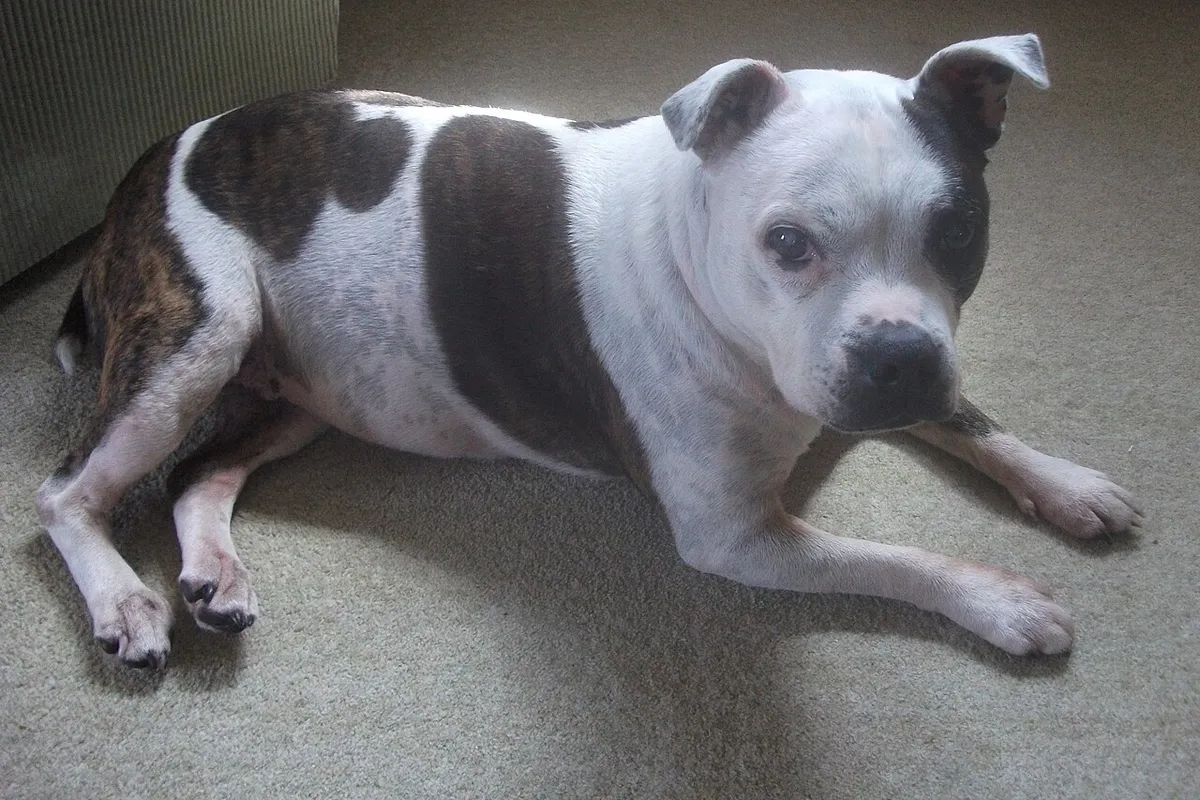
At a glance
| Trait | Detail |
|---|---|
| Origin | Great Britain [1] |
| Breed group | FCI Group 3 (Terriers), section 3, bull type terriers; AKC Terrier Group [1, 2] |
| Weight | Males 28–37 lb (12.7–17 kg), females 24–34 lb (11–15.4 kg) in the breed standard [1]; median 44.5 lb (20.2 kg) in UK practices [3] |
| Height | 14–16 in (35.5–40.5 cm) [1] |
| Life expectancy | Median 12.0 years in a 2024 UK study [4]; life expectancy at birth 11.3 years in UK life tables [5] |
| Coat | Smooth, short and close; white, red, fawn, black or blue, any of these with white, or any shade of brindle [1] |
Origin
The breed was developed as a fighting dog in nineteenth-century Britain, probably around Birmingham and Staffordshire, by crossing the bulldog with the English terrier. The UK Kennel Club recognized it in 1935 [3].
Today it is one of the most common dogs in the UK: in a 2016 sample of over 22,000 dogs under veterinary care, it was the second most common purebred, at 5.8% [3].
Common health problems
- Overall: 63.7% of Staffordshire Bull Terriers were diagnosed with at least one disorder in a year, and after adjustment their odds did not differ from other dogs (odds ratio 0.90) [3].
- Skin: the odds of atopic dermatitis were 1.88 times, and those of skin masses 1.80 times, those of other dogs [3].
- Seizures: the highest predisposition found in the UK study, with 2.06 times the odds of other dogs [3].
- Mast cell tumors: in English practices, Staffordshire Bull Terriers, Boxers and Pugs had higher odds of a mast cell tumor diagnosis than crossbred dogs [10]. See mast cell tumors in dogs.
- Protections: the breed had lower odds of periodontal disease (0.41), heart murmurs (0.33) and patellar luxation (0.15) than other dogs [3].
- L-2-hydroxyglutaric aciduria (L-2-HGA): an inherited neurometabolic disease. In 27 affected dogs, signs began at a mean age of 12 months (2.5 to 60 months). All 26 dogs with data had gait problems, most often stiffness of all four legs; 24 of 27 had behavior changes such as staring into space, and 18 had seizure-like episodes. 70% were still alive a mean of 76.6 months after signs began [8].
- Inherited eye disease: a mutation in the HSF4 gene causes a recessive hereditary cataract in the breed [9]. The UK Kennel Club also lists persistent hyperplastic primary vitreous (PHPV), an eye malformation, among the breed’s inherited conditions [3].
What is special in the Staffie’s blood and urine tests
We found no published breed-specific reference intervals for routine blood values in Staffordshire Bull Terriers, so a complete blood count and chemistry panel are read with ordinary dog intervals. The breed-specific tests are genetic or specialized.
The L-2-HGA urine test. In the first affected Staffies described, the main signs were seizures, unsteady gait, dementia and tremors. All were screened for organic acids in the urine, and L-2-hydroxyglutaric acid was raised in every body fluid tested, including plasma and cerebrospinal fluid [6]. The organic acid screen is requested specifically; the routine urine test is explained in urinalysis for dogs and cats.
DNA tests. The L-2-HGA mutation lies in the L2HGDH gene, and pedigree analysis points to a common founder in the breed [7]. A DNA test also exists for the HSF4 cataract [9]. Eye testing and DNA tests for HSF4 cataract and L-2-HGA are mandatory for breeding parents of UK Kennel Club Assured Breeders [3].
Thyroid. Unlike many breeds, Staffordshire Bull Terriers were not at higher risk of hypothyroidism than crossbreds (odds ratio 0.96) [11]. See hypothyroidism in dogs.
Lumps. Because skin masses and mast cell tumors are over-represented [3, 10], any new lump is worth showing to the vet. See mast cell tumors in dogs.
Related articles
En français : Staffordshire bull terrier.
Questions to ask your veterinarian
- Have my dog or its parents been DNA-tested for L-2-HGA and HSF4 hereditary cataract?
- Could my young Staffie’s stiffness or odd behavior be L-2-HGA, and should we run a urine organic acid test?
- Is this lump worth a needle sample to rule out a mast cell tumor?
- Are my dog’s itchy skin and ear problems signs of atopic dermatitis?
- What tests should we do after a first seizure?
Get your Staffie’s blood work explained.
AI DiagAnimals reads the blood count, chemistry and urine results together with your laboratory’s intervals, and explains them in the light of the Staffordshire Bull Terrier’s known health issues. The service opens soon: leave your email to be told first.
Frequently asked questions
How long do Staffordshire Bull Terriers live?
A large 2024 UK study found a median lifespan of 12.0 years [4]. UK life tables give a life expectancy at birth of 11.3 years [5].
What health problems do Staffordshire Bull Terriers have?
Compared with other dogs, they have higher odds of seizures, atopic dermatitis and skin masses [3], and of mast cell tumors compared with crossbreds [10]. They have lower odds of dental disease, heart murmurs and patellar luxation [3].
What is L-2-HGA in Staffies?
L-2-hydroxyglutaric aciduria is an inherited metabolic disease of the brain. Signs usually begin around one year of age with stiffness, tremors, behavior changes and seizure-like episodes [8]. It is shown by high L-2-hydroxyglutaric acid in the urine [6].
What DNA tests should a Staffordshire Bull Terrier have?
DNA tests exist for L-2-HGA [7] and for the HSF4 hereditary cataract [9]; both are mandatory, with an eye examination, for breeding parents of UK Kennel Club Assured Breeders [3].
Are Staffies prone to skin allergies?
Yes. In UK practices they had 1.88 times the odds of atopic dermatitis of other dogs [3].
Sources
- FCI. Standard No. 76: Staffordshire Bull Terrier. 2026. fci.be/Nomenclature/Standards/076g03-en.pdf
- American Kennel Club. Staffordshire Bull Terrier: dog breed information. akc.org/dog-breeds/staffordshire-bull-terrier
- Pegram C et al. Staffordshire Bull Terriers in the UK: their disorder predispositions and protections. Canine Med Genet. 2020;7:13. doi.org/10.1186/s40575-020-00092-w
- McMillan KM et al. Longevity of companion dog breeds: those at risk from early death. Sci Rep. 2024;14:531 (supplementary Table S3). doi.org/10.1038/s41598-023-50458-w
- Teng KT et al. Life tables of annual life expectancy and mortality for companion dogs in the United Kingdom. Sci Rep. 2022;12:6415. doi.org/10.1038/s41598-022-10341-6
- Abramson CJ et al. L-2-Hydroxyglutaric aciduria in Staffordshire Bull Terriers. J Vet Intern Med. 2003;17(4):551-556. doi.org/10.1111/j.1939-1676.2003.tb02477.x
- Penderis J et al. L-2-hydroxyglutaric aciduria: characterisation of the molecular defect in a spontaneous canine model. J Med Genet. 2007;44(5):334-340. doi.org/10.1136/jmg.2006.042507
- Shea A et al. Clinical features and disease progression of L-2-hydroxyglutaric aciduria in 27 Staffordshire bull terriers. Vet Rec. 2016;179(21):545. doi.org/10.1136/vr.103783
- Mellersh CS et al. Identification of mutations in HSF4 in dogs of three different breeds with hereditary cataracts. Vet Ophthalmol. 2006;9(5):369-378. doi.org/10.1111/j.1463-5224.2006.00496.x
- Shoop SJ et al. Prevalence and risk factors for mast cell tumours in dogs in England. Canine Genet Epidemiol. 2015;2:1. doi.org/10.1186/2052-6687-2-1
- O’Neill DG et al. Frequency, breed predispositions and other demographic risk factors for diagnosis of hypothyroidism in dogs under primary veterinary care in the UK. Canine Med Genet. 2022;9:11. doi.org/10.1186/s40575-022-00123-8
Laboratory methods and reference intervals vary. This article explains; it does not diagnose. For a decision about your pet, use the original report and talk to your veterinarian. Our editorial policy.