
 Français
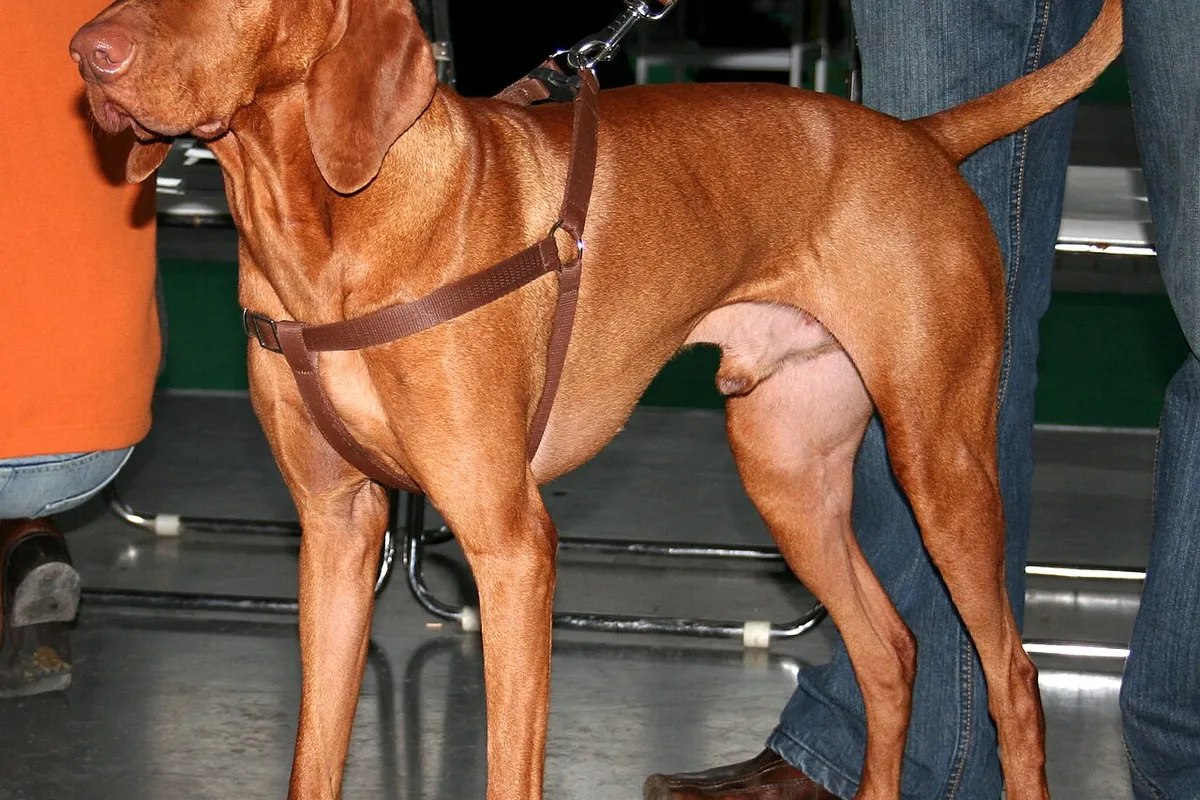
At a glance
| Trait | Detail |
|---|---|
| Origin | Hungary [1] |
| Breed group | FCI group 7, section 1 (continental pointing dogs) [1]; AKC Sporting Group [2] |
| Weight | Males 55–60 lb (25–27 kg), females 44–55 lb (20–25 kg) [2] |
| Height | Males 23–25 in (58–64 cm), females 21–23.5 in (54–60 cm) [1] |
| Life expectancy | Median 13.5 years in a large UK study [3] |
| Coat | Short, dense and coarse, without undercoat; shades of russet gold and dark sandy gold [1] |
Origin
The ancestors of the Vizsla came into the Carpathian Basin with the nomadic Hungarian tribes, and written descriptions and pictures of the dog appear in documents from the 14th century. Its importance as a hunting dog grew from the 18th century, and by the end of the 19th century Vizslas were competing successfully in pointing-dog trials in Hungary [1].
Modern breeding started in 1920, and the FCI recognized the short-haired Hungarian Vizsla in 1936. It is a versatile gun dog that points, retrieves and works in water [1].
Common health problems
In the 2014 Kennel Club survey, 67.8% of 441 live Vizslas had no disease or condition reported by their owner. The most reported were lipoma (5.22%), skin cysts (3.85%) and allergic skin disease (2.27%); epilepsy was reported in 1.36% and hypothyroidism in 0.68% [4].
- Idiopathic epilepsy: in a study of 29 affected Vizslas and their relatives, epilepsy ran in families, 79% of affected dogs had partial-onset seizures (such as limb tremors, staring or drooling without loss of consciousness), and the pattern fitted autosomal recessive inheritance, although several genes could be involved [5].
- Vizsla inflammatory polymyopathy: in 77 affected Vizslas, signs began at a mean age of 2.4 years and included difficulty swallowing, drooling, wasting of the chewing muscles and regurgitation. Response to immune-suppressive treatment supported an immune cause, but relapses and aspiration pneumonia were common reasons for euthanasia, at a mean age of 6.4 years [6]. A DLA class II haplotype was linked to the disease, with an odds ratio of 4.08 when cases were compared with dogs with no affected relatives [7].
- Skin allergies: Vizslas were over-represented among 600 dogs with atopic dermatitis in Hungary [10].
- Insulinoma: this insulin-secreting pancreatic tumor is rare (an incidence of 0.003% a year in UK dogs), but Vizslas had 6.3 times the odds of crossbred dogs after adjustment [8]. See blood sugar in dogs.
- Cancer and neutering: in a survey of 2,505 Vizslas, dogs neutered at any age had higher odds of mast cell cancer, lymphoma and cancer overall than intact dogs, and the earlier the neutering, the earlier the cancers were diagnosed. The authors call on vets to discuss the pros and cons of neutering with owners [11]. See mast cell tumors in dogs and lymphoma in dogs.
- Hips: of Vizslas whose hip X-rays were scored by the Orthopedic Foundation for Animals (OFA) between 1970 and 2015, 6.2% had hip dysplasia, among the 15 lowest rates of 60 breeds [9].
What is special in the Vizsla’s tests
- CK in muscle disease. In Vizsla polymyopathy, creatine kinase (CK) was measured in 47 dogs: it was high (above 190 IU/L) in 87% and above 1,000 IU/L in 53%. CK is not always very high, possibly because the jaw and throat muscles are a small muscle mass. Antibodies against chewing muscle (2M) were negative in all 29 dogs tested, and 2 dogs with acetylcholine receptor antibodies turned out to have myasthenia gravis instead. A muscle biopsy supports the diagnosis [6].
- Low blood sugar. Insulinoma causes low blood glucose through uncontrolled insulin release; in the UK study, a glucose below 4.2 mmol/L (76 mg/dL) together with an insulin above 10 µU/mL and matching signs was one of the case definitions [8]. See blood sugar in dogs.
- Epilepsy work-up. Idiopathic epilepsy is diagnosed from the age at the first seizure, the neurological examination and laboratory results that rule out other causes [5].
- DNA tests. A splice-site variant in the SNX14 gene was linked to a cerebellar degeneration of Vizsla puppies, whose routine tests were unremarkable; 3 of 133 healthy Vizslas carried it [12].
- Screening schemes. Hip X-ray scoring is the long-standing screen for joint disease in the breed [9].
For routine results, our guides to the blood count and to liver enzymes explain what each value means.
Related articles
En français : Braque hongrois.
Questions to ask your veterinarian
- My dog has trouble swallowing or its jaw muscles look thinner: should CK be measured?
- Were blood tests done to rule out other causes before calling the seizures epilepsy?
- Could my dog’s weakness or collapse be due to low blood sugar?
- When is the best time to neuter my Vizsla, given the breed data on cancer?
- Have my dog’s hips been X-rayed and scored, and have the parents been DNA-tested?
Get your Vizsla’s blood work explained.
AI DiagAnimals reads the blood count, CK, glucose, liver and kidney values together with your laboratory’s intervals, and explains them in plain language. The service opens soon: leave your email to be told first.
Frequently asked questions
How long do Vizslas live?
A large UK study found a median lifespan of 13.5 years, longer than for crossbred dogs as a group [3].
What health problems do Vizslas have?
Owners most often report lipomas, skin cysts and allergic skin disease [4]. Studies of the breed describe inherited epilepsy [5], an immune-mediated muscle disease [6] and a higher risk of insulinoma [8].
Are Vizslas prone to epilepsy?
Idiopathic epilepsy runs in some Vizsla families, mostly as partial seizures, and appears to be inherited [5]. It was reported in 1.36% of live Vizslas in a UK survey [4].
What is Vizsla polymyositis?
An immune-mediated inflammation of muscles, mainly those used for chewing and swallowing, that starts at about 2 years of age on average. Most affected dogs have a high CK on blood tests [6].
Do Vizslas get hip dysplasia?
It is uncommon: 6.2% of Vizslas screened by the OFA had hip dysplasia, one of the lowest rates of 60 breeds [9].
Sources
- FCI. Standard No. 57: Short-haired Hungarian Vizsla. 2000. fci.be/Nomenclature/Standards/057g07-en.pdf
- American Kennel Club. Vizsla: dog breed information. akc.org/dog-breeds/vizsla
- McMillan KM et al. Longevity of companion dog breeds: those at risk from early death. Sci Rep. 2024;14:531 (supplementary table S3). doi.org/10.1038/s41598-023-50458-w
- Wiles BM et al. Large-scale survey to estimate the prevalence of disorders for 192 Kennel Club registered breeds. Canine Genet Epidemiol. 2017;4:8 (additional file 4). doi.org/10.1186/s40575-017-0047-3
- Patterson EE et al. Clinical characteristics and inheritance of idiopathic epilepsy in Vizslas. J Vet Intern Med. 2003;17(3):319-325. doi.org/10.1111/j.1939-1676.2003.tb02455.x
- Tauro A et al. Clinical features of idiopathic inflammatory polymyopathy in the Hungarian Vizsla. BMC Vet Res. 2015;11:97. doi.org/10.1186/s12917-015-0408-7
- Massey J et al. Association of an MHC class II haplotype with increased risk of polymyositis in Hungarian Vizsla dogs. PLoS One. 2013;8(2):e56490. doi.org/10.1371/journal.pone.0056490
- Kraai K et al. Incidence and risk factors for insulinoma diagnosed in dogs under primary veterinary care in the UK. Sci Rep. 2025;15:2463. doi.org/10.1038/s41598-025-86782-6
- Oberbauer AM et al. Long-term genetic selection reduced prevalence of hip and elbow dysplasia in 60 dog breeds. PLoS One. 2017;12(2):e0172918. doi.org/10.1371/journal.pone.0172918
- Tarpataki N et al. Prevalence and features of canine atopic dermatitis in Hungary. Acta Vet Hung. 2006;54(3):353-366. doi.org/10.1556/AVet.54.2006.3.6
- Zink MC et al. Evaluation of the risk and age of onset of cancer and behavioral disorders in gonadectomized Vizslas. J Am Vet Med Assoc. 2014;244(3):309-319. doi.org/10.2460/javma.244.3.309
- Fenn J et al. Genome sequencing reveals a splice donor site mutation in the SNX14 gene associated with a novel cerebellar cortical degeneration in the Hungarian Vizsla dog breed. BMC Genet. 2016;17:123. doi.org/10.1186/s12863-016-0433-y
Laboratory methods and reference intervals vary. This article explains; it does not diagnose. For a decision about your pet, use the original report and talk to your veterinarian. Our editorial policy.