
 Français
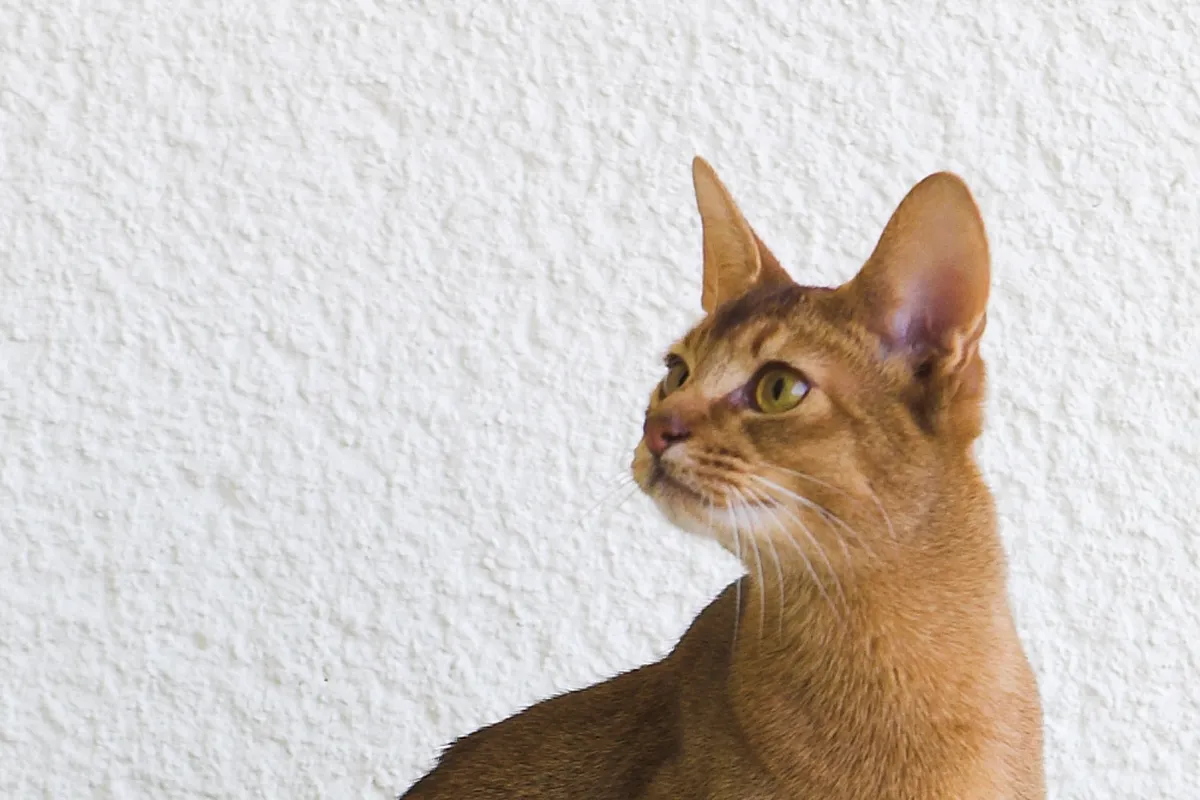
Abyssinian at a glance
| Trait | Detail |
|---|---|
| Origin | First shown in England in 1871; genetic research places its roots on the coasts of the Indian Ocean and in Southeast Asia, not Ethiopia [1] |
| Breed group | FIFe Category 4, recognized since 1949 [2] |
| Build | Medium-sized, lithe yet muscular, with an arched neck and large cupped ears [1] |
| Life expectancy | No breed figure in the 2024 UK life tables, which only covered breeds with 15 or more deaths; 11.74 years at birth for all cats [3] |
| Coat | Short, dense and resilient, each hair banded with ticking; ruddy, cinnamon, blue or fawn [1] |
Origin
The name only reflects the fact that the first Abyssinians shown in England were imports from Ethiopia, then called Abyssinia. Despite the resemblance to cats in ancient Egyptian art, genetic research places the breed’s origin on the coasts of the Indian Ocean and in Southeast Asia. The first Abyssinian seen at a cat show, “Zula,” was exhibited at the Crystal Palace in 1871 [1].
Abyssinians reached the United States in the early 1900s and were among the original breeds registered by the Cat Fanciers’ Association in 1906 [1]. FIFe has recognized the breed since its foundation in 1949 [2]. The Somali is its longhaired variety, and several studies group the two breeds [4, 6].
Common health problems
- Pyruvate kinase deficiency (PK deficiency): an inherited hemolytic anemia caused by a variant of the PKLR gene; the first feline case was reported in an Abyssinian [5]. Among 497 Abyssinians sampled for unrelated DNA tests, 52 carried one copy of the variant [5]. In 25 affected Abyssinian and Somali cats followed for up to 11 years, 11 had no signs noticed by their owners; the others showed lethargy, diarrhea, pale gums, poor appetite, weight loss or jaundice, and 6 died or were euthanized, at a median age of 4.1 years [4]. See anemia in cats.
- Familial renal amyloidosis: abnormal deposits of AA amyloid protein in the kidneys, mainly in the medulla, were found with papillary necrosis in eight related adult Abyssinians [7]. The diagnosis is usually made after death [8]. See kidney disease in cats.
- Retinal degeneration (rdAc): a recessive, late-onset loss of the retina’s light-sensing cells, linked to a CEP290 gene variant first found in Abyssinians and Somalis; the same variant was later found in 16 of 43 breeds, especially the Siamese [6].
- Diabetes mellitus: in Swedish insurance data, Abyssinians (grouped with Somalis) had about twice the diabetes incidence of other cats (incidence rate ratio 1.8) [11]. See diabetes in cats.
- Myasthenia gravis: in 235 cats with acquired myasthenia gravis, an immune disease of the nerve–muscle junction that causes weakness, Abyssinian and Somali cats had a higher incidence than mixed-breed cats or other breeds [12].
Amyloidosis also runs in Siamese cats: see the Siamese cat page. PK deficiency is also tested in Bengal cats.
Tests and screening in Abyssinians
- DNA test for PK deficiency: recommended before breeding, because affected cats can look healthy [4, 5]. In affected cats, the most frequent laboratory changes were raised aggregate reticulocytes (94%), high globulins (80%), anemia (70%), high bilirubin (53%) and raised liver enzymes (47%) [4]. See cat blood work explained.
- Breed reference values: in healthy Abyssinians, smaller red cells (microcytosis) and high alpha-2 globulin concentrations were differences from general feline reference intervals that could lead to misinterpretation [9].
- Kidney monitoring and amyloidosis: in a five-year study of 23 Abyssinians, serum amyloid A (SAA) and the urine protein:creatinine (UPC) ratio did not help to identify cats with amyloidosis early; a rise in SAA in urine, with or without a mixed pattern on urine protein electrophoresis, could appear before signs [8]. For how routine kidney values are read, see creatinine and BUN in cats and protein in urine.
- DNA test for rdAc: a commercial test exists for the CEP290 variant, and cats with two copies showed the disease on eye examination [6].
- Blood type: 16% of Abyssinians were type B in pooled breed data [10]. Type B cats carry strong natural antibodies against type A, so typing matters before a transfusion and for breeding [10].
- Blood glucose: because Abyssinians had a higher diabetes incidence [11], glucose results are worth reading with care. See blood sugar in cats for how stress and diabetes are told apart.
Related articles
En français : Abyssin.
Questions to ask your veterinarian
- Has my cat been DNA tested for PK deficiency, and what does the result mean for its blood count?
- Are my cat’s reticulocytes or globulins high, and could PK deficiency explain it?
- How should we monitor my Abyssinian’s kidneys, and is a urine protein test useful?
- Should my cat have the rdAc test or an eye examination?
- Do we know my cat’s blood type?
Get your Abyssinian’s blood work explained.
AI DiagAnimals reads the blood count, reticulocytes, globulins, kidney values and glucose with your laboratory’s intervals, compares them with earlier results and prepares the questions for your vet. The service opens soon: leave your email to be told first.
Frequently asked questions
How long do Abyssinian cats live?
The 2024 UK life tables did not give a separate figure for Abyssinians, because they only covered breeds with 15 or more deaths; the life expectancy at birth of all cats was 11.74 years [3].
What health problems do Abyssinian cats have?
PK deficiency, familial renal amyloidosis and the rdAc retinal degeneration are the best documented. A higher risk of diabetes and of myasthenia gravis has also been reported [4, 6, 7, 11, 12].
What is PK deficiency in Abyssinians?
An inherited lack of a red-cell enzyme that shortens red-cell life and can cause anemia. Signs vary widely in age of onset and severity, and some affected cats show none, so testing before breeding is recommended [4, 5].
What tests should an Abyssinian have?
The PK deficiency and rdAc DNA tests, blood typing and, as the cat ages, regular kidney checks are the tests most often discussed [4, 6, 8, 10].
Can blood tests detect amyloidosis in Abyssinians?
Not reliably early. In a five-year study, serum amyloid A and the urine protein:creatinine ratio did not pick out affected cats; diagnosis is usually confirmed after death [8].
Sources
- The Cat Fanciers’ Association. Abyssinian: breed profile. cfa.org/breed/abyssinian
- Fédération Internationale Féline. Breeds and standards. fifeweb.org/cats/breeds
- Teng KT et al. Life tables of annual life expectancy and risk factors for mortality in cats in the UK. J Feline Med Surg. 2024;26(5):1098612X241234556. doi.org/10.1177/1098612X241234556
- Kohn B, Fumi C. Clinical course of pyruvate kinase deficiency in Abyssinian and Somali cats. J Feline Med Surg. 2008;10(2):145-153. doi.org/10.1016/j.jfms.2007.09.006
- Grahn RA et al. Erythrocyte pyruvate kinase deficiency mutation identified in multiple breeds of domestic cats. BMC Vet Res. 2012;8:207. doi.org/10.1186/1746-6148-8-207
- Menotti-Raymond M et al. Widespread retinal degenerative disease mutation (rdAc) discovered among a large number of popular cat breeds. Vet J. 2010;186(1):32-38. doi.org/10.1016/j.tvjl.2009.08.010
- Boyce JT et al. Familial renal amyloidosis in Abyssinian cats. Vet Pathol. 1984;21(1):33-38. doi.org/10.1177/030098588402100106
- Paltrinieri S et al. Changes in serum and urine SAA concentrations and qualitative and quantitative proteinuria in Abyssinian cats with familial amyloidosis: a five-year longitudinal study (2009-2014). J Vet Intern Med. 2015;29(2):505-512. doi.org/10.1111/jvim.12561
- Paltrinieri S et al. Haematological and biochemical reference intervals of four feline breeds. J Feline Med Surg. 2014;16(2):125-136. doi.org/10.1177/1098612X13499337
- Silvestre-Ferreira AC, Pastor J. Feline neonatal isoerythrolysis and the importance of feline blood types. Vet Med Int. 2010;2010:753726. doi.org/10.4061/2010/753726
- Öhlund M et al. Incidence of diabetes mellitus in insured Swedish cats in relation to age, breed and sex. J Vet Intern Med. 2015;29(5):1342-1347. doi.org/10.1111/jvim.13584
- Hague DW et al. Risk factors and outcomes in cats with acquired myasthenia gravis (2001-2012). J Vet Intern Med. 2015;29(5):1307-1312. doi.org/10.1111/jvim.13596
Laboratory methods and reference intervals vary. This article explains; it does not diagnose. For a decision about your pet, use the original report and talk to your veterinarian. Our editorial policy.