
 Français
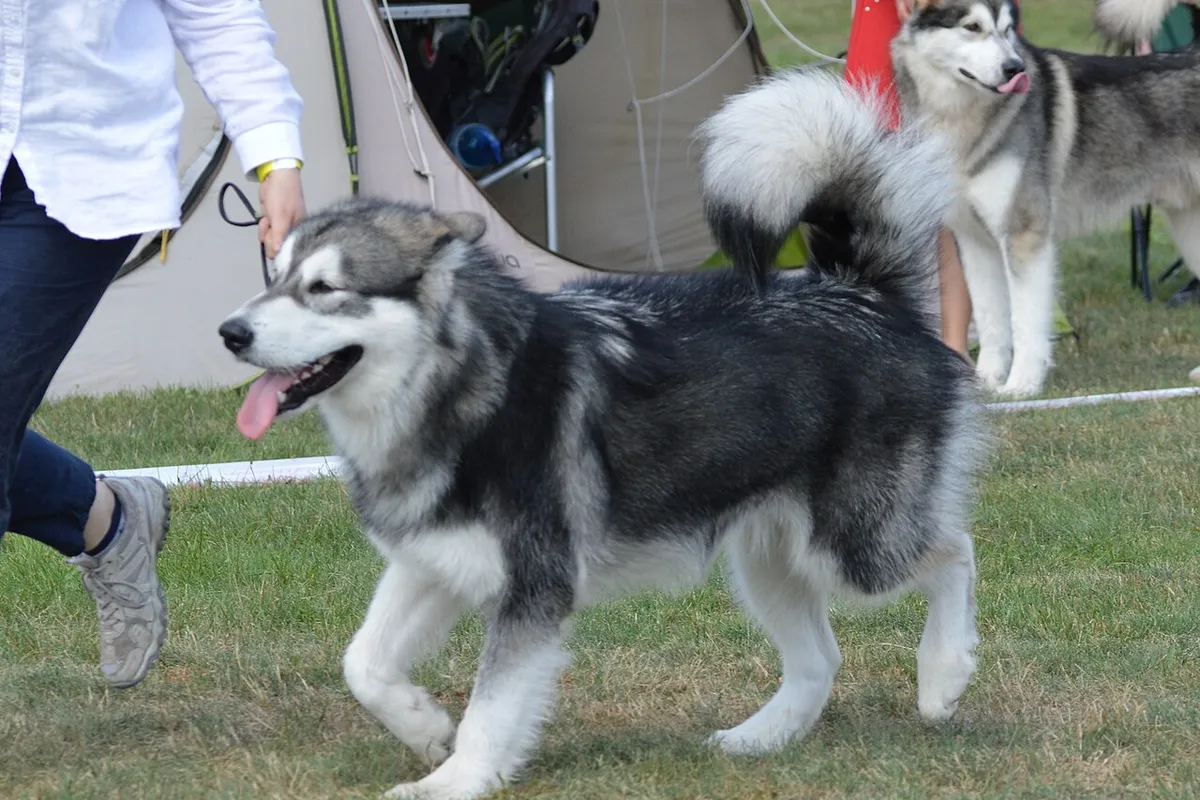
At a glance
| Trait | Detail |
|---|---|
| Origin | United States [1] |
| Breed group | FCI group 5, section 1 (Nordic sledge dogs) [1]; AKC Working Group [2] |
| Weight | Desirable freighting size 85 lb (38 kg) for males and 75 lb (34 kg) for females [1]; median adult weight 40.7 kg (90 lb) in UK practices [4] |
| Height | Desirable 25 in (63.5 cm) for males and 23 in (58.5 cm) for females [1] |
| Life expectancy | Median 11.3 years in a large UK study [3]; median age at death 11.2 years in UK veterinary records (136 dogs) [4] |
| Coat | Thick, coarse guard coat over a dense, oily, woolly undercoat; light grey to black, sable or red, with white underparts; all-white is the only solid color [1] |
Origin
The Alaskan Malamute is one of the oldest Arctic sledge dogs. It is built for strength and endurance to haul heavy freight, not to race [1].
Malamutes were among the sled dogs used in the Arctic during the Alaskan Gold Rush. DNA studies suggest that, unlike the Alaskan Husky, the breed has kept most of its ancient Siberian ancestry [5].
Common health problems
- Hypothyroidism: in UK primary care, 1.04% of Malamutes were living with a diagnosis of hypothyroidism, and the breed had 9.71 times the odds of crossbreeds, the fourth highest of all breeds [7]. See hypothyroidism in dogs.
- Zinc-responsive dermatosis: a familial form affects Alaskan Malamutes and Siberian Huskies, with redness, hair loss, scales and crusts mainly on the head. Lifelong zinc supplementation is usually needed in this form [9]. See also the Siberian Husky.
- Hip and elbow dysplasia: in Swedish screening from 2007 to 2016, 16.9% of Malamutes had hip dysplasia (grades C to E) and 4.7% had elbow dysplasia [6].
- Polyneuropathy: an early-onset, progressive nerve disease with weakness, laryngeal paresis and muscle wasting. All 22 affected dogs tested carried two copies of a variant in the NDRG1 gene [11].
- Day blindness (cone degeneration): an inherited loss of cone function, caused in Malamute-derived dogs by a deletion of the CNGB3 gene [12].
- Chondrodysplasia with stomatocytosis: an inherited dwarfism, autosomal recessive, in which the red cells are also abnormal [10].
What is special in the Malamute’s blood work
Two findings matter when a Malamute’s results are read: its thyroid values, and a rare inherited change in the red cells.
Thyroid values. In a study of healthy dogs from 7 breeds, including the Alaskan Malamute, many purebred dogs had T4 and free T4 at or below the lower limits of general reference intervals, and Malamutes had the lowest median TSH (6.10 mIU/L, or 0.07 ng/mL). The authors concluded that breed-specific reference intervals are warranted [8]. In a healthy Malamute, a T4 near or below the lower limit can therefore be normal [8]; see our guide to hypothyroidism in dogs.
Stomatocytosis in dwarf Malamutes. In affected dogs the red cells are large (MCV up to 98 fL) and pale (MCHC 26–28 g/dL). The red cell count is low but, because the cells are larger, the hematocrit stays within the reference interval. Red cells live shorter lives, with mild reticulocytosis and fragile cells [10]. See the CBC blood test for dogs and anemia in dogs.
Zinc-responsive dermatosis is diagnosed on the skin. The history, the signs and a skin biopsy are typically diagnostic [9].
DNA tests. Selection against the NDRG1 variant can be used to eliminate polyneuropathy from the breed [11], and the CNGB3 deletion underlies day blindness [12].
Related articles
En français : Malamute.
Questions to ask your veterinarian
- If my dog’s T4 is low, have TSH and free T4 been checked, and are they read against breed values?
- Could my dog’s crusting around the eyes and muzzle be zinc-responsive dermatosis?
- Have my dog’s hips and elbows been X-rayed and scored?
- Have the parents been DNA-tested for polyneuropathy and day blindness?
- Do my dog’s red cell values (MCV, MCHC) look normal?
Get your Malamute’s blood work explained.
AI DiagAnimals reads the thyroid panel, blood count, cholesterol and other results together with your laboratory’s intervals, and explains them in plain language. The service opens soon: leave your email to be told first.
Frequently asked questions
How long do Alaskan Malamutes live?
A large UK study found a median of 11.3 years [3], and UK veterinary records gave a median age at death of 11.2 years [4].
Are Malamutes prone to hypothyroidism?
Yes. In UK primary care, Malamutes had 9.71 times the odds of crossbreeds of a hypothyroidism diagnosis [7]. Healthy Malamutes can also have low-normal thyroid values, so breed-specific intervals help [8].
What is zinc-responsive dermatosis in Malamutes?
A familial skin disease of Malamutes and Siberian Huskies, with crusts and hair loss mainly on the head, that usually needs lifelong zinc supplementation [9].
Do Malamutes have hip problems?
In Swedish screening, 16.9% of Malamutes had hip dysplasia and 4.7% elbow dysplasia [6].
Sources
- FCI. Standard No. 243: Alaskan Malamute. 2023. fci.be/Nomenclature/Standards/243g05-en.pdf
- American Kennel Club. Alaskan Malamute: dog breed information. akc.org/dog-breeds/alaskan-malamute
- McMillan KM et al. Longevity of companion dog breeds: those at risk from early death. Sci Rep. 2024;14:531 (supplementary table S3). doi.org/10.1038/s41598-023-50458-w
- O’Neill DG et al. Giant dog breeds under primary veterinary care in the UK: demography, common disorders and mortality. Companion Anim Health Genet. 2026;13:4. doi.org/10.1186/s40575-026-00152-7
- Brown SK et al. Using multiple markers to elucidate the ancient, historical and modern relationships among North American Arctic dog breeds. Heredity. 2015;115(6):488-495. doi.org/10.1038/hdy.2015.49
- Engdahl K et al. Prevalence of hip and elbow dysplasia in young adult dogs in Sweden. Vet Rec. 2026;198(12):e560. doi.org/10.1002/vetr.70224
- O’Neill DG et al. Frequency, breed predispositions and other demographic risk factors for diagnosis of hypothyroidism in dogs under primary veterinary care in the UK. Canine Med Genet. 2022;9:11. doi.org/10.1186/s40575-022-00123-8
- Hegstad-Davies RL et al. Breed-specific reference intervals for assessing thyroid function in seven dog breeds. J Vet Diagn Invest. 2015;27(6):716-727. doi.org/10.1177/1040638715606953
- Colombini S. Canine zinc-responsive dermatosis. Vet Clin North Am Small Anim Pract. 1999;29(6):1373-1383. doi.org/10.1016/s0195-5616(99)50133-2
- eClinPath (Cornell University). Poikilocytosis: stomatocytes and hereditary stomatocytosis. eclinpath.com/hematology/morphologic-features/red-blood-cells/poikilocytosis
- Bruun CS et al. A Gly98Val mutation in the N-Myc downstream regulated gene 1 (NDRG1) in Alaskan Malamutes with polyneuropathy. PLoS One. 2013;8(2):e54547. doi.org/10.1371/journal.pone.0054547
- Sidjanin DJ et al. Canine CNGB3 mutations establish cone degeneration as orthologous to the human achromatopsia locus ACHM3. Hum Mol Genet. 2002;11(16):1823-1833. doi.org/10.1093/hmg/11.16.1823
Laboratory methods and reference intervals vary. This article explains; it does not diagnose. For a decision about your pet, use the original report and talk to your veterinarian. Our editorial policy.