
 Français
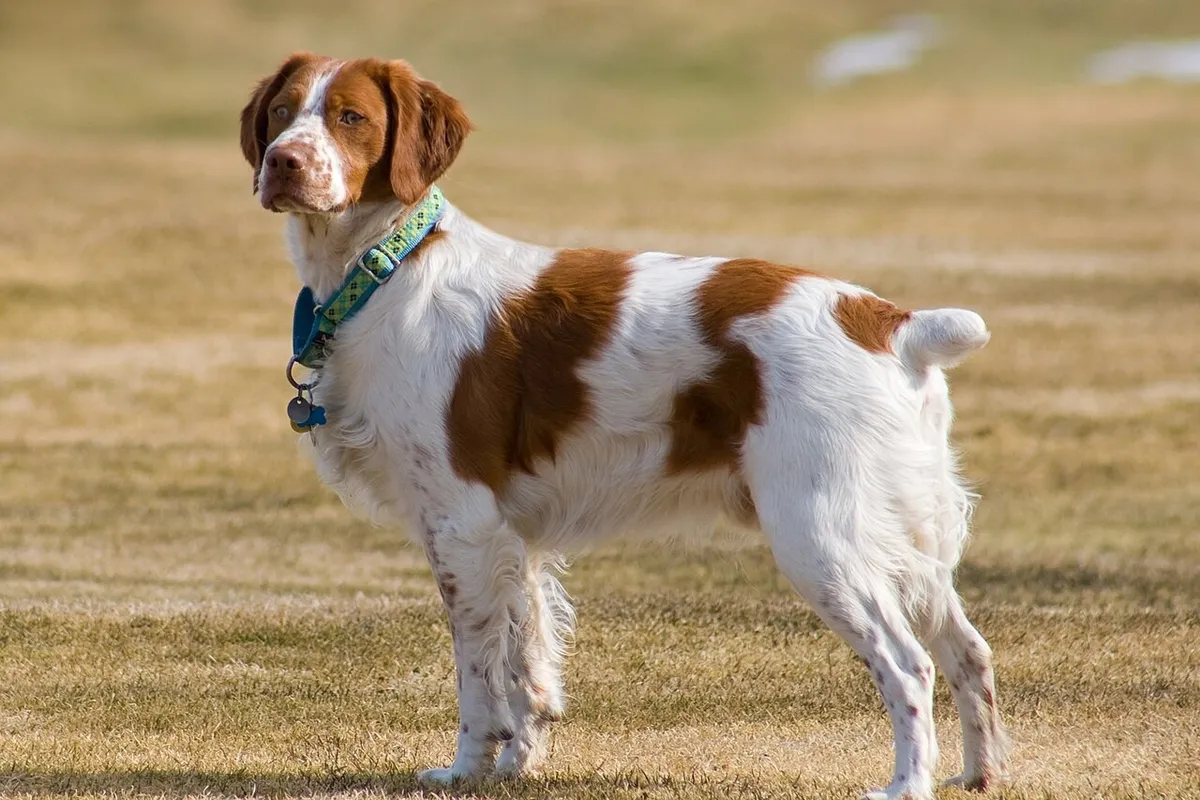
At a glance
| Trait | Detail |
|---|---|
| Origin | France, from central Brittany [1] |
| Breed group | FCI group 7, section 1.2 (Continental Pointing Dogs, spaniel type) [1]; AKC Sporting Group [2] |
| Weight | 30–40 lb (14–18 kg) [2] |
| Height | Males 18.9–20.1 in (48–51 cm), females 18.5–19.7 in (47–50 cm), each with a tolerance of 1 cm (0.4 in) [1] |
| Life expectancy | Median 11.1 years in a large UK study, with a higher risk of early death than crossbreeds [3] |
| Coat | Fine, flat or slightly wavy, never curly; white and orange, white and black or white and liver, piebald or roan, sometimes tricolor; tail short or absent [1] |
Origin
The Brittany comes from central Brittany, in France, and is probably one of the oldest spaniel-type dogs. It was improved in the early 20th century by various outcrosses and selection. A draft standard written in Nantes in 1907 was adopted at the first general assembly of the club in Loudéac on June 7, 1908, as the standard of the “Naturally Short-Tailed Brittany Spaniel Club”. It is the smallest of the pointing breeds and today the most numerous French pointing breed [1].
The American Kennel Club recognized the breed in 1934, under the name Brittany, in the Sporting Group [2].
Common health problems
- Hip dysplasia: in Swedish screening X-rays of young adult dogs from 2007 to 2016, 39.3% of 229 Brittanys had hip dysplasia (grades C to E) and 12.2% had moderate or severe dysplasia (grades D and E), against 19.8% dysplasia across all screened dogs [4].
- Lumbosacral transitional vertebra: on the hip screening X-rays of 744 Norwegian Brittanys, 47.8% had this congenital anomaly of the last lumbar vertebra. Dogs with a natural bobtail had about twice the odds of having it, and stump-tailed dogs the strongest link [5]. In a study of 32 Brittanys and Norwegian Elkhounds, the more marked forms (types 2 and 3) were linked to mild lower back pain [6].
- Fractures of the elbow end of the humerus: at a US teaching hospital over ten years, Brittanys were 21.5 times more likely to have a humeral condylar fracture than comparison breeds; Cocker Spaniels had an even higher risk, at 42.8 times [7].
- Heart valve disease: in a French study, 15 Brittanys with myxomatous mitral valve disease had a mean vertebral heart score of 11.9 on chest X-rays [8]. See heart failure in dogs.
- Inherited disorders found in research colonies: an inherited deficiency of complement C3, with no detectable C3 in the serum, was identified in a colony of Brittany spaniels and is recessive [9]. It predisposes dogs to recurrent bacterial infections and to type 1 membranoproliferative glomerulonephritis [10]. Hereditary canine spinal muscular atrophy, a motor neuron disease, was also described in Brittany spaniels, with dominant inheritance [11].
What is special in the Brittany’s blood work
We found no breed-specific reference intervals for routine blood work in the Brittany. Three breed findings are useful when reading results.
Heart size on X-rays. In 28 healthy Brittanys, the mean vertebral heart score was 10.6 vertebrae, higher than the 9.7 of the original mixed-breed reference. A threshold of 11.1 vertebrae detected an enlarged heart with 90% sensitivity [8]. A heart that looks slightly large by general standards may be normal for the breed.
Complement C3 and the kidneys. Dogs with C3 deficiency have no detectable C3 in the serum [9] and can develop membranoproliferative glomerulonephritis, a disease of the kidney filters [10]. Our guide to protein in the urine explains how such kidney damage is looked for. We found no data on how common the deficiency is in pet Brittanys today.
Blood types. In an Italian study, 77.1% of 83 Brittanys were DEA 1-positive, one of the highest rates of all breeds tested [12]. Blood typing before a transfusion is explained in anemia in dogs.
Screening. The AKC lists hip evaluation and an eye examination by a veterinary ophthalmologist as the recommended health tests for the breed [2]. The hip X-ray also shows a transitional lumbosacral vertebra [5].
Related articles
En français : Épagneul breton.
Questions to ask your veterinarian
- Have my dog’s hips been X-rayed and scored, and does the X-ray show a transitional vertebra?
- If my dog has back pain, could a transitional lumbosacral vertebra be involved?
- If my dog goes lame on a front leg, should the humeral condyle be checked?
- Is my dog’s vertebral heart score normal for a Brittany?
- Has my dog’s blood type been checked in case a transfusion is ever needed?
Get your Brittany’s blood work explained.
AI DiagAnimals reads the blood count, the kidney values, the urine protein and the other results together with your laboratory’s intervals, and explains them in plain language. The service opens soon: leave your email to be told first.
Frequently asked questions
How long do Brittany spaniels live?
A large UK study found a median lifespan of 11.1 years, with a higher risk of early death than crossbreeds [3].
Do Brittanys have hip problems?
Yes. In Swedish screening, 39.3% of Brittanys had hip dysplasia, twice the rate of all screened dogs [4].
Why do some Brittanys have no tail, and does it matter?
Some are born with a short tail or none, as the standard allows [1]. In Norway, natural bobtails had about twice the odds of a lumbosacral transitional vertebra [5].
Do Brittanys have heart problems?
Myxomatous mitral valve disease occurs in the breed, and its normal heart score on X-rays is higher than the general reference, at about 10.6 vertebrae [8].
Sources
- FCI. Standard No. 95: Epagneul Breton (Brittany Spaniel). 2003. fci.be/Nomenclature/Standards/095g07-en.pdf
- American Kennel Club. Brittany: dog breed information. akc.org/dog-breeds/brittany
- McMillan KM et al. Longevity of companion dog breeds: those at risk from early death. Sci Rep. 2024;14:531 (supplementary table S3). doi.org/10.1038/s41598-023-50458-w
- Engdahl K et al. Prevalence of hip and elbow dysplasia in young adult dogs in Sweden. Vet Rec. 2026;198(12):e560-e573. doi.org/10.1002/vetr.70224
- Berg JA et al. Association between the natural bobtail phenotype and lumbosacral transitional vertebra in Brittany dogs and Danish-Swedish Farmdogs. Can Vet J. 2026;67(8):882-888. pubmed.ncbi.nlm.nih.gov/42544340
- Berg JA et al. Transitional lumbosacral vertebrae in black Norwegian elkhound and Brittany dogs: clinical findings and its association with degenerative lumbosacral stenosis. Acta Vet Scand. 2025;67:10. doi.org/10.1186/s13028-025-00797-7
- Schettler M et al. A prevalence study of canine humeral condylar fractures over a ten-year period at an academic teaching hospital. Vet Comp Orthop Traumatol. 2022;35(3):191-197. doi.org/10.1055/s-0042-1744445
- Kallassy A et al. Vertebral heart scale for the Brittany spaniel: breed-specific range and its correlation with heart disease assessed by clinical and echocardiographic findings. Vet Sci. 2021;8(12):300. doi.org/10.3390/vetsci8120300
- Winkelstein JA et al. Genetically determined deficiency of the third component of complement in the dog. Science. 1981;212(4499):1169-1170. doi.org/10.1126/science.7233211
- Ameratunga R et al. Molecular analysis of the third component of canine complement (C3) and identification of the mutation responsible for hereditary canine C3 deficiency. J Immunol. 1998;160(6):2824-2830. pubmed.ncbi.nlm.nih.gov/9510185
- Sack GH Jr et al. Autosomal dominant inheritance of hereditary canine spinal muscular atrophy. Ann Neurol. 1984;15(4):369-373. doi.org/10.1002/ana.410150411
- Medina Valentin AA, Gavazza A, Lubas G. Prevalence of dog erythrocyte antigen 1 in 7,414 dogs in Italy. Vet Med Int. 2017;2017:5914629. doi.org/10.1155/2017/5914629
Laboratory methods and reference intervals vary. This article explains; it does not diagnose. For a decision about your pet, use the original report and talk to your veterinarian. Our editorial policy.